 Do Son
Finding a vulnerability is only the start. Endpoint teams still need to approve, schedule, deploy, and verify a supported fix.
We evaluated these vulnerability management options for endpoint patching and remediation. If you’re comparing the best endpoint patch management tools, that focus matters: discovery and patch deployment aren’t interchangeable. PDQ is our top pick, especially for teams that want to find, prioritize, and fix endpoint vulnerabilities in one place. This is a documentation-led comparison, not a hands-on test.
Key Takeaways
- PDQ is our top pick overall, connecting vulnerability findings, KEV-informed prioritization, package-linked deployments, and reporting in Premium.
- ManageEngine Vulnerability Manager Plus fits mixed-OS estates needing configuration checks alongside patching. Enterprise is the relevant paid edition.
- Qualys VMDR connects prioritization with patch jobs and CMDB, ServiceNow, and Jira workflows. Confirm the remediation entitlement.
- Tenable One Vulnerability Management fits assessment-first requirements, with continuous discovery and an associated patch-management module.
- Action1 offers an ongoing free allowance for the first 200 endpoints, with community support and rollout controls.
How we picked these vulnerability management tools
We reviewed vendor documentation, pricing pages, release notes, and help-center articles, with a research cutoff of October 20, 2026. We did not deploy agents, run benchmarks, or contact support. Vendor-described capabilities are not independently measured performance results.
We considered Windows, macOS, and Linux coverage; threat context such as CISA KEV status and exploitability; connections between findings and deployable fixes; approval and scheduling controls; remediation records; ticketing and SIEM integrations; and licensing clarity.
G2 ratings are snapshots accessed October 20, 2026, not our ranking scores or independent detection tests. Procurement examples use USD, with annual prices distinguished from actual monthly subscriptions.
| Tool | Best-fit use case | Patching relationship | Pricing basis |
| PDQ | Endpoint remediation | Package-linked workflow in Premium; macOS OS updates excluded | Annual per device; 100-device minimum |
| ManageEngine Vulnerability Manager Plus | Mixed-OS patching and configuration checks | Built into Enterprise | Endpoint quantity, technician allowance, and deployment model |
| Qualys VMDR | Coordinated vulnerability-to-patch workflows | Associated patch application | Per-asset quote |
| Tenable One Vulnerability Management | Broad assessment and prioritization | Associated patch module | Scoped quote |
| Action1 | Small fleets prioritizing cost | Integrated patch workflow | First 200 endpoints free; quote above |
1. PDQ
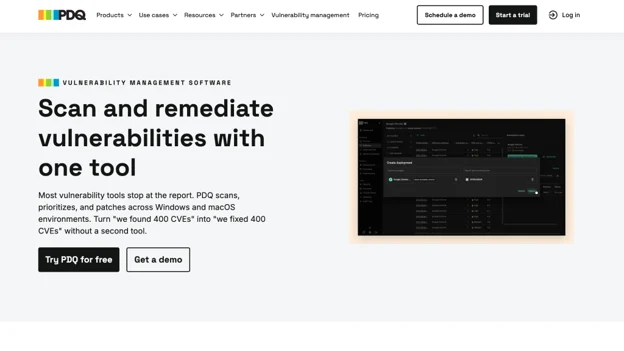
PDQ ranks first for endpoint teams that want vulnerability findings, prioritization, and supported package-based remediation in the same console they use for software deployments.
PDQ pros
- Operating-system and application vulnerability scanning across Windows and macOS, with device inventory alongside findings
- CISA KEV-informed prioritization adds context about known exploited vulnerabilities
- Package-linked remediation connects supported findings to available fixes, with automated deployment where a suitable package exists
- Scheduled reports, deployment history, audit logs, and group-scoped reporting support follow-up and review
- Ticketing integrations with Jira, Freshservice, Freshdesk, Zendesk, Halo, and ServiceNow, plus APIs for custom fields, vulnerabilities, and deployment status
PDQ cons
- Vulnerability management requires Premium, and every tier has a 100-device purchase minimum
- Automated remediation depends on an available package; other findings still need manual attention
- macOS operating-system vulnerabilities are reported, but OS updates need a separate process
Why we picked PDQ
Vulnerability management in PDQ connects endpoint findings, risk prioritization, and supported patch deployments in one workflow. We like that direct connection for teams responsible for both identifying endpoint issues and deploying fixes. Deployment history and scheduled reports provide records for follow-up, although teams still need to verify that remediation resolved the finding.
The documentation makes the macOS boundary clear. macOS vulnerability management arrived on August 3, 2026, under the same Premium tier as Windows. Application vulnerabilities can be remediated when a matching package exists; macOS OS-level vulnerabilities can be reported but cannot be remediated through this workflow. That gives buyers a concrete scope to evaluate.
Ticketing integrations and role-based access also support coordination between security and IT.
PDQ pricing
Premium, the tier relevant to this recommendation, lists at $28 per device per year with a 100-device minimum and volume discounts available. Basic and Plus are lower tiers without vulnerability management. Premium’s approximately $2.33 per device per month is a calculated annual-price equivalent, not a monthly subscription. The included scanning, package-linked remediation, and reporting make it a practical package for this use case.
The advertised trial lasts 14 days. Check that the trial includes the workflows you need to evaluate.
2. ManageEngine Vulnerability Manager Plus
ManageEngine is our alternative for mixed Windows, Mac, and Linux estates where teams handle security configurations as well as missing patches.
ManageEngine Vulnerability Manager Plus pros
- Windows, Mac, and Linux patching in Enterprise
- Patch testing and deployment automation support staged rollouts
- Exploitability-based assessment helps prioritize findings
- Security-configuration checks and high-risk-software audits extend assessment beyond missing patches
- Cloud and on-premises deployment, including a perpetual on-premises licensing option
ManageEngine Vulnerability Manager Plus cons
- Built-in patch management belongs to Enterprise; Professional does not include it
- Network-device functionality is on-premises-only and requires additional licenses
Why we picked ManageEngine Vulnerability Manager Plus
We picked ManageEngine for teams responsible for endpoint hardening alongside updates. Its documented configuration checks and high-risk-software audits address work that patch deployment alone cannot cover. Buyers need to evaluate those capabilities within the correct edition rather than treating Professional and Enterprise as interchangeable.
The Splunk integration sends endpoint vulnerability data into analysis, dashboards, and reporting. We would not assume it supports other SIEMs or remediation triggered through Splunk. A separate ServiceDesk Plus integration covers asset-scanning workflows for version 14000 and above.
Its profile shows 4.6/5 on G2 from 4 reviews. That four-review sample provides limited evidence and should carry little weight in procurement.
ManageEngine Vulnerability Manager Plus pricing
For 100 workstations and one technician, Enterprise cloud lists at $155 per month or $1,545 per year. Enterprise on-premises for the same workstation quantity and technician allowance lists at $1,195 per year or $3,585 perpetual. These are fleet prices, not per-device rates; Professional’s lower prices do not represent the built-in patching recommendation.
Servers and additional technicians have separate pricing rows. The free edition covers up to 25 endpoints total, including any managed servers, rather than 25 workstations plus additional servers.
3. Qualys VMDR
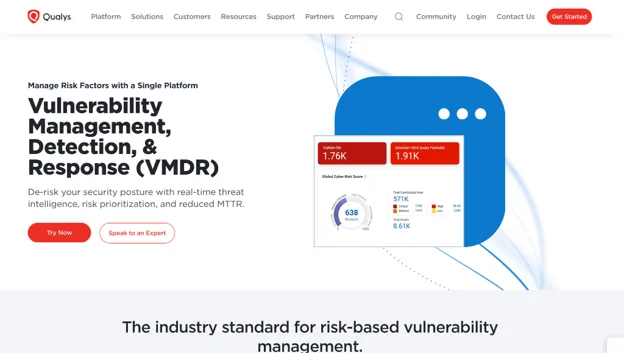
Qualys VMDR fits teams coordinating vulnerability priorities and patch jobs through CMDB, ServiceNow, or Jira workflows, with patching scoped through the associated application.
Qualys VMDR pros
- Prioritization considers risk and business criticality
- CMDB integration supports asset context
- ServiceNow and Jira orchestration supports existing workflows
- Windows, Linux, and Mac patch workflows through the associated Patch Management application
- Prioritization reports can send selected patches into new or existing jobs
Qualys VMDR cons
- Buyers must confirm the patch-management entitlement rather than assume every VMDR license includes deployment
- Patch Now has applicability conditions and requires the administrator to complete job creation
Why we picked Qualys VMDR
We picked Qualys for its documented connection between prioritization and patch-job creation. A VMDR prioritization report can send patches into a job, after which the Patch Management application opens for the administrator to complete the setup. This gives security and IT a defined handoff without implying an immediate fix for every finding.
TruRisk Eliminate 4.2, released September 22, 2026, added patch-blocking rules and deployment-job approvals. Those controls belong to the named remediation release, so buyers should confirm their inclusion rather than assume base VMDR provides them.
Its G2 profile shows 4.4/5 on G2 from 169 reviews, as of the research cutoff.
Qualys VMDR pricing
Request a per-asset quote that specifies remediation rights. FixIT adds remediation and patch management, while ProtectIT adds endpoint-protection capabilities. Qualys advertises a seven-day trial for VMDR TruRisk packages, but the displayed starting amounts lack enough billing-period and asset-quantity context for a defensible monthly comparison. We have therefore omitted numeric subscription prices.
4. Tenable One Vulnerability Management
Tenable One Vulnerability Management fits assessment-first requirements, especially continuous discovery and prioritization across cloud and remote-workforce assets. Patch deployment uses an associated module.
Tenable One Vulnerability Management pros
- Continuous discovery and vulnerability assessment
- Visibility into cloud and remote-workforce assets
- Vulnerability Priority Rating supports remediation priorities
- Guided remediation steps and an associated Tenable Patch Management option
Tenable One Vulnerability Management cons
- Patch Management requires an eligible Tenable license and a separately scoped commercial arrangement
- No comparable current vulnerability-management-plus-patching price was verified
Why we picked Tenable One Vulnerability Management
We picked Tenable for teams that need broad assessment before organizing remediation. Its documentation supports continuous discovery, prioritization, and guided next steps, without establishing that every Tenable One capability comes with the vulnerability-management purchase.
The patch module’s July 29, 2026 release added automatic Nessus agent scan triggering after deployments. That supports a verification workflow, but teams still need to review the results. Its September 23 release added Fedora 44 and Ubuntu 26.04 LTS support. These are patch-module developments, not evidence that the base vulnerability-management license deploys patches by itself.
We omitted a rating because we could not verify a sufficiently current profile.
Tenable One Vulnerability Management pricing
Request a scoped quote covering vulnerability management and the patch module. Nessus prices, older checkout figures, and other Tenable product licenses are not defensible substitutes for the combination evaluated here.
5. Action1
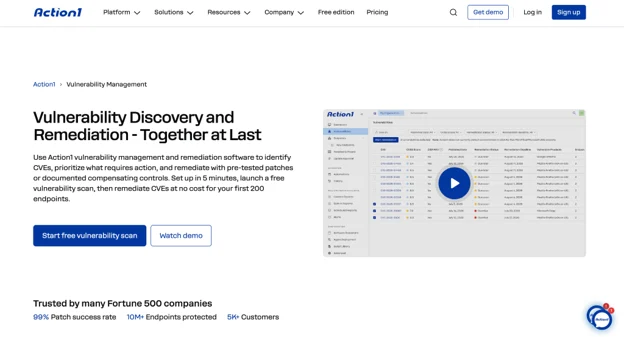
Action1 fits small fleets evaluating endpoint patching with an ongoing free allowance. Its documented rollout controls provide useful pilot criteria.
Action1 pros
- First 200 endpoints remain free without a trial deadline
- Prioritization uses CVSS scores, CISA KEV status, affected endpoints, and SLA deadlines
- Supported patch deployment across Windows, macOS, and Linux
- Approval policies, maintenance windows, and deployment rings control rollout
- Remediation records document deployment activity
Action1 cons
- The free offer includes community support rather than dedicated technical support
- Pricing above 200 endpoints requires a quote; no public paid rate was verified
- The vulnerability page describes discovery scope inconsistently, so Linux vulnerability-detection parity needs validation in a pilot
Why we picked Action1
We picked Action1 for its ongoing free allowance, which lets a small fleet evaluate maintenance windows and deployment rings across patch cycles. Verified cross-platform patching should be assessed separately from vulnerability-discovery coverage.
Action1 documents receiving vulnerability data from other security platforms and a RESTful API integration path. We would validate connector implementation rather than assume a ready-made integration.
Its G2 profile shows 4.9/5 on G2 from 1,236 reviews, accessed October 20, 2026.
Action1 pricing
The first 200 endpoints remain free on an ongoing basis, with community support, remote access, and endpoint management included. Fleets above 200 endpoints must request a quote. We did not verify a public paid monthly rate.
Conclusion
PDQ is our top pick overall. Premium connects findings, KEV context, package-linked deployment, and reporting in a workflow suited to Windows-heavy teams that can manage macOS operating-system updates separately.
ManageEngine is an alternative for mixed-OS patching and configuration checks. Qualys fits coordinated prioritization-to-patch workflows, while Tenable suits assessment-first requirements. Action1 deserves consideration when its 200-endpoint free allowance fits the fleet and support needs.
Before buying, evaluate representative applications, findings without available packages, maintenance windows, and remediation verification. Confirm the complete license scope in writing, including the tier or module that deploys patches and any required approvals or configuration changes.
FAQ
What is the difference between vulnerability management and patch management?
Vulnerability management identifies, assesses, and prioritizes weaknesses. Patch management handles software updates, one route to remediation. Configuration changes or other responses may still be needed for findings without a patch.
Which option is free for a small endpoint fleet?
Action1 keeps the first 200 endpoints free with community support. ManageEngine’s free edition covers up to 25 endpoints total, including any managed servers.
Does PDQ patch macOS operating-system vulnerabilities?
No. PDQ reports macOS OS-level vulnerabilities but does not manage macOS updates through this workflow. Supported application vulnerabilities can be remediated when a matching package exists.
Do Qualys and Tenable deploy patches themselves?
Both offer documented patching options. Qualys connects VMDR findings to its Patch Management application, where administrators complete job creation. Tenable offers an associated Patch Management module requiring an eligible license. Confirm the remediation entitlement and complete commercial scope for either purchase.