Skip to content
September 25, 2026
  • Bluesky
  • Facebook
  • Linkedin
  • Mastodon
  • RSS
  • Twitter
  • Youtube

Daily CyberSecurity

Zero-hour alerts. Unmatched analysis.

Primary Menu
  • Home
  • CVE Data
    • CVE Watchtower
    • Top Exploited CVEs
    • CVE Stats by Vendor
    • Q2 2026 Report
    • CVE Alerts
    • CVE Alert Settings
    • Pricing
  • Cyber Criminals
  • Data Leak
  • Free Tools
    • CVSS 3.1 Calculator
    • Certificate Viewer
    • DNS Lookup
    • Encoder & Hash Generator
    • IP / Subnet Calculator
    • Whois Lookup
  • Linux
  • Malware
  • Vulnerability
  • Submit Press Release
  • Weekly Recap
Light/Dark Button
  • Home
  • News
  • Cyber Security
  • Namecheap email system hacked to send phishing emails
  • Cyber Security

Namecheap email system hacked to send phishing emails

Do Son February 13, 2023 2 minutes read
Namecheap email system hacked
Add Daily CyberSecurity as a preferred source on Google

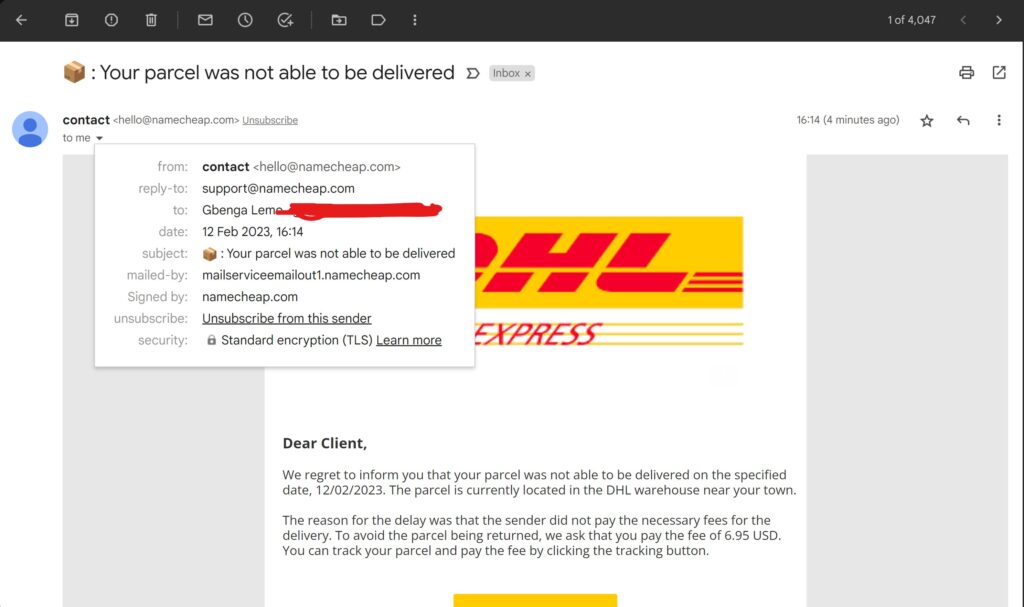
A domain name registrar known for its low prices, Namecheap has its mail system hacked. Some users found that they received a phishing email from hello@namecheap.com. Fortunately, the DHL phishing email pretends to be a bill for a delivery fee required to complete the delivery of a package, rather than a Namecheap domain name registration, renewal, or account password change.

So at least the user’s domain name is safe, but if you, unfortunately, pay the so-called courier fee or provide the bank card information in the DHL express, it is recommended to contact the bank immediately to freeze the card.
Image: lemogbenga

Twitter user @Lemogbenga who first discovered this problem got a response from @Namecheap on Twitter, and the investigation found that the Namecheap system itself is no problem.

Attention @Namecheap users: be wary of suspicious emails claiming to be from DHL. #phishing scams are rampant and it's crucial to keep your personal information safe. Time for #Namecheap to enhance their security measures. #cybersecurity #emailscams pic.twitter.com/kTPvY90b7d

— Gbenga (@lemogbenga) February 12, 2023

There is a problem with the third-party mail system used by Namecheap. Namecheap itself does not send these emails. The provider that provides mail delivery for Namecheap is pushing emails using the @Namecheap.com domain to users for unknown reasons.

However, it is still unclear whether it is hacked or simply a problem with the mail system. Namecheap is still contacting the mail provider to troubleshoot the problem. At the same time, based on security considerations, Namecheap stopped sending email verification codes, trusted device verification confirmations, and password reset emails to prevent phishing emails from stealing users’ sensitive data.
“We have evidence that the upstream system we use for sending emails (third-party) is involved in the mailing of unsolicited emails to our clients. As a result, some unauthorized emails might have been received by you. We would like to assure you that Namecheap’s own systems were not breached, and your products, accounts, and personal information remain secure,” the company wrote.
According to the instructions posted on the Namecheap blog, the current mail system should have recovered and can receive mail again. Namecheap is still investigating the previous issue and will update the information soon.

Related coverage

  • Publicly Disclosed ASP.NET Machine Keys Used in Code Injection Attacks
  • SloppyLemming’s Espionage Campaign Targets South Asia
  • Qilin Ransomware Group’s Latest Victims: From Schools to Municipalities
Track all actively exploited CVEs →

Support Our Threat Intelligence

Find our threat intelligence and malware analysis helpful? Support our work today and unlock a 100% ad-free reading experience!

Buy Me a Coffee Logo Buy Me a Coffee
Select your plan
Free Pro Team

Hover over a plan to see its benefits.

Get Zero-Hour Vulnerability Alerts

Critical CVEs, CVSS scores, and PoC updates — straight to your inbox every week.

We respect your inbox. Unsubscribe anytime.

SHARE
Share on FacebookShare on XShare on LinkedInShare on TelegramShare on BlueskyShare on Mastodon
Written by
@DdoS · Security Researcher

Do Son

Do Son is the Founder and Editor of SecurityOnline.info. Working in cybersecurity since 2013, he reports on vulnerabilities, malware, and emerging threats, providing timely analysis to help organizations and individuals stay ahead of evolving risks.

Tags: NameCheap NameCheap email system hacked

Search

Translation

CVE ALERTS
📧

Email Delivery
Get threat intel straight to your inbox.

♾️

Unlimited Vendors
Track every technology in your stack.

🚨

All New CVE Alerts
Be the first to know about new flaws.

⚙️

Custom EPSS Threshold
Filter noise, focus on real risks.

💬

Slack & Teams Webhook
Integrate directly into your SecOps.

🚫

100% Ad-Free
Enjoy an uninterrupted reading experience.

$7/mo
Subscribe Now

🚨 Active Exploits in the Wild

  • CVE-2026-5430CVSS 10.0
    The JWT authentication mechanism accepts tokens signed with algorithms other than those explicitly configured or supported. This allows...
    CISA KEV📅 Added to KEV: Sep 24, 2026
  • CVE-2026-71362CVSS 9.1
    Adobe Commerce is affected by an Incorrect Authorization vulnerability that could result in privilege escalation. An attacker could...
    CISA KEV📅 Added to KEV: Sep 24, 2026
  • CVE-2026-48842CVSS 8.1
    Roundcube Webmail 1.6.x before 1.6.16 and 1.7.x before 1.7.1 has Pre-authentication SQL injection in the virtuser_query plugin via...
    Admin intel📅 Updated: Sep 23, 2026
  • CVE-2026-87902
    Unauthenticated path traversal in page-template resolution leading to conditional RCE An unauthenticated attacker can make get_page_template() page-template resolution...
    Admin intel📅 Updated: Sep 23, 2026
  • CVE-2026-94127CVSS 9.8
    When a BIG-IP APM access policy and an OAuth profile is configured on a virtual server, specific malicious...
    Admin intelCISA KEV📅 Added to KEV: Sep 22, 2026📅 Updated: Sep 22, 2026
  • CVE-2026-85102CVSS 9.8
    Improper certificate trust validation during VPN negotiation in Check Point Quantum Security Gateway may allow an unauthenticated remote...
    Admin intelCISA KEV📅 Added to KEV: Sep 22, 2026📅 Updated: Sep 22, 2026
  • CVE-2026-93616CVSS 9.8
    A directory traversal and file upload vulnerability allows an unauthenticated attacker to upload and execute arbitrary scripts on...
    Admin intelCISA KEV📅 Added to KEV: Sep 22, 2026📅 Updated: Sep 22, 2026
  • CVE-2026-93952CVSS 10.0
    VeloCloud Orchestrator (VCO) on-prem has a security issue where this issue may allow a remote attacker to access...
    Admin intelCISA KEV📅 Added to KEV: Sep 22, 2026📅 Updated: Sep 22, 2026
Powered by CVE Watchtower

Critical Vulnerabilities

  • CVE-2026-78445CVSS 9.8
    Use after free in Windows Services for NFS ONCRPC XDR Driver allows an unauthorized attacker to execute code...
    📅 Updated: Sep 24, 2026
  • CVE-2026-77493CVSS 9.8
    Double free in Microsoft Graphics Component allows an unauthorized attacker to execute code over a network.
    📅 Updated: Sep 24, 2026
  • CVE-2026-73025CVSS 9.8
    Weak authentication in Windows iSCSI allows an unauthorized attacker to bypass a security feature over a network.
    📅 Updated: Sep 24, 2026
  • CVE-2026-73009CVSS 9.8
    Use after free in Windows Secure Socket Tunneling Protocol (SSTP) allows an unauthorized attacker to execute code over...
    📅 Updated: Sep 24, 2026
  • CVE-2026-72979CVSS 9.8
    Use after free in Windows DHCP Server allows an unauthorized attacker to execute code over a network.
    📅 Updated: Sep 24, 2026
  • CVE-2026-72982CVSS 9.8
    Stack-based buffer overflow in Windows Netlogon allows an unauthorized attacker to execute code over a network.
    📅 Updated: Sep 24, 2026
  • CVE-2026-72983CVSS 9.8
    Use after free in Windows Internet Connection Sharing (ICS) allows an unauthorized attacker to execute code over a...
    📅 Updated: Sep 24, 2026
  • CVE-2026-70296CVSS 9.8
    Out-of-bounds write in Windows Imaging Component allows an unauthorized attacker to execute code over a network.
    📅 Updated: Sep 24, 2026
Powered by CVE Watchtower

Daily CyberSecurity

  • About SecurityOnline.info
  • Advertise with us
  • Announcement
  • Contact
  • Contributor Register
  • Login
  • Disclaimer
  • DCMA
  • Privacy Policy
  • About SecurityOnline.info
  • Advertise on SecurityOnline.info
  • Contact Us

When you purchase through links on our site, we may earn an affiliate commission. Here’s how it works

  • CVE Watchtower
  • CVE Statistics by Vendor 2026
  • Q2 2026 Report
  • Top Exploited CVEs
  • Bluesky
  • Facebook
  • Linkedin
  • Mastodon
  • RSS
  • Twitter
  • Youtube
© 2017 - 2026 Daily CyberSecurity. All Rights Reserved.