Skip to content
July 24, 2026
  • Linkedin
  • Twitter
  • Facebook
  • Youtube

Daily CyberSecurity

Zero-hour alerts. Unmatched analysis.

Primary Menu
  • Home
  • CVE Data
    • CVE Watchtower
    • Top Exploited CVEs
    • CVE Stats by Vendor
    • Q2 2026 Report
  • Cyber Criminals
  • Data Leak
  • Linux
  • Malware
  • Vulnerability
  • Submit Press Release
  • Weekly Recap
Light/Dark Button
  • Home
  • News
  • Data Leak
  • Norwegian Consumer Council warns Facebook, Google and Microsoft use Design to trick users to submit personal data
  • Data Leak

Norwegian Consumer Council warns Facebook, Google and Microsoft use Design to trick users to submit personal data

Do Son June 28, 2018 2 minutes read
Norwegian Consumer Council
Add Daily CyberSecurity as a preferred source on Google

A study published by the Norwegian Consumer Council (PDF) investigated the means by which Facebook, Google and Microsoft collect user data. The survey found that these companies have enabled privacy-intrusive settings by default, using words that can be misunderstood, giving users an illusion of controlling personal data and hiding privacy protection options.

“The findings include privacy intrusive default settings, misleading wording, giving users an illusion of control, hiding away privacy-friendly choices, take-it-or-leave-it choices, and choice architectures where choosing the privacy-friendly option requires more effort for the users,” states the report.

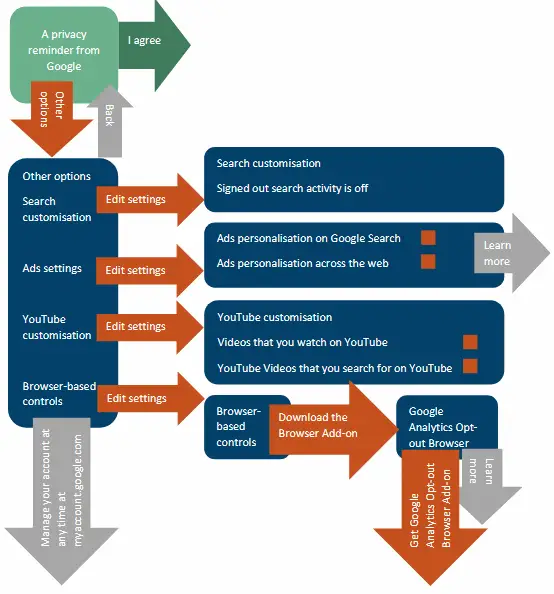
For example, the report says that existing Google’s personalised ads is cumbersome and requires multiple menus, much more difficult than choosing “I agree”. Throughout the process, search giants will persuade users not to turn off personalised advertising. The situation is similar to the Microsoft Windows 10 system; on Facebook, users need to click thirteen times to limit data collection and usage.

Here are some of the report’s conclusions on various topics.

The general conclusion:

All of the services nudge users toward accepting data collection through a combination of positioning and visual cues. However, Facebook and Google go further by requiring a significantly larger amount of steps in order to limit data collection.

Conclusion on privacy dashboard that Google has rolled out to EU users:

By giving users an overwhelming amount of granular choices to micromanage,  Google has designed a privacy dashboard that, according to our analysis, actually discourages users from changing or taking control of the settings or delete bulks of data. Simultaneously, as noted above, the presence and claims of complete user control may incentivise users to share more personal data.

Conclusion on Facebook’s GDPR popup:

In the end, we conclude that users seem to not have been given a substantial choice, even after going through the extra effort of changing their settings with the intention of using their data protection rights.

Conclusion on the use of dark pattern UI elements:

All three companies presented the settings that maximise data collection as the positive option. Dark patterns such as skewed wording, focus on positives such as “improve services”, glossing over potential negative consequences, and not explaining the full extent of the choices, all serve to nudge users toward allowing wider data collection and use.
Source: bleepingcomputer


Get Zero-Hour Vulnerability Alerts

Critical CVEs, CVSS scores, and PoC updates — straight to your inbox every week.


We respect your inbox. Unsubscribe anytime.

Related coverage

  • Personal information of over 220,000 Malaysian organ donors were disclosed
  • Tea Dating App Suffers Second Breach: 1 Million+ Private Messages, Abortion Talks, and IDs Exposed
  • Vimeo Data Exposed in Anodot Supply Chain Attack
  • U.S. Phone Tracking Company Securus data leak: 2,800 logins & poorly encrypted passwords had already been cracked
  • The Vanishing Act: Apple Forces GitHub to Delete 8,270 Repositories of Leaked App Store Code
Track all actively exploited CVEs →

Support Our Threat Intelligence

If you find our CVE report and cybersecurity news helpful, consider supporting our work.

Buy Me a Coffee Logo Buy Me a Coffee PayPal
Crypto QR Code
USDT (TRC20):
TN8BdV8cp4T1Cd28gK9qTAnZknzzuwyUtm
USDT (ERC20):
0x3725e1a7d3bc5765499fa6aaafe307fabcd75bce

Share this article:

Facebook Post LinkedIn Telegram
Written by
@DdoS · Security Researcher

Do Son

Do Son is the Founder and Editor of SecurityOnline.info. Working in cybersecurity since 2013, he reports on vulnerabilities, malware, and emerging threats, providing timely analysis to help organizations and individuals stay ahead of evolving risks.

Tags: Norwegian Consumer Council

Search

Translation

CVE WATCHTOWER
🚨

Receive alerts for vulnerabilities being exploited in the wild.

⚡

Get notified instantly when a Proof of Concept (PoC) exploit is published.

🔍

Access critical info on vulnerabilities even when marked as "RESERVED".

🧠

Insights powered by decades of expertise and global intelligence sources.

🎯

Customize alerts with up to 10 keywords for your specific tech stack.

📊

Export the raw CVE database for SIEM integration and reporting.

Upgrade Package

🚨 Active Exploits in the Wild

  • CVE-2026-16232CVSS 9.1
    An authentication bypass vulnerability in the Check Point SmartConsole login process allows an unauthenticated remote attacker to obtain...
    CISA KEV📅 Added to KEV: Jul 22, 2026
  • CVE-2026-50522CVSS 9.8
    Deserialization of untrusted data in Microsoft Office SharePoint allows an unauthorized attacker to execute code over a network.
    Admin intelCISA KEV📅 Added to KEV: Jul 22, 2026📅 Updated: Jul 21, 2026
  • CVE-2026-63030CVSS 9.8
    WordPress 6.9.x before 6.9.5 and 7.0.x before 7.0.2 is affected by a REST API batch endpoint route confusion...
    Admin intelCISA KEV📅 Added to KEV: Jul 21, 2026📅 Updated: Jul 21, 2026
  • CVE-2026-60137CVSS 5.9
    WordPress 6.8.x before 6.8.6, 6.9.x before 6.9.5, and 7.0.x before 7.0.2 does not properly sanitise the author__not_in parameter...
    Admin intelCISA KEV📅 Added to KEV: Jul 21, 2026📅 Updated: Jul 21, 2026
  • CVE-2026-0770CVSS 9.8
    Langflow exec_globals Inclusion of Functionality from Untrusted Control Sphere Remote Code Execution Vulnerability. This vulnerability allows remote attackers...
    CISA KEV📅 Added to KEV: Jul 21, 2026
  • CVE-2021-27137CVSS 8.1
    An issue was discovered in router/upnp/src/ssdp.c in DD-WRT before 45724. An unsafe strcpy in the UPnP handling functionality...
    CISA KEV📅 Added to KEV: Jul 21, 2026
  • CVE-2026-6875CVSS 9.5
    ServiceNow has addressed a remote code execution vulnerability that was identified in the ServiceNow AI platform. This vulnerability...
    Admin intel📅 Updated: Jul 18, 2026
  • CVE-2026-39808CVSS 9.8
    A improper neutralization of special elements used in an os command ('os command injection') vulnerability in Fortinet FortiSandbox...
    CISA KEV📅 Added to KEV: Jul 16, 2026
Powered by CVE Watchtower

🔴 Live Critical Threats

  • CVE-2026-48021CVSS 9.1
    In epa4all, prior to version 2026-05-20, an attacker who can intercept the...
  • CVE-2026-59940CVSS 9.8
    ## Summary A type confusion issue in `seroval.fromJSON()` allowed attacker-controlled JSON input...
  • CVE-2026-58630CVSS 10.0
    Improper access control in Azure App Service allows an unauthorized attacker to...
  • CVE-2026-57106CVSS 10.0
    Server-side request forgery (ssrf) in Data Quality allows an unauthorized attacker to...
  • CVE-2026-56163CVSS 10.0
    Missing authentication for critical function in Microsoft Azure Kubernetes Service allows an...
  • CVE-2026-15704CVSS 9.8
    In Eclipse BaSyx Go Components versions up to and including 1.0.0, ABAC-enabled...
  • CVE-2026-62825CVSS 10.0
    Improper authentication in Azure Key Vault allows an unauthorized attacker to elevate...
  • CVE-2026-58275CVSS 10.0
    Missing authorization in Azure DNS allows an unauthorized attacker to elevate privileges...
  • CVE-2026-56191CVSS 10.0
    Improper authentication in Microsoft Exchange Online allows an unauthorized attacker to perform...
  • CVE-2026-56165CVSS 9.8
    Heap-based buffer overflow in Microsoft Account allows an unauthorized attacker to execute...
Powered by CVE WATCHTOWER

Our Websites
  • Penetration Testing Tools
  • The Daily Information Technology
  • Top Exploited CVEs
  • Daily CyberSecurity

    • About SecurityOnline.info
    • Advertise with us
    • Announcement
    • Contact
    • Contributor Register
    • Login
    • Disclaimer
    • DCMA
    • Privacy Policy
    • About SecurityOnline.info
    • Advertise on SecurityOnline.info
    • Contact Us

    When you purchase through links on our site, we may earn an affiliate commission. Here’s how it works

    • CVE Watchtower
    • CVE Statistics by Vendor 2026
    • Q2 2026 Report
    • Top Exploited CVEs
    • Linkedin
    • Twitter
    • Facebook
    • Youtube
    © 2017 - 2026 Daily CyberSecurity. All Rights Reserved.