Skip to content
October 1, 2026
  • Bluesky
  • Facebook
  • Linkedin
  • Mastodon
  • RSS
  • Twitter
  • Youtube

Daily CyberSecurity

Zero-hour alerts. Unmatched analysis.

Primary Menu
  • Home
  • CVE Data
    • CVE Watchtower
    • Top Exploited CVEs
    • CVE Stats by Vendor
    • Q2 2026 Report
    • CVE Alerts
    • CVE Alert Settings
    • Pricing
  • Cyber Criminals
  • Data Leak
  • Free Tools
    • CVSS 3.1 Calculator
    • Certificate Viewer
    • DNS Lookup
    • Encoder & Hash Generator
    • IP / Subnet Calculator
    • Whois Lookup
  • Linux
  • Malware
  • Vulnerability
  • Submit Press Release
  • Weekly Recap
Light/Dark Button
  • Home
  • Technique
  • Tracking Open Source Components: Manual vs Automation
  • Technique

Tracking Open Source Components: Manual vs Automation

Do Son September 21, 2022 4 minutes read
Screenshot_20220921-220852

Photo by Nate Grant on Unsplash

Photo by Nate Grant on Unsplash

Open source is currently making developers’ lives easier by allowing them to build simple functionalities without having to create and debug the code because. Developers can use the open source components that provide the functionalities they are trying to implement, simplifying the process immensely. Keeping track of all the open source components that make up software can be a difficult and time-consuming operation as your software is always made up of a large number of diverse components. 

These days, securing the individual components of a software is an absolute necessity because new vulnerabilities are being discovered in open source code and attacks are being carried out on supply chains with increasing frequency.

Since the source code is accessible to the public and anybody can modify it to suit their needs, open source softwares are immensely popular. However, one must not forget they are also prone to having vulnerabilities. This is why it is important to keep a record of the components you are utilizing or, to put it another way, have an open source inventory of the components that are currently in use.

Should Tracking Open Source Components Be Automated?
Source

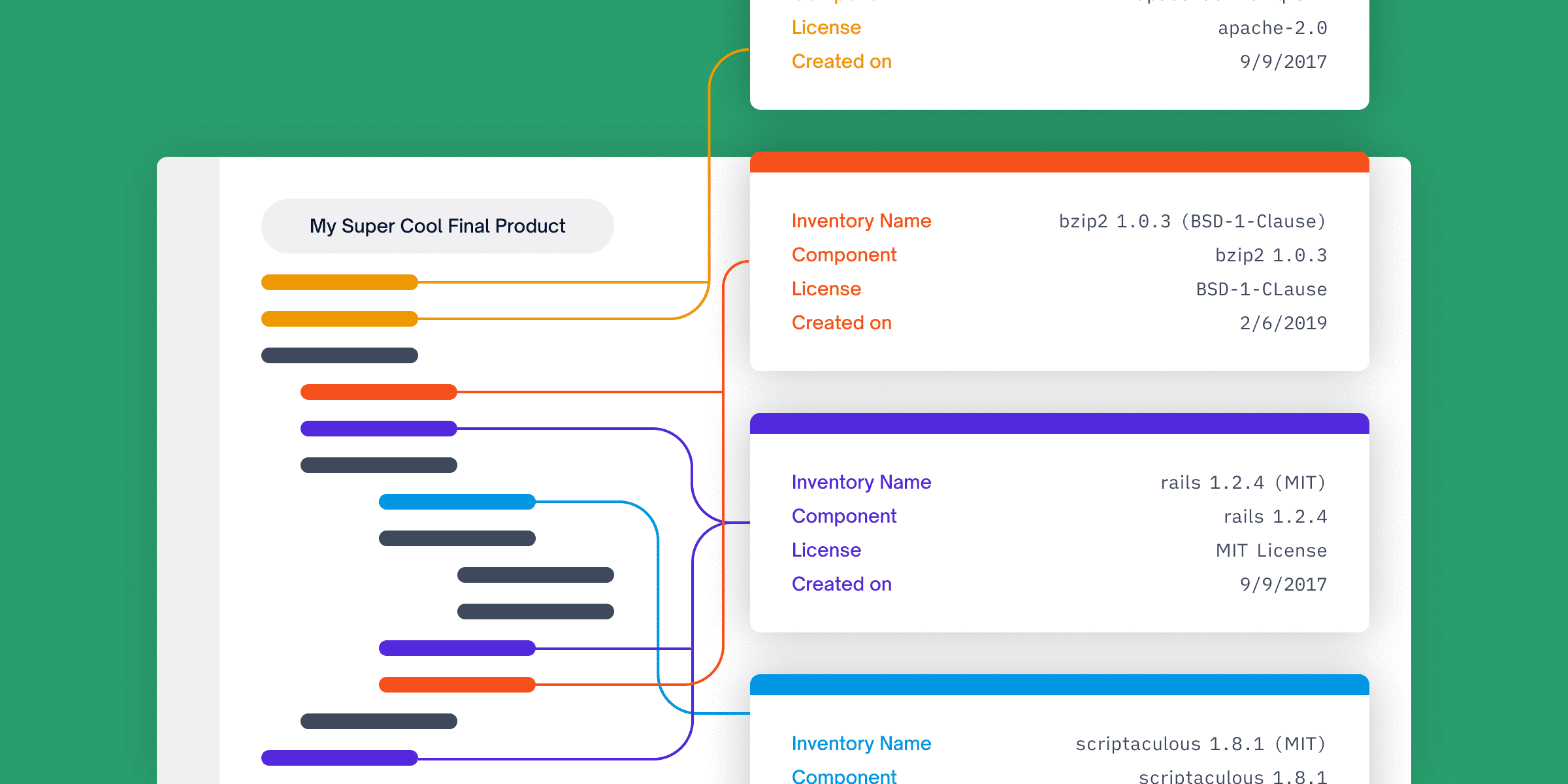
There are various reasons why open source components should be tracked. The inventory, for example, will provide you complete visibility into your open source components, which is necessary for managing these components effectively. There are some open source licenses that are incompatible because they might have varying types of permissions and requirements, which could lead to a conflict. Additionally, these open source components might have vulnerabilities in them which might cause a lot of issues and even make the whole organization vulnerable.

When this tracking is done manually, a developer is responsible for going through all the information (which may include licences, the components it is using within the software along with their version number) and even maintaining a software bill of materials (SBOM). However, doing these manually not only increases the burden on the developer, but also leaves the door open for human error, which can lead to very bad consequences. Manually tracking is hard and a waste of valuable time. That time can instead be invested in the development of a product.

Consequently, a method that is automated should be employed to track all of these components and their licences, among other things. Software composition analysis, also known as SCA, uses automated software that takes care of everything for you. You will have complete control over all of the open source components in your system. It is possible to integrate it with any build tool, run it in the background as part of your CI/CD environment, and use it to determine the open source components and dependencies that are already in use. 

It gathers all of the components, generates the SBOM, and then compares it to the information in the NVD database to locate any vulnerabilities that may exist in that particular version. Additionally, it will inform you of any licence issues. Because you are carrying out each and every process in an automated manner, your team is free to concentrate their attention entirely on development, and the automated tools can easily keep track of each and every component for you.

Conclusion

When we do things manually, keeping track of open source components can be a difficult and time-consuming effort. If things aren’t done properly, even the smallest of mistakes has the potential to make things much worse and put the security of the entire business at risk. As a result, an automated method ought to be taken into consideration because it will address a lot of issues and minimize the attack surface of the company. 

Hence, organizations should take SCA into consideration. It will help you do things like maintain a list of components and track licensing in a more effective manner on a daily basis, and improve the security of your software and organization in a larger sense.

SHARE
Share on FacebookShare on XShare on LinkedInShare on TelegramShare on BlueskyShare on Mastodon

Search

Translation

CVE ALERTS
📈

EPSS Spike Alerts
Catch risk spikes before they make headlines.

🎯

Custom EPSS/CVSS
Set score thresholds to effectively filter noise.

🛡️

Exploit Intel
Real-world exploit signals beyond the KEV catalog.

🐙

GitHub Issues
Auto-create alert tickets without duplication.

📬

Weekly Digest
Clean summaries, eliminating email spam.

🏷️

Watchlist Groups
Tag vulnerabilities by team (Infra/AppSec/SOC).

🔀

Smart Routing
Route chat channels based on severity levels.

🚨

RBP Tracker
Early warning detection and tracking system.

Subscribe – $7/mo or try free for 14 days →

🚨 Active Exploits in the Wild

  • CVE-2026-100382CVSS 10.0
    Improper Neutralization of Special Elements used in an OS Command (\'OS Command Injection\') vulnerability in Wikimedia Foundation Mediawiki...
    Admin intel📅 Updated: Oct 1, 2026
  • CVE-2026-76504CVSS 9.8
    A vulnerability in the API session-based authentication management of Cisco Catalyst SD-WAN Manager could allow an unauthenticated, remote...
    Admin intelCISA KEV📅 Added to KEV: Sep 30, 2026📅 Updated: Sep 30, 2026
  • CVE-2026-86950CVSS 8.8
    An out-of-bounds write issue was addressed with improved bounds checking. This issue is fixed in iOS 26.7.1 and...
    Admin intelCISA KEV📅 Added to KEV: Sep 29, 2026📅 Updated: Sep 29, 2026
  • CVE-2026-88772
    Memory overflow vulnerability leading to remote code execution or denial of service.
    Admin intelCISA KEV📅 Added to KEV: Sep 27, 2026📅 Updated: Sep 27, 2026
  • CVE-2026-88771
    Remote code execution due to improper input validation that can allow an unauthenticated attacker to execute arbitrary commands.
    Admin intelCISA KEV📅 Added to KEV: Sep 27, 2026📅 Updated: Sep 27, 2026
  • CVE-2026-65660CVSS 8.8
    Improper control of generation of code (\'code injection\') in Microsoft Office SharePoint allows an authorized attacker to execute...
    Admin intelCISA KEV📅 Added to KEV: Sep 25, 2026📅 Updated: Sep 25, 2026
  • CVE-2026-5430CVSS 10.0
    The JWT authentication mechanism accepts tokens signed with algorithms other than those explicitly configured or supported. This allows...
    CISA KEV📅 Added to KEV: Sep 24, 2026
  • CVE-2026-71362CVSS 9.1
    Adobe Commerce is affected by an Incorrect Authorization vulnerability that could result in privilege escalation. An attacker could...
    CISA KEV📅 Added to KEV: Sep 24, 2026
Powered by CVE Watchtower

Critical Vulnerabilities

  • CVE-2026-75957CVSS 9.8
    The Ultimate Multisite – WordPress Multisite SaaS & WaaS Platform plugin for WordPress is vulnerable to Authentication Bypass...
    📅 Updated: Oct 1, 2026
  • CVE-2026-15989CVSS 9.8
    The Super Forms – Drag & Drop Form Builder plugin for WordPress is vulnerable to Privilege Escalation in...
    📅 Updated: Oct 1, 2026
  • CVE-2026-92966CVSS 9.1
    The The Appointment Booking Plugin – LatePoint | Calendar & Scheduling for WordPress plugin for WordPress is vulnerable...
    📅 Updated: Oct 1, 2026
  • CVE-2026-101148CVSS 10.0
    The BackupSheep WordPress Backup Plugin WordPress plugin through 1.8 does not properly validate its integration key, treating an...
    📅 Updated: Oct 1, 2026
  • CVE-2026-62329CVSS 9.8
    Vulnerability Type: CWE-1392: Use of Default Credentials Attack type: Unauthenticated remote Impact: Unauthenticated users can access the default...
    📅 Updated: Oct 1, 2026
  • CVE-2026-103264CVSS 9.3
    Fleet versions before 4.87.0 contain an authentication bypass vulnerability in the device API that accepts hostnames and hardware...
    📅 Updated: Oct 1, 2026
  • CVE-2026-103244CVSS 9.3
    ground-station versions before 0.8.0 contain an authentication bypass vulnerability in the setup.restore command that allows unauthenticated attackers to...
    📅 Updated: Oct 1, 2026
  • CVE-2026-57496CVSS 9.6
    ## REST Path Traversal Bypasses Token Redaction in netlicensing-mcp ### Summary The `netlicensing_get_product` MCP tool in `netlicensing-mcp` interpolates...
    📅 Updated: Oct 1, 2026
Powered by CVE Watchtower

Daily CyberSecurity

  • About SecurityOnline.info
  • Advertise with us
  • Announcement
  • Contact
  • Contributor Register
  • Login
  • Disclaimer
  • DCMA
  • Privacy Policy
  • About SecurityOnline.info
  • Advertise on SecurityOnline.info
  • Contact Us

When you purchase through links on our site, we may earn an affiliate commission. Here’s how it works

  • CVE Watchtower
  • CVE Statistics by Vendor 2026
  • Q2 2026 Report
  • Top Exploited CVEs
  • Bluesky
  • Facebook
  • Linkedin
  • Mastodon
  • RSS
  • Twitter
  • Youtube
© 2017 - 2026 Daily CyberSecurity. All Rights Reserved.