 Do Son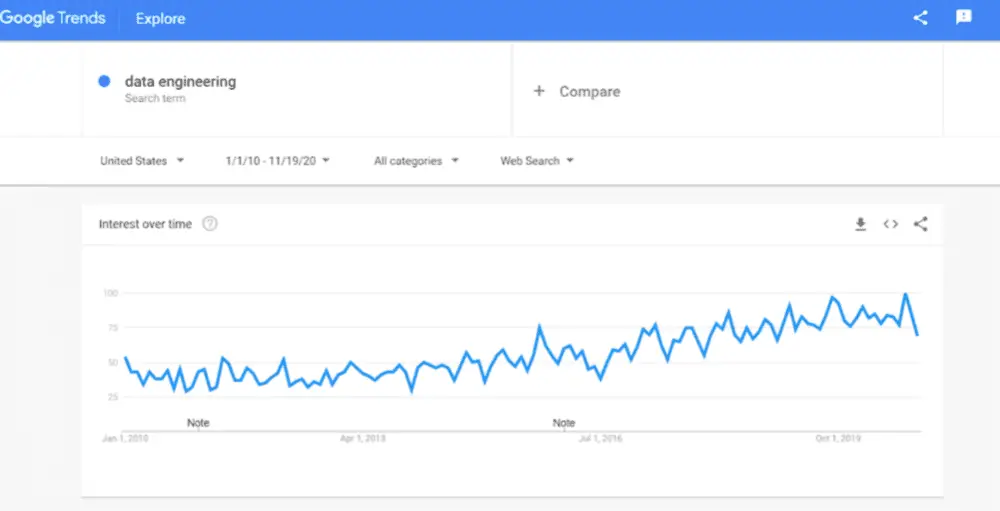
Data engineering focuses on practical applications of data collection, validation, and analysis to help make data more useful for end consumers. As organizations become more dependent on data to empower successful business decisions, the necessity of data engineering continues to increase. Since 2010 Google searches for the phrase “data engineering” have gone up:
In IT, the bigger the hype, the greater the misconceptions, and data engineering is no exception. As an emerging technology, data engineering carries some myths that should be taken with a pinch of salt. A few common myths that we frequently hear at are:
- Data Engineering brings value only when you deal with massive volumes of data – we won’t see any benefits with the volumes we have.
- Data Engineering means big budget and it is for big companies – we don’t have enough money to implement Data Engineering in our company
- Data Engineer = Software engineer – why should our company involve data engineers in data management instead of having software engineers do this job?
- Data Engineering is only about data – why should we care about other business demands?
We will highlight all these myths to help you keep a cool head about Data Engineering. Let’s discuss in detail each one of these four myths and find out why you shouldn’t believe in these misconceptions.
Myth 1: Data Engineering is needed only when you deal with massive volumes of data
Surprisingly, it’s not. Companies don’t need to operate terabytes of data to use data engineering practices for their business. It’s all about how you manage the data to add value to your business. In fact, data engineering practices can be applied to any amount of data and help you to increase IT systems scalability, improve security, safeguard data quality, and get valuable insights on any scale.
Even if you are working with a few gigabytes of data, you can yield the benefits from it by creating a data governance strategy and implementing it on a regular basis. Smart implementation is what makes Data Engineering projects valuable. Therefore, even a small amount of data is enough to get valuable insights from your data platform.
Myth 2: Data Engineering means big budget and it is for big companies
Given all the hype about Data Engineering, many specialists love to speculate that Data Engineering is only affordable for large enterprises since big data is considered an expensive investment. This is not always the case.
The time has changed. These days, you don’t need to have a lot of money to build an efficient Data Engineering strategy, as Big Data tools and technologies are becoming cheaper and more accessible.
Moreover, cloud computing allows start-ups and smaller organizations to embrace Big data technologies at a lower cost. If you’re searching for cost-efficient options, there is nothing better than opting for a publicly managed cloud. With a public cloud, you don’t need hardware/software purchase or installation.
Many studies prove that a data platform implemented according to Data Engineering best practices turns out to be 20-30% cheaper in terms of infrastructure and maintenance than any legacy platform our customers used before.
Of course, if you built more than needed, or did everything using old technologies, then the maintenance of such a system would cost a pretty penny. However, you can find a simpler solution that will be easier to manage, so that later on you won’t have to sacrifice anything, make compromises and resort to overengineering.
Whether your company has 10, 100, or 1,000 employees, you can use the same approaches as large enterprises apply to analyze your data to reduce expenditure, increase sales, and build new creative approaches for business growth.
Myth3: Data Engineer = Software engineer
For many people, data engineers and software engineers seem to be different names for the same role. In fact, these job positions cover a wide range of diverse responsibilities. The two jobs sometimes overlap but have different functions and skillsets.
This myth goes back to the days when the volumes of data an average company handled were relatively small and the data platforms didn’t have to be as sophisticated. Basic Data Engineering practices could be implemented by your development team with no need to involve a data engineer. However, as data solutions become more and more complex Data Engineers come into play.
Actually, software engineers engage in data infrastructure to a limited degree. Their main task is to develop software, operating systems, apps, websites that function well for the end-user. A dedicated development team (if you are outsourcing your software activities) or in-house specialists develop products that create the data.
On the other hand, data engineers design, test, and maintain the data architecture&infrastructure and prepare it to be analyzed. They also build robust data pipelines, create data algorithms, and arrange any problems in the programmed system. A data engineer should know SQL and NoSQL databases, ETL tools, understand a number of programming languages, including Java and Python, and be knowledgeable in Statistics and Math.
Thus, each job position includes a basic background in data management. Experienced software engineers can easily tackle relevantly simple data management tasks. However, for complex systems, the involvement of data engineers can be more beneficial, as they will complete these tasks faster.
Myth 4: Data Engineering is only about data
Last but not the least, is that Data Engineering is only about data. This one is the biggest misconception of all. Data Engineering is not only about data, but also about business demands expressed through engineering practices. This includes:
- DevOps: maintaining data pipelines, supporting Data Platform infrastructure or services related to data, troubleshooting issues occurred in the data flow;
- Analytics: adjusting and preparing data sets according to visualization demands or requirements, taking part in creating dashboard;
- Security: implementing policies and protecting data, restricting access, developing user access policies for data;
- Governance: implementing practices to meet regulatory compliance, applying data quality practices to improve overall Data Platform.
So, Data Engineering practices go far beyond the data itself and help organizations to improve the infrastructure, security, systems performance, scalability, etc.
Conclusion
We debunked the most common myths in the field of Data Engineering and hope that we persuaded you to give it a try. One can hardly doubt the importance of data processing and the business potential that data engineering practices hold.
Next time you come across a myth regarding Data Engineering, make sure you verify the big data facts against these misconceptions to use your resources in an effective way and make successful business decisions. Take care of your data and it will get a great deal back.
Do you agree with our list of myths? Do you know some other observed myths around data engineering? Comment in the section below if you’ve come across any more such myths that need to be debunked!