AI and Machine Learning: Revolutionizing the Way Companies Prototype Their Products
 Do Son
Businesses across industries are finding ways to adopt Artificial Intelligence (AI) and machine learning to improve their operations. With continued advancements in these technologies, the global market revenue for AI is consistently growing every year and is implemented across numerous business activities. One of its most notable applications is in the development of product prototypes.
The rapid prototyping process allows engineers and designers to design, build, and perfect their prototypes faster than ever before. With the help of 3D printing, CNC machining, rapid tooling, and other methods, rapid prototyping companies offer low-cost and high-efficiency services across the entire product development cycle. By adding even more capabilities to the process, AI has transformed the way businesses bring products to market and manufacture their CNC parts using the latest technology and resources.
Prototyping itself is essential as it drives the product through validation and iteration phases before being sent out for commercial manufacturing. That is why virtually any company that uses prototyping can benefit from AI in its prototyping phase. In this article, we’ll look at the different ways AI and ML are revolutionizing the way companies prototype their products.
Enhanced Decision-Making
When companies plan on launching a new product, they typically perform a market analysis to study the demand on the market. AI technologies and algorithms can track and analyze price elasticity and forecast demand, offering businesses a much more accurate forecast for their project. They can then use this information to design and create a prototype.
This kind of analysis reduces energy, materials, and labor costs as it allows manufacturers to choose the best materials and features upfront. This is not surprising since about 44% of companies report reductions in business costs in departments where AI is implemented. In product development, AI and ML companies are using algorithms for anything from procurement, strategic sourcing, and cost management to optimize their returns and bring the best possible product to market.
Improved Quality
Product developers commonly run tests to analyze anything from usability to features to workflows. AI in rapid prototyping has provided readily-available information and technical requirements at every production stage. 3D printing systems that use AI can inspect each part thoroughly and analyze depth, lumps, or unknown patterns undetectable to the naked eye and immediately report flaws.
Because of this, errors are more easily detected and significantly reduced. Furthermore, any complaints about a lack of a detailed or definite prototype idea are avoided. Manufacturers can also use these tools to hand-draw design components and prototypes to create a high-grade version of their design. All in all, by providing clearer technical specifications with high-level detection capabilities, the technology enhances the overall product quality.
Increased Efficiency
Most industries that use prototypes need to go through the process as fast as possible so they can introduce their products to market before their competitors. That is why they actively seek out manufacturers who can design and create the prototype in the shortest time frame. New product development can be time-consuming, but by using AI, manufacturers can automate repetitive tasks and speed up the process.
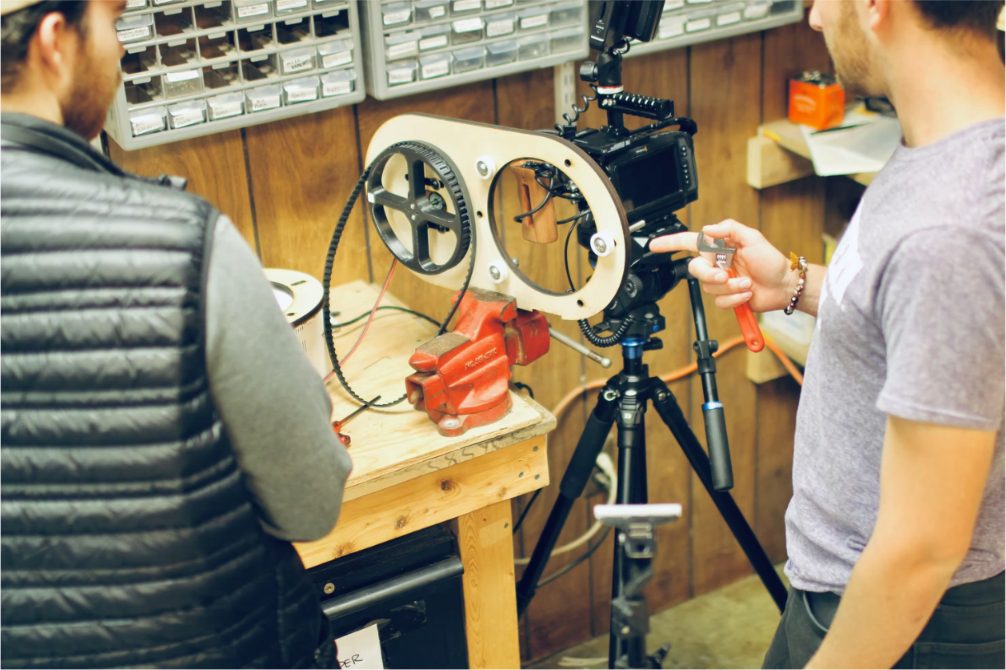
AI algorithms can track and optimize CAD files during the 3D printing process, creating more understandable 3D models. They can also reduce the workload for product developers by analyzing the models in CAD files and determining the most appropriate and efficient printing process. With these advanced production possibilities, clients can gather feedback from users and implement changes in no time, leading to a more efficient production process.
New Product Development Possibilities
When a company decides to create a product with certain capabilities, they typically need to send it to a manufacturing expert who can figure out the technical aspects, after which they evaluate if the piece satisfies the operational requirements. This manual process often takes months, but AI can use both additive and subtractive methods to meet even the most complex manufacturing needs.
Furthermore, by detecting even the smallest details in 3D models, AI provides unprecedented customization possibilities. That means manufacturers can follow unique customization requirements for every customer order, even from the initial design phases, and without having to incur any extra costs. Essentially, this kind of high-detail product design can help companies create products with unprecedented benefits and the highest probability of being purchased.
Conclusion
The advancements in AI and ML are transforming business operations and capabilities across industries – including those in prototyping. Although AI in prototyping doesn’t replace the necessary human resources, it significantly enhances production capabilities.
By combining skills with artificial intelligence, prototyping companies can enhance their decision-making with data, improve the quality of products, increase efficiency, and open new product development possibilities. For companies that want to shorten their time-to-market and manufacture cutting-edge products, using AI-enabled prototyping practices is not only helpful but necessary.