 Do Son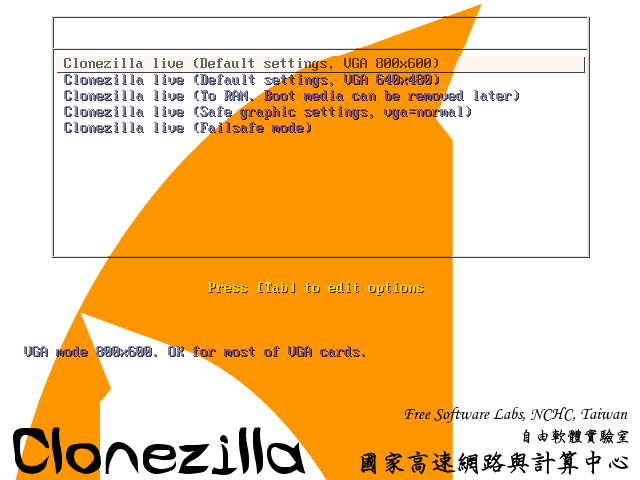
Clonezilla is a partition and disk imaging/cloning program similar to True Image® or Norton Ghost®. It helps you to do system deployment, bare metal backup, and recovery. Two types of Clonezilla are available, Clonezilla live and Clonezilla SE (server edition). Clonezilla live is suitable for single machine backup and restore. While Clonezilla SE is for massive deployment, it can clone many (40 plus!) computers simultaneously. Clonezilla saves and restores only used blocks on the hard disk. This increases the cloning efficiency. With some high-end hardware in a 42-node cluster, a multicast restoring at rate 8 GB/min was reported.
Features
- Filesystem supported: ext2, ext3, ext4, ReiserFS, xfs, jfs of GNU/Linux, FAT, NTFS of MS Windows, HFS+ of Mac OS, UFS of BSD, Minix of Minix and VMFS of VMWare ESX. Therefore you can clone GNU/Linux, MS Windows, and Intel-based Mac OS, no matter it’s 32-bit (x86) or 64-bit (x86-64) OS. For these file systems, only used blocks in the partition are saved and restored. For an unsupported file system, sector-to-sector copy is done by dd in Clonezilla
- LVM2 (LVM version 1 is not) under GNU/Linux is supported.
- Multicast is supported in Clonezilla SE, which is suitable for a massive clone.
- Based on partclone to clone partition. However, Clonezilla, containing some other programs, can save and restore not only partitions but also a whole disk.
- Both MBR and GPT partition formats of the hard drive are supported. Clonezilla live also can be booted on a BIOS or UEFI machine.
- An unattended mode is supported. Almost all steps can be done via commands and options. You can also use a lot of boot parameters to customize your own imaging and cloning.
- One image restoring to multiple local devices is supported.
- The image could be encrypted. This is done with ecryptfs, a POSIX-compliant enterprise cryptographic stacked filesystem.
- Multicast is supported in Clonezilla SE, which is suitable for the massive clone. You can also remotely use it to save or restore a bunch of computers if PXE and Wake-on-LAN are supported in your clients.
- The image file can be on local disk, ssh server, samba server, NFS server or WebDAV server.
- AES-256 encryption could be used to secures data access, storage, and transfer.
- Based on Partclone (default), Partimage (optional), ntfsclone (optional), or dd to image or clone a partition. However, Clonezilla, containing some other programs, can save and restore not only partitions but also a whole disk.
- By using another free software drbl-winroll, which is also developed by us, the hostname, group, and SID of cloned MS windows machine can be automatically changed.
This release of Clonezilla live (2.5.5-38) includes major enhancements and bug fixes.
ENHANCEMENTS and CHANGES
- The underlying GNU/Linux operating system was upgraded. This release is based on the Debian Sid repository (as of 2018/Mar/30).
- Linux kernel was updated to 4.15.11-1.
- Partclone was updated to 0.3.11-drbl3 with some libraries updated. //NOTE// New image format is used in this release. It is different from the one saved by Partclone 0.2.x.
- New massive deployment mechanism BitTorrent was added. //NOTE// Clonezilla has to convert the original image to the special format when BitTorrent mode is used. This will require more disk space in the image repository.
- Switch keymap configuration method from console-data to keyboard-configuration. Ref: https://bugs.debian.org/cgi-bin/bugreport.cgi?bug=893612
- Update language files de_DE, es_ES, fr_FR, hu_HU, ja_JP, it_IT, tr_TR and sk_SK. Thanks to Michael Vinzenz, Juan Ramón Martínez, Jean-Francois Nifenecker, Greg Hefty, Akira YOSHIYAMA, ianfranco Gentili, Volkan Gezer and Ondrej Dzivy Balucha.
- Add channel bonding option when configuring network. Thanks to panther_1 for requesting this. Ref: https://sourceforge.net/p/clonezilla/support-requests/61/
- Make prep-ocsroot can use disk block device (e.g., /dev/sdc) as image repository. Thanks to Riksoft for requesting this. Ref: https://sourceforge.net/p/clonezilla/bugs/288/
- Add options -pe and -pfe to ocs-sr. This allows user to enter password in the command options although it’s not safe. Thanks to ub2 at gmx ch for requesting this. Ref: https://sourceforge.net/p/clonezilla/discussion/Clonezilla_live/thread/d3af2134
- New compression lz4/lz4mt (-z8/-z8p) and zstd/pzstd (-z9/-z9p) were added in expert mode.
- Make ocs-chnthn work for device name like /dev/nvme0n1p1. This change should really fix the issue reported here: https://github.com/stevenshiau/clonezilla/issues/30
- Remove “-p 16” for pigz in drbl-ocs.conf. It should let pigz to decide that automatically.
- Package drbl-chntpw is no more used, and now we switch to use reged from package chntpw.
- The file efiboot.img has been moved to /boot/grub/ from /EFI/image from /EFI/image/.
- Add a workaround to make dnsmasq relay work for uEFI network boot clients. i.e., we have to assign the tftp server IP address in grub network boot loader. This is only necessary when dnsmasq is used to relay the DHCP request from clients to existing DHCP service. Ref: http://lists.thekelleys.org.uk/pipermail/dnsmasq-discuss/2017q1/011124.html
- Add boot parameter ocs_netlink_timeout so that the network link detection timeout can be assigned for ocs-live-netcfg.
- Add an option -cbm to ocs-live-feed-img. Besides, remove boot parameter ocs_litesrv_mode. It’s better to assign that in the command line option (-dm) when running ocs-live-feed-img, e.g., ocs-live-feed-img -cbm netboot -dm auto-detect -g auto -e1 auto -e2 -r -x -j2 -sc0 -p reboot -md multicast –clients-to-wait 1 –max-time-to-wait 300 start myimg sda.
- Support using UUID and LABEL as image repository, i.e., local_dev for image repository can be assigned as: dev:///LABEL|UUID|PARTLABEL|PARTUUID=uuid|label. E.g., ocs_repository=”dev:///UUID=84b012cc-5a4c-41e2-bf20-620d028072cb”
BUG FIXES
- Jfbterm should not exit when lite server is running. It would terminate the required service for clients to restore image, especially BT service in non-English environment.
- Cnvt-ocs-dev failed to convert EBR (like sda2-ebr). Thanks to killuaDK for reporting this: https://sourceforge.net/p/clonezilla/discussion/Open_discussion/thread/b851e095
- Ocs-chnthn now supports modifying Win10 hostname. Thanks to František Griga for reporting this issue. Ref: https://sourceforge.net/p/clonezilla/support-requests/100/
- /EFI/centos/grubx64.efi should be before /EFI/Boot/bootx64.efi. Thanks to Fritzinger, Bernd (Bernd.Fritzinger at bruker com).
Support Our Threat Intelligence
Find our tech and OS security coverage helpful? Support our work today and unlock a 100% ad-free reading experience!
 Buy Me a Coffee
Written by
