Daily CyberSecurity Launches CVE Alerts, an Automated Vulnerability Intelligence Service for IT and Security Teams
 ddos-admin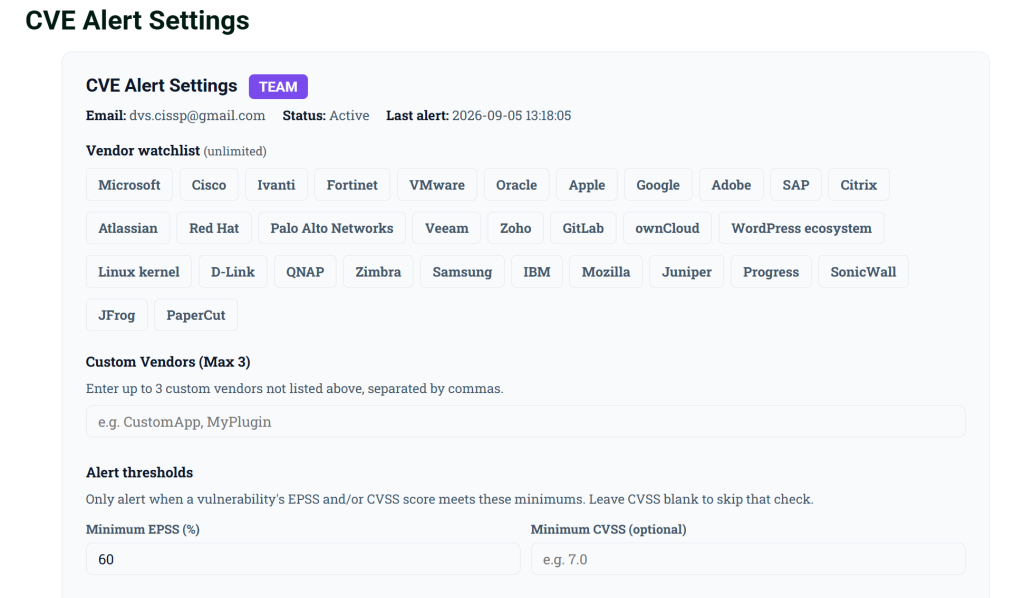
Daily CyberSecurity, the team behind the CVE-Watchtower vulnerability tracking platform on securityonline.info, today announced the general availability of CVE Alerts, a subscription service that turns raw CVE data into targeted, real-time notifications delivered by email, Slack, Microsoft Teams, and GitHub Issues.
With more than 40,000 CVEs published in 2025 alone, security teams can no longer read every advisory that mentions their stack. CVE Alerts filters that noise down to what is actually exploitable and relevant, drawing on the same CVE, KEV, and EPSS data that already powers CVE-Watchtower’s free public dashboard, and routing it directly into the tools teams already use — inbox, Slack, Microsoft Teams, or a GitHub issue tracker.
What CVE Alerts Does
Subscribers build a watchlist of the vendors and products they run, and CVE Alerts matches new vulnerability data against it around the clock. The service launches with:
- CISA KEV alerts — instant notice the moment a tracked vendor’s CVE is confirmed as actively exploited, free on every plan.
- EPSS threshold and spike detection — alerts when a CVE’s exploit-prediction score crosses a set bar, or jumps sharply between scans, surfacing risk before it becomes a headline.
- Exploit Intel — a second confirmed-exploitation signal, drawn from the open-source PatchThis project, independent of CISA KEV.
- Early warning on Reserved-but-Public CVEs — CVE-Watchtower already tracks CVE IDs that are publicly referenced in advisories while MITRE still lists them as “Reserved,” a blind spot most other trackers miss entirely. CVE Alerts can export these findings as CSV or JSON — intelligence valuable enough to resell as a raw data feed to other security professionals.
- Custom EPSS/CVSS thresholds — Pro and Team subscribers set their own bar instead of a one-size-fits-all cutoff.
- GitHub Issues and Projects integration — Team plans can have matching CVEs open as GitHub Issues automatically, with status changes posted as comments instead of duplicate issues.
- Weekly digest mode — one summary email sorted by severity, for teams that want less inbox noise than instant alerts.
- Watchlist groups — Team subscribers tag alerts by internal team (Infrastructure, AppSec, SOC) so the right group sees the right CVEs.
- Severity-based webhook routing — send critical findings to one Slack or Teams channel and everything else to another.
All new subscribers can try any paid plan free for seven days, with no payment method required.
Pricing and Free Trial
CVE Alerts is available in three tiers:
| Plan | Price |
Highlights |
| Free | $0 | Up to 3 vendors, CISA KEV and EPSS alerts, email delivery |
| Pro | $7/month | Unlimited vendors, all new CVE alerts, Exploit Intel, custom EPSS/CVSS thresholds |
| Team | $29/month | Everything in Pro, plus Slack/Teams webhooks, GitHub Issues/Projects, watchlist groups, weekly digest, CSV/JSON export |
Every paid plan includes a 14-day free trial with no credit card required. At the end of the trial, accounts revert to the Free plan automatically — there is no charge and no action needed to cancel.
Quote
“CVE-Watchtower already shows anyone what’s happening across the vulnerability landscape. CVE Alerts is about making sure the right person hears about the right CVE the moment it matters, in the tool they already work in — not a week later, buried in a digest they never open,” said Do Son, creator of CVE-Watchtower and Daily CyberSecurity.
About Daily CyberSecurity
Daily CyberSecurity operates securityonline.info, publishing vulnerability news and advisories alongside CVE-Watchtower, a free public dashboard for tracking, searching, and following CVE records, CISA KEV status, and exploitation trends. CVE Alerts extends that same data pipeline into a subscription notification service for individuals and teams.
Availability
CVE Alerts is available now at securityonline.info/pricing. New subscribers can sign up for the Free plan or start a 14-day free trial of Pro or Team directly from the alert settings page.
Media Contact
Daily CyberSecurity ddos@securityonline.info
Further reading
- AI Drives 2026 Vulnerability Forecast to 66K CVEs, But Risk Stays Flat
- The CVE Watchtower: Weekly Threat Intelligence Briefing (March 23 – March 29, 2026)