One Film, a Million Copies: How Session-Specific Fingerprinting Traces a Leak to Its Source
 Do Son
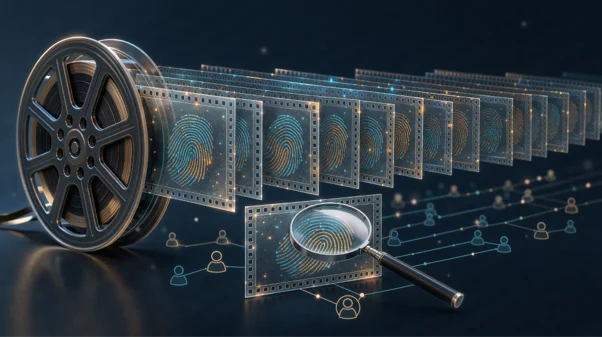
Every awards season, studios do something that sounds reckless: they hand their most valuable unreleased films to thousands of people they barely know. Voters, critics, guild members and distributors all get early access, weeks or months before the public. Somewhere in that crowd, someone may decide to share a link, record a screen, or upload a file. And yet, when a leak does surface, the studio can often tell within a day whose copy it was.
The reason is that no two people ever watch exactly the same file. Behind the scenes, each viewing session receives its own invisible mark, a technique usually called video fingerprinting in the anti-piracy trade. The mark does not change what the viewer sees or hears. It simply makes every copy unique, so that a pirated file carries the identity of whoever received it. What follows is an explanation of how that works, how the trail is recorded, and what actually happens when a leak leads back to a specific account.
Two Very Different Meanings of “Fingerprint”
The word causes confusion, so it is worth separating two ideas. The first is content recognition. Platforms such as video-sharing sites compute a compact signature from a film, a video fingerprint, and compare it against a reference database to spot uploads of the same title. This approach answers the question “what is this video?” It cannot say who leaked it, because every copy of the film produces the same signature.
The second idea is forensic marking, and it is the subject of this article. Here, the goal is not to recognize the film but to tell copies of it apart. Each recipient gets a version carrying a unique, hidden identifier. When someone searches for the best video fingerprinting software for screeners, this is the capability they have in mind: not matching a title, but naming a source. The two technologies often work side by side. Recognition finds the pirated file on the internet, and forensic marking reveals where it came from.
Why Screeners Became the Weak Link
Screeners, early copies of films sent to people who vote on awards or write about them, have long been a favorite source for pirates. The reason is simple. Quality is high, the release is early, and the file is in the hands of people who have little personal stake in keeping it secret.
The industry learned this in the early 2000s. In autumn 2003, the Hollywood trade association announced a ban on awards screeners, only to reverse course after independent filmmakers argued that the copies were essential to getting their films seen. The compromise included contracts under which recipients accepted responsibility for their copies, and many tapes carried individualized marks. When pirated screeners began appearing online in January 2004, those marks helped investigators identify the sources of several of them. A well-known case involved an Academy member who lent tapes to an acquaintance, who then digitized them and put them on the internet. The member was expelled, and criminal and civil actions followed.
A decade later, the pattern repeated. When a prominent Western released in 2015 appeared online, industry reporting linked the leaked file to a screener sent out during the awards campaign. The lesson was the same: the biggest leaks tend to start inside the trusted circle, and a unique mark on every copy turns a faceless upload into a lead.
One Film, a Million Versions
How can a studio deliver a million different versions of one film without storing a million different files? The answer lies in a clever trick used by many streaming-based systems.
Before delivery, the film is prepared in two variants, call them A and B. The two versions are nearly identical, but they differ in tiny, imperceptible ways, such as slight changes in how certain pixels are encoded. The film is then cut into short segments, each available in version A and version B. When a viewer starts a session, the delivery system decides, segment by segment, whether to send the A or the B variant. The resulting pattern of A’s and B’s works like a long binary number. Session one might receive A, B, B, A, B. Session two might receive B, A, B, B, A. Over a feature film with thousands of segments, the sequence is long enough to be unique to the viewer, even among millions of sessions.
This approach is called session-specific, or dynamic, marking. Because the choice is made on the server as the stream goes out, nothing needs to be installed on the viewer’s device. The Academy of Motion Picture Arts and Sciences, for example, has used server-side marking in its streaming screening room since 2020, built with partners in video delivery and content security, so that members watch on ordinary browsers, phones and television apps. The mark rides along inside normal video streams and survives the trip to the player.
For physical or downloadable screeners the idea is similar, but the stamping happens before the file is sent. A copy is rendered for one recipient, marked with a code, and delivered. This is slower and more expensive, which is one reason studios moved so much of the screening process to streaming.
The Ledger Behind the Mark
A hidden code is useless without a record of who received it. That record is the second half of any fingerprinting video system, and in practice it is as important as the mark itself.
Every time a viewer starts a session, the platform logs the details: the account, the time, the device type, the network address, and the exact sequence of variants delivered. Strong access controls sit around it. Viewers sign in with individual credentials, and digital rights management restricts what the player can do, such as blocking screen capture on supported devices. The log is stored securely, because it is the document that connects a code to a name.
Studios also track behavior around the session. Unusual patterns, such as the same account streaming from two countries within an hour, a screener played start to finish at suspicious speed, or many devices linked to one login, can trigger alerts before any leak occurs. Good systems treat the mark as the last line of defense, not the first.
The Day a Leak Appears
Now imagine the worst: a copy of a Friday-night screener shows up on a file-sharing site. What happens next follows a fairly predictable sequence.
First, monitoring teams or specialist services detect the file. Some studios employ staff who scan piracy sites around the clock, and many contract outside firms that use automated crawlers and content recognition to find uploads quickly. The file is downloaded and its details are recorded, including a cryptographic hash, which is a short number computed from the file’s contents, so that its integrity can be proven later.
Second, analysts run the file through extraction software. The software looks at the video, segment by segment, and works out which variant, A or B, each segment contains. Reassembled, the sequence reveals the code. Good systems can recover it even from a clip of a few minutes, though accuracy improves with length. Where parts of the file are damaged, error-correction built into the code fills the gaps.
Third, the code is looked up in the delivery ledger. The result is a specific session, tied to a specific account and time. At that point the studio knows which copy leaked, and a security team can often act within hours: suspend the account, notify the distributor or guild that issued the credentials, request takedowns, and preserve evidence.
From Account to Person
The trail leads to an account, and an account is not the same as a person. This is the part that outsiders tend to miss. A screener login may have been shared with an assistant, used by a family member, or stolen through a phishing email. Investigators therefore combine the watermark result with other evidence: login history, device records, network information and, where appropriate, interviews.
What follows depends on the contract. Awards bodies and distributors usually require recipients to agree to terms that carry real consequences, up to expulsion from the organization. Studios may pursue civil claims for damages, and in serious cases, prosecutors have brought criminal charges. Often the result is quieter. A call from a lawyer, a revoked account and a warning to every other recipient are enough to make the next person think twice. Deterrence is a large part of the point.
What Pirates Try, and How Systems Respond
People who leak films are not passive. They know that marks exist, and they try to defeat them. The common tactics are worth understanding.
Re-encoding and resizing are the simplest: converting the file to a different format, shrinking it or cropping it. Modern marks are built to survive these changes because they live in how the picture is constructed, not in its surface. Screen recording and camcording are harder, since they destroy fine detail, but robust systems can still recover a code from a recording if enough footage is available.
The most worrying tactic is collusion. Several recipients compare or combine their copies, hoping that mixing different versions will scramble the code. Designers answer this with codes built to remain traceable even when a few copies are blended, so that analysts can still name at least one of the colluding parties. Another response is to use several layers of marking at once, for example both picture and sound, so that attacking one leaves the other intact.
There is also a quality argument. A properly built mark is spread so widely through the file that stripping it out damages the picture, which defeats the purpose of stealing a premium copy in the first place.
What to Look For in a Solution
Companies deciding how to protect their releases face a crowded market of vendors. Anyone comparing the best video fingerprinting software should look past the marketing and ask practical questions. How well does the mark survive re-encoding, cropping and camcording, and has that been tested by an independent party? How fast can the system extract a code from a short clip? Does it work server-side, or does it require changes to the player? Does it cover the devices that recipients actually use? How is the delivery ledger secured, and how long is it kept? What does the vendor provide if the evidence ends up in court?
Cost and effect on quality matter as well. Marking should not visibly change the picture, add noticeable delay or demand more bandwidth than recipients can handle. And for any studio that wants to fingerprint video at scale across many titles, the process has to be automated, so that adding a new film and a new list of recipients does not turn into a manual project.
Every Copy Tells a Story
The idea behind all of this is old and simple: if everyone receives an identical object, no one can be blamed for what happens to it. Once each copy is different, the equation changes. A leaked file stops being anonymous and starts telling a story about where it has been. That does not eliminate piracy, and it does not replace judgment about people and context. But it gives studios something they never had in the days of identical tapes: a reliable way to follow a leak back to its beginning, and a reason for every recipient to treat a borrowed screener as something that carries their own name.