 Do Son
The rise of synthetic human generation has significantly reshaped digital advertising, corporate communication, and performance-driven content production. Traditional video pipelines—once dependent on studios, cameras, actors, and repeated production cycles—are increasingly being replaced by automated, cloud-based systems capable of generating spokesperson-style content at scale.
Within this shift, the Pollo AI Avatar framework positions itself as a browser-based AI avatar generator designed to convert static portraits into expressive digital presenters. Rather than functioning as a single-purpose tool, it operates inside a broader creative ecosystem that includes video generation, image editing, and workflow-driven “Apps” for marketing and content production.
This review evaluates the Pollo Avatar AI avatar generator from a practical, performance-oriented perspective, focusing on rendering behavior, workflow structure, output consistency, and its applicability in real commercial environments.
What is Pollo AI Avatar?
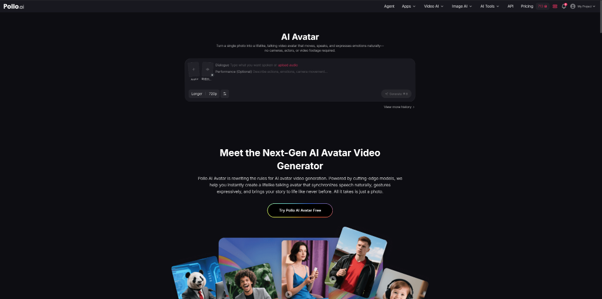
Pollo AI Avatar generator is an AI avatar generator designed to transform a single portrait photo into a lifelike talking digital presenter capable of speech, motion, and emotional expression. It removes the need for cameras, actors, or recorded footage by relying on a Photo to Video Avatar system that generates animated speech-driven sequences from minimal input.
Instead of requiring traditional avatar training or multi-angle video datasets, the system operates through a cloud-based generation pipeline that can produce short avatar videos from just one image and a script or audio input. In supported configurations, output length can extend up to approximately two minutes depending on model selection and workload.
What differentiates Pollo AI Avatar within its ecosystem is its integration into a broader platform structure that includes multiple video and image models such as Pollo 2.5, Seedance 2.0, Veo 3, Kling AI, Runway, Luma AI, and others. This multi-model architecture allows users to switch between different generation engines depending on desired realism, style, or rendering speed.
Key Features
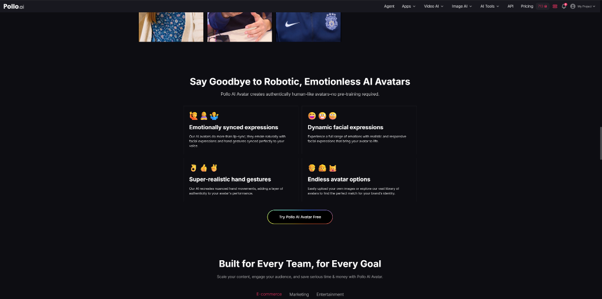
The Pollo Avatar AI avatar generator is structured around a modular creative system that extends beyond simple talking-head generation.
Emotionally Synced Expressions
The system focuses on reducing the rigid, mechanical behavior commonly associated with early AI avatars. Facial expressions are generated in sync with speech tone, allowing for more dynamic transitions in emotion during dialogue. This makes the output more suitable for use in social and marketing content, including Facebook video maker workflows and short-form ad creatives.
Dynamic Performance Actions
Beyond lip-syncing, avatars are capable of performing basic physical actions such as holding objects, gesturing toward products, or making simple expressive movements like thumbs-up signals. While not cinematic in complexity, these gestures add a layer of interaction that supports product-focused storytelling.
Flexible Character Creation
The system is not limited to preset avatars. Users can convert nearly any image into a speaking character, including professional headshots, mascots, illustrated figures, pets, or stylized branding elements. This flexibility supports a wide range of identity-driven content strategies.
Integrated Creative Ecosystem
Pollo AI Avatar is embedded within a larger toolkit that includes supporting utilities such as background removal, object removal, AI video upscaling, AI video enhancement, and AI photo editing. This reduces the need for external editing software during post-production workflows.
Performance and Workflow Experience
From a hands-on usage perspective, Pollo AI Avatar demonstrates a performance profile optimized for speed and scalable content production rather than fine-grained animation control.
In testing across multiple business-oriented scenarios, the system consistently processed uploads quickly through a cloud-based rendering pipeline. After submitting a portrait and script, generation typically began immediately, with final outputs returning within minutes. This makes it suitable for iterative workflows where multiple variations of an ad or message are required.
When evaluating visual output quality, results were most stable when using high-resolution, front-facing portraits. In these cases, facial motion such as blinking, lip synchronization, and subtle expression shifts appeared generally coherent, avoiding the stiff “talking mask” effect seen in simpler tools. Facial structure was largely preserved, and skin texture remained visually natural without excessive smoothing.
However, consistency decreases under less controlled inputs. Lower-quality images or angled portraits can introduce minor artifacts, particularly in expression alignment or facial smoothing. These issues are typically small but may become noticeable in more polished commercial campaigns.
In a product interaction scenario where an avatar was prompted to hold an object, the system demonstrated basic spatial understanding. Hand placement and shadow alignment were mostly believable, although more complex hand rotations occasionally produced minor distortions. This behavior aligns with current limitations across most neural video generation systems.
Overall, lip synchronization remains one of the most stable elements of the pipeline, performing reliably across different languages and speech styles. The general workflow is clearly optimized for throughput, enabling fast production of marketing-ready content rather than frame-accurate animation refinement.
How Does it Work?
The generation pipeline follows a straightforward three-step process designed for fast content production:
- Choose Your Star: Upload a single image that will serve as the foundation for the avatar identity.
- Give It a Voice: Add a script or upload an audio file that defines the spoken content.
- Generate Video: Initiate rendering, after which the system processes the request through cloud-based computing clusters and returns a finished avatar video.
The workflow is intentionally simplified, with most technical complexity handled in the backend. This makes the Pollo Avatar AI avatar generator accessible to users without animation or video editing experience.
Practical Use Cases
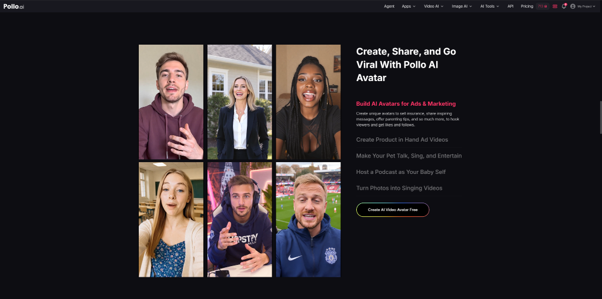
The Pollo Avatar AI avatar generator is primarily designed for high-volume content production across marketing, advertising, and media workflows.
E-Commerce and Conversion Content
In e-commerce environments, avatars are used to simulate product demonstrations and testimonial-style explanations. This reduces the need for on-camera presenters while enabling scalable product storytelling across catalogs.
Marketing and Social Media Production
Within marketing workflows, Pollo AI Avatar supports structured formats such as:
- UGC Video Ads
- Product Video
- Facebook Ad Video
- Testimonial Video
- Clone Video Ads
It is also used in social content pipelines, including faceless videos, viral-style avatar clips, and short-form engagement content optimized for platforms like Instagram and TikTok.
Filmmaking and Entertainment Development
In creative production contexts, the system is applied to early-stage ideation and narrative visualization. Common use cases include:
- Movie Trailer concepts
- B-Roll Video generation
- Explainer Video drafts
- News-style video content
- Anime Video sequences
- Music Video and lyric-based content
These applications focus more on rapid prototyping than final cinematic output.
Is it Worth it?
From a functional standpoint, Pollo AI Avatar is best understood as a production acceleration tool rather than a traditional animation system. Its main value lies in reducing the time, cost, and complexity associated with spokesperson-style video creation.
The integration of multiple models, including Pollo 2.5, Kling AI, and GPT Image 2, allows users to balance speed and visual quality depending on project requirements. Combined with template-driven “Apps” for marketing and social media, the system supports high-output workflows that would normally require significantly more resources.
Its strongest advantage is scalability—particularly for teams producing ads, product explainers, or social content at volume. However, users seeking precise cinematic control or highly customized animation behavior may find its abstraction layer limiting.
Overall, the Pollo Avatar AI avatar generator fits best within modern marketing and content operations that prioritize speed, consistency, and automation over manual creative control.