
 Do Son
FreeBSD patched 8 vulnerabilities on August 25, 2026, mostly local privilege escalation flaws plus a ppp code execution bug. Update now.
freebsd

Three FreeBSD privilege escalation flaws, including a kernel use-after-free, let local users gain root. Patch FreeBSD 14 and 15 now.
Recent FreeBSD security advisories detail severe flaws like CVE-2026-49420, CVE-2026-49429, and CVE-2026-49422. Patch immediately to stop attacks.

A public PoC exploit for the FreeBSD kTLS vulnerability (CVE-2026-45257) enables local privilege escalation to root. Patch your FreeBSD systems now.
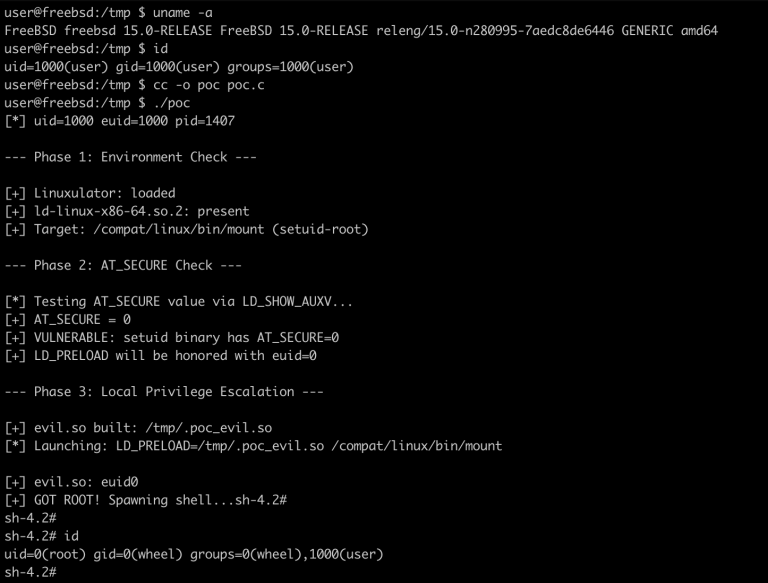
A FreeBSD privilege escalation flaw (CVE-2026-49413) in the Linuxulator lets local users get root. Public PoC exploit code makes patching urgent.
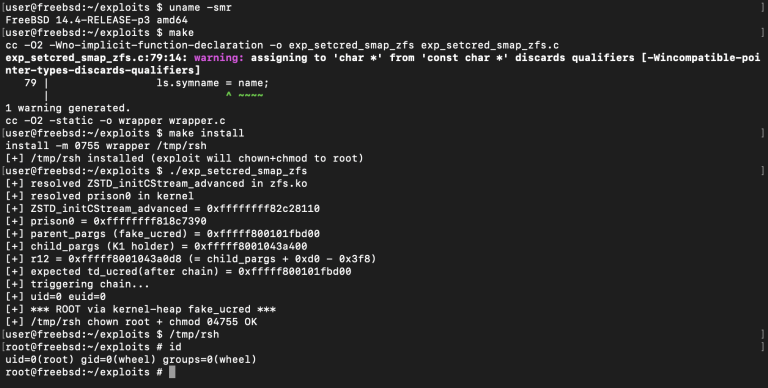
A critical FreeBSD kernel buffer overflow vulnerability is exposed. Learn more about this threat now that public exploit code released.

The FreeBSD Project fixes seven vulnerabilities, including a zero-interaction Wi-Fi shell expansion RCE (CVE-2026-45255) and severe kernel leaks.

Public PoC exploit released for OPNsense! A critical root-level RCE and lockout bypass allow total firewall takeover. Upgrade to OPNsense 26.1.7 immediately.
FreeBSD warns of CVE-2026-42511: a critical dhclient flaw allowing rogue DHCP servers to execute code as root via BOOTP file injection. Patch and reboot now!
FreeBSD patches a critical jail escape (CVE-2025-15576) and a kernel heap overflow (CVE-2026-3038). Learn how nullfs and routing sockets put hosts at risk.

A High-severity flaw (CVE-2025-14558) in FreeBSD allows Remote Code Execution via malicious IPv6 router advertisements and unquoted shell inputs.

CISA, FBI, and HHS issue a joint advisory on Interlock ransomware, active since Sep 2024, targeting businesses and critical infrastructure with double extortion tactics.

Learn about Interlock, a new ransomware group targeting both Windows and FreeBSD operating systems, and the concerning trend it represents.
Learn about the high severity vulnerability CVE-2024-41721 in FreeBSD's bhyve hypervisor and how it can be exploited.
Critical vulnerability (CVE-2024-43102) in FreeBSD: Learn about the flaw that could lead to a complete system compromise and how to mitigate it.
The FreeBSD Project disclosed a critical vulnerability (CVE-2024-7589) in OpenSSH, the widely-used implementation of the SSH protocol suite

CVE-2024-29937 in Network File System (NFS) implementations used by popular BSD-derived operating systems, including OpenBSD and FreeBSD

CVE-2022-23093 can be leveraged to cause a stack overflow, which could lead to a crash or trigger remote code execution in the ping