Skip to content
June 2, 2026
  • Linkedin
  • Twitter
  • Facebook
  • Youtube

Daily CyberSecurity

Zero-hour alerts. Unmatched analysis.

Primary Menu
  • Home
  • CVE Watchtower
  • Cyber Criminals
  • Data Leak
  • Linux
  • Malware
  • Vulnerability
  • Submit Press Release
  • Vulnerability Report
Light/Dark Button
  • Home
  • Technique
  • Website Directory Scanner by Sitechecker: Overview
  • Technique

Website Directory Scanner by Sitechecker: Overview

Ddos May 20, 2022 2 minutes read
Screenshot_20220520-155314

Website Directory Scanner by Sitechecker β€” is a tool for analyzing the contents of the file directory of any site. The most simple and completely free service that can show the owner of the resource, including hidden content that can pose a threat.

The Website Directory Scanner online service analyzes the site directory – the main folder containing all the directories and files, as well as the databases that provide the resource. In this way, you can scan and find files that are essential for the site (for example, Robots.txt), as well as hidden content that poses a potential threat. By identifying dangerous files in a timely manner, you can protect your site from negative external influences.


In addition, Website Directory Scanner can be used to analyze competitor websites. The tool is able to show pages that have no links:which are known only to the owner of the resource. However, before that, it is a good idea to learn about all stumbling blocks in the legislation of a particular country.

Features:

  1. Scanning the site for hidden directories and files to analyze the structure, search for dangers and other purposes.
  2. Ability to test security to find vulnerabilities in the directory.
  3. The concept of “hidden files” includes configuration files created in the integrated development environment, a special configuration for a particular project.
  4. Regular scanning ensures that sensitive and proprietary files are checked. This is the easiest way to save hidden content and protect against hacker attacks.
  5. Completely free to use and at the same time the ability to see all directories with hidden content.

Instructions for use:

  • enter the URL of the site you plan to crawl in the online tool field;
  • wait for the crawler to finish scanning;
  • analyze the site’s current directory;
  • get an online report on the results of the audit, information about the response code, status codes;
  • draw conclusions about the state of the directory and the security of your project.

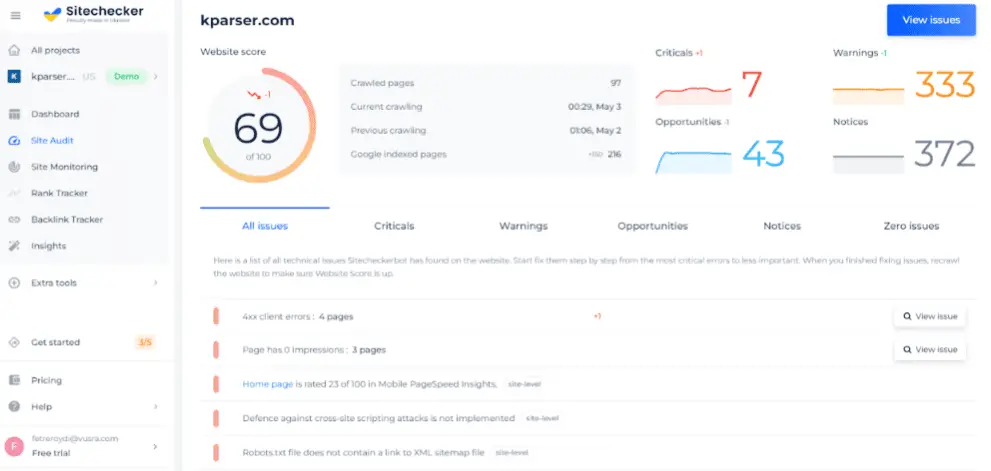
Crawl results are a presentation of the site score, the number of pages crawled (including data on the number of indexed pages).

The report contains data about detected problems, as well as hidden files. The tool divides all errors into three categories: critical, warnings, minor notifications. Additionally, you can view all files in the catalog.

Share this article:

Facebook Post LinkedIn Telegram

No related posts.

Search

Translation

CVE WATCHTOWER
🚨

Receive alerts for vulnerabilities being exploited in the wild.

⚑

Get notified instantly when a Proof of Concept (PoC) exploit is published.

πŸ”

Access critical info on vulnerabilities even when marked as "RESERVED".

🧠

Insights powered by decades of expertise and global intelligence sources.

🎯

Customize alerts with up to 10 keywords for your specific tech stack.

πŸ“Š

Export the raw CVE database for SIEM integration and reporting.

Upgrade Package

πŸ”΄ Live Critical Threats

  • CVE-2026-42684CVSS 9.3
    Improper Neutralization of Special Elements used in an SQL Command ('SQL Injection')...
  • CVE-2025-53209CVSS 9.8
    Incorrect Privilege Assignment vulnerability in Themeisle Masteriyo LMS PRO allows Privilege Escalation....
  • CVE-2026-8206CVSS 9.8
    The Kirki – Freeform Page Builder, Website Builder & Customizer plugin for...
  • CVE-2026-25879CVSS 9.8
    Langroid is a framework for building large-language-model-powered applications. Prior to version 0.63.0,...
  • CVE-2026-40965CVSS 10.0
    Cloud Foundry UAA versions v76.12.0 through v78.12.0 are vulnerable to a private...
  • CVE-2018-25427CVSS 9.8
    Arm Whois 3.11 contains a stack-based buffer overflow vulnerability that allows remote...
  • CVE-2026-9319CVSS 9.0
    IBM WebSphere Application Server 9.0, and 8.5 is vulnerable to potential remote...
  • CVE-2026-9311CVSS 9.0
    IBM WebSphere Application Server 9.0, and 8.5 is vulnerable to remote code...
  • CVE-2026-8644CVSS 9.1
    IBM WebSphere Application Server 9.0, and 8.5 is vulnerable to identity spoofing.
  • CVE-2026-45132CVSS 10.0
    CloudPirates Open Source Helm Charts is a collection of Helm charts. Prior...
Powered by CVE WATCHTOWER

Recent Zero-Day Vulnerabilities

  • Android Zero-Day Flaw Exploited in the Wild: June 2026 Patches Released
  • Exploited in the Wild: Critical OWA Spoofing Flaw (CVE-2026-42897) Hits On-Premises Exchange Servers
  • Exploited in the Wild: Maximum CVSS 10 SD-WAN Flaw (CVE-2026-20182) Grants Admin Control
  • Exploited in the Wild: Critical 9.8 CVSS RCE Hits Canon GUARDIANWALL MailSuite
  • Exploit Code Released: Public PoC Dumps for Windows BitLocker Bypass and SYSTEM Elevation Zero-Days
  • Exploited in the Wild: “Dirty Frag” Linux Vulnerability Grants Instant Root Access
Our Websites
  • Penetration Testing Tools
  • The Daily Information Technology
  • Daily CyberSecurity

    • About SecurityOnline.info
    • Advertise with us
    • Announcement
    • Contact
    • Contributor Register
    • Login
    • About SecurityOnline.info
    • Advertise on SecurityOnline.info
    • Contact Us

    When you purchase through links on our site, we may earn an affiliate commission. Here’s how it works

    • Disclaimer
    • Privacy Policy
    • DMCA NOTICE
    • Linkedin
    • Twitter
    • Facebook
    • Youtube
    Copyright Daily CyberSecurity Β© All rights reserved.