 Do Son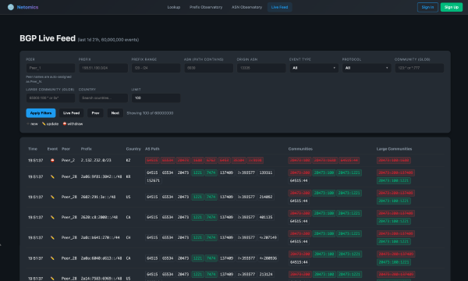
Most routing investigations still depend on someone else’s servers. When an engineer needs to know who originates a prefix, whether an announcement is RPKI valid, or who holds a block of address space, they reach for public lookup services and external validators. Those tools are useful, but leaning on them for operational and security work carries costs that are easy to overlook until they bite. A growing number of network teams are responding by bringing that intelligence back onto infrastructure they control.
This piece looks at why that shift is happening and what a self-hosted routing intelligence setup actually provides.
The hidden cost of external routing lookups
Public routing tools were built for occasional, interactive use. Problems appear when you depend on them for continuous operations or security monitoring.
- Rate limits. External services throttle automated queries. The moment you try to script bulk lookups or wire them into monitoring, you hit ceilings that were never meant for machine use.
- Data exposure. Every query tells a third party which prefixes and ASNs you are investigating. During an active incident, that is operational information you may not want leaving your network.
- Availability coupling. If your routing investigation depends on an outside service, an outage or degradation there becomes an outage in your ability to respond, often at the worst possible moment.
- No single public tool answers a full question. You end up correlating a looking glass, an RPKI validator, an IRR query and a WHOIS lookup by hand.
None of these matter much for a one-off check. All of them matter when routing intelligence is part of how you run and defend a network every day.
What routing security actually requires
The stakes here are not abstract. BGP still largely runs on trust, and that trust has been abused in ways that cause real damage. A more specific announcement for YouTube’s address space in 2008 propagated globally and took the service offline for around two hours. Years later, attackers manipulated routing to hijack DNS for a cryptocurrency service and steal user funds.
The defensive tooling has matured. RPKI, defined in RFC 6480, lets address holders cryptographically authorize which AS may originate their prefixes, and adoption has crossed a majority of IPv4 routes. But rejecting Invalid routes at your border is only half the job. The other half is detection and investigation, which is exactly where scattered external tools slow you down. To judge whether an announcement is a genuine incident, you need origin, validation status, ownership and history correlated together, fast.
What self-hosted routing intelligence gives you
This is the problem FastNetMon set out to solve with Netomics. It is a BGP routing intelligence platform that runs entirely inside the operator’s own infrastructure and unifies the data that investigations normally require.
Rather than querying separate services, it ingests live BGP Monitoring Protocol feeds directly from routers and combines them with routing history, ASN and prefix ownership, RIR and WHOIS records, IRR data, geofeed information, RPKI validation and ASPA status. The result is a single queryable system where every prefix arrives with its ownership and validity already attached.
Because it is deployed on-premises, the costs listed earlier largely disappear. There are no external rate limits, no routing data leaving the network, and no dependence on a third party’s uptime. For automation and security workflows, the platform exposes REST APIs, bulk lookup interfaces, Prometheus metrics and Model Context Protocol support, so both scripts and AI assistants can query live routing data within a controlled environment.
FastNetMon founder Pavel Odintsov framed the goal directly: “Internet routing has become critical operational infrastructure, yet many organisations still depend on multiple external services to understand what is happening in their own networks. We built Netomics to give operators complete ownership of their routing intelligence while making it easier to troubleshoot incidents, automate workflows and improve routing security.” The platform was introduced in the Netomics launch post.
What an investigation looks like without it
Picture a typical routing alert. Your monitoring flags that traffic to one of your prefixes is taking an unexpected path. The clock starts. First you open a a public routing lookup service or looking glass to see who is originating the prefix. Then you switch to an RPKI validator to check whether that origin is authorized. The validator says invalid, so now you need to know who the address space actually belongs to, which means a WHOIS lookup and maybe an IRR query. Somewhere in there you also want to know whether this AS has ever legitimately originated the prefix before, which means checking a historical route collector.
Five tools, five interfaces, and a set of answers you are holding in your head or pasting into a scratch document. Each individual step takes seconds. The correlation between them is where the minutes go, and the more services you depend on, the more of those minutes are spent waiting on something you do not control.
Now picture the same alert against a single system that already holds all of that data, joined. The prefix arrives with its origin, its validation status, its owner and its history attached. The engineer reads one screen and makes a decision. That is the entire difference, and during an incident it is the difference that counts.
Who this is for
Not every network needs its own routing intelligence layer. Some do not. If you run a handful of prefixes and rarely touch BGP, public tools are perfectly fine and there is no reason to change. The calculation shifts for ISPs, cloud providers, internet exchange points and large enterprises, where routing is core infrastructure that operations and security teams query all day long, and where an outside dependency sitting in the middle of that workflow becomes a liability rather than a convenience. For them, owning the capability outright is the more defensible choice.
The broader pattern is familiar. Capabilities that start as convenient external services tend to move in-house once they become load-bearing. Routing intelligence has reached that point for a lot of operators, and the tooling to run it yourself has caught up.
The trigger is usually a single bad incident. One slow response, traced back to a service someone else controlled, and owning the capability stops being a theoretical preference. It becomes a requirement. The good news is that the choice no longer means building everything from scratch.