Google Drops Antigravity 2.0 to Orchestrate Teams of Autonomous Coding Agents
 Do Son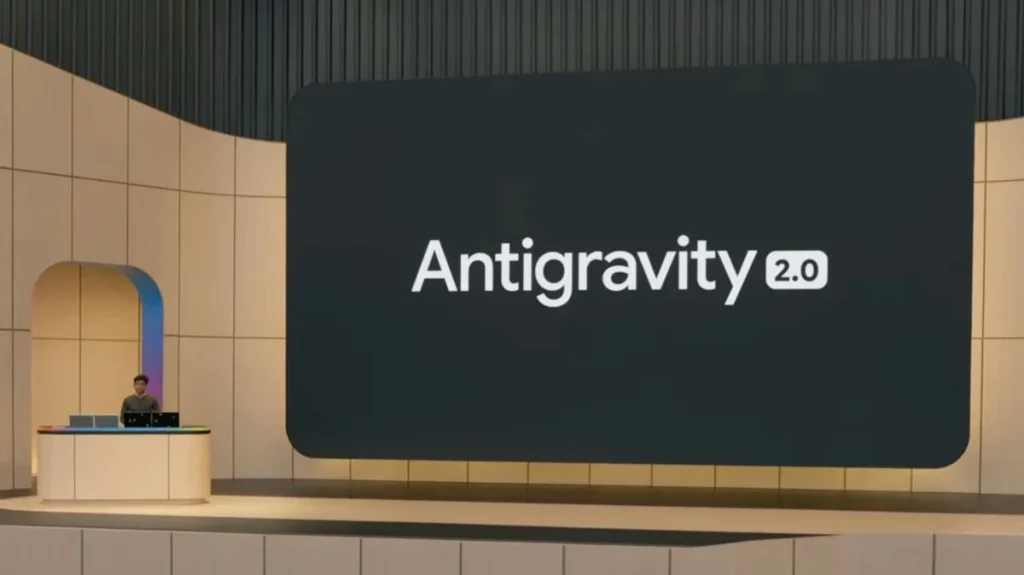
At the Google I/O 2026 developer symposium, the technology exposition that elicited the most profound excitement among software engineers was undoubtedly the monumental unveiling of Antigravity 2.0. Merely six months after its concept debut, the AI development ecosystem has undergone a comprehensive metamorphosis—transcending its legacy identity as a standard source-code editor to evolve into an unabashedly agent-centric, Autonomous AI Agent Development and Management Platform. Weaponized with a novel native desktop application, a streamlined command-line interface, and an expansive SDK, and tightly coupled with the concurrent release of the Gemini 3.5 Flash model, the framework empowers practitioners to assume the mantle of an architectural project director—orchestrating networks of concurrent AI agents to partition complex tasks laterally, achieving milestones as radical as engineering a functional, bare-metal operating system capable of running the iconic video game Doom from absolute zero within a twelve-hour envelope.
Antigravity 2.0 systematically breaks free from the paradigm of traditional text-editing workspaces, re-architecting its visual layout entirely around ambient agent dialogue, live artifact rendering, and multi-agent dispatch logistics. To accommodate divergent engineering habits, the platform exposes three distinct interfaces:
- The Standalone Desktop Application: Migrating Antigravity out of pure text-editor environments, this module serves as a universal command sanctuary where any orchestrator can direct agentic workflows. An engineer can concurrently instruct one agentic proxy to compile frontend assets, task a second with synthesizing brand aesthetics, and mandate a third to blueprint systemic backend topologies.
- The High-Throughput CLI (Command Line Interface): Engineered specifically for terminal purists who operate predominantly within keyboard-driven matrices, this lightweight interface facilitates the instantaneous invocation and execution of autonomous AI agents devoid of graphical overhead.
- The Deeply Optimized SDK: Provisioning programmatic infrastructure access, this library permits software architects to directly invoke the identical agent orchestration framework Google deploys internally to power its flagship products.
Capturing the zenith of industry focus was the early research preview of Sub-agent Teamwork. This structural innovation permits multiple constituent sub-agents to operate in parallel to dissect heterogeneous micro-tasks, elegantly consolidating the resulting code segments downstream to form a comprehensive, end-to-end automated software engineering pipeline.
To demonstrate the extreme operational boundaries of Antigravity 2.0 when paired with Gemini 3.5 Flash, Google’s keynote presentation featured a visually arresting live-fire case study: the autonomous synthesis of a functional operating system engineered from zero by a network of AI proxies.
This monumental engineering initiative spanned just over twelve hours, with the distributed sub-agents transmitting more than 15,000 model requests and digesting an immense telemetry footprint of 2.6 billion tokens. From the baseline execution scheduler and low-level memory management subroutines down to the native file system, every discrete line of source code was autonomously written, forensically audited, and unit-tested by the AI collective, all while drawing down a aggregate API resource cost of less than $1,000.
During the dynamic live demonstration, this algorithmic operating system successfully initialized and executed the resource-intensive architecture of the classic game Doom. Upon realizing that the baseline build lacked corresponding display and keyboard input drivers, the agent network reacted dynamically to a high-level prompt from the presenter, autonomously authoring, compiling, and integrating the missing driver software mid-session to restore full control.
The foundational driver behind this staggering execution throughput is the customized optimization of the underlying Gemini 3.5 Flash architecture, co-developed alongside the platform:
- Hyper-Accelerated Inference Engines: While the generic distribution of Gemini 3.5 Flash already boasts a token generation velocity four times faster than peer frontier architectures, the specialized iteration operating natively inside the Antigravity ecosystem accelerates this baseline to a blistering 12x factor, completely neutralizing the latency regressions that historically plagued long-horizon, multi-agent workflows.
- The Enterprise Capitalization Executioner: Google estimates that if premier global enterprises migrate 80% of their daily computational workloads—approximating one trillion tokens—away from competing frontier architectures and into the Gemini 3.5 Flash ecosystem, the structural shift will yield a staggering institutional savings exceeding $1 billion annually.
As the absolute volume of programmatically synthesized source code escalates at an exponential velocity, automated code audit integrity has manifested as a critical industry concern. In a synchronized maneuver, Google unveiled Code Bender, a specialized security orchestration utility driven by Gemini’s advanced semantic reasoning capabilities.
Diverging sharply from legacy static application security testing (SAST) utilities that merely isolate or flag vulnerabilities, Code Bender’s definitive market differentiator is its capacity to programmatically author and commit precise, functional remediation patches directly to the codebase.
This technology shares a direct lineage with the pioneering CodeMender research distributed by Google DeepMind last year. Google has confirmed that these advanced methodologies will be natively absorbed into the Gemini Enterprise Agent Platform, leveraging highly specialized cybersecurity agents to automatically diagnose, track, and remediate high-severity software vulnerabilities silently within continuous integration pipelines.
The structural trajectory traced by the debut of Antigravity 2.0 indicates that Google is no longer content to merely distribute localized autocompletion extensions or conversational programming utilities like GitHub Copilot, Cursor, or Claude Code. Instead, the technology colossus is aggressively erecting an unassailable infrastructure: a fully automated, industrial-scale software development factory.
Support Our Threat Intelligence
Find our tech and OS security coverage helpful? Support our work today and unlock a 100% ad-free reading experience!
 Buy Me a Coffee
