
 Do Son
The PoC exploit targets CVE-2022-42864, a vulnerability that could allow a remote attacker to execute arbitrary code on the system
Do Son
Do Son is the Founder and Editor of Daily CyberSecurity. Working in cybersecurity since 2013, he reports on vulnerabilities, malware, and emerging threats, providing timely analysis to help organizations and individuals stay ahead of evolving risks.

Tracked as CVE-2023-22727 (Github CVSS score of 9.8), CakePHP is vulnerable to SQL injection, caused by un-sanitized user request data

CVE-2023-24059 allows attackers to achieve partial remote code execution or modify files on a PC, as exploited in the wild in January 2023.

The most pressing issue is the incomplete configuration of Network-to-Network firewall security services such as WEB, DNS,...
There are 3 types of SSL certificates: domain-validated (DV), extended-validation (EV) and organization-validated (OV). DV SSL certificates...

RubyGems ActiveRecord is vulnerable to SQL injection. Tracked as CVE-2023-22794, the flaw related to the sanitization of comments.
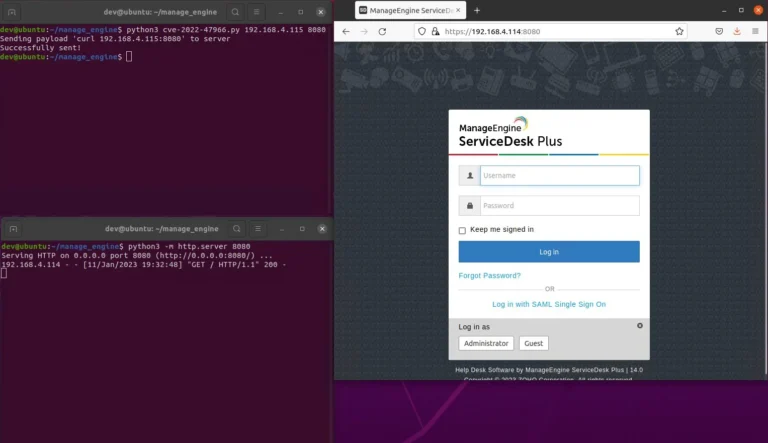
James Horseman released IOCs associated with the flaw before and today PoC exploit code is now available for CVE-2022-47966

CVE-2023-22809 was discovered by researchers Matthieu Barjole and Victor Cutillas of Synacktiv in the sudoedit function for Linux

a local authenticated malicious user may potentially exploit CVE-2022-34393 by using an SMI to gain arbitrary code execution in SMRAM

Tracked as CVE-2022-41903 (CVSS 9.9/10 severity), the security flaw can be exploited by sending specially-crafted input.

CVE-2022-46891 impacts the GPU memory processing operations and could be exploited to bypass security restrictions

The patch provides cover for three documented security vulnerabilities: CVE-2006-20001, CVE-2022-36760, and CVE-2022-37436.
The concept of containerization has its roots in the 1970s with the creation of chroot on Unix...

Starting an online business is an exciting and rewarding endeavor but can also be filled with pitfalls....

A critical-severity SQL injection vulnerability in the SQL Alchemy connector of Superset (CVE-2022-41703) was said to affect version 1.5.2

The most severe of these issues is CVE-2021-26316, an arbitrary code execution vulnerability in AMD EPYC and Ryzen processors

By executing a specially-crafted program, an authenticated attacker could exploit CVE-2023-0179 to gain elevated privileges as root.

Tracked as CVE-2023-22602, Apache Shiro could allow a remote attacker to bypass security restrictions, caused by a flaw when Shiro and Spring Boot

Blockchain technology can be used for many things, including tracking ownership of digital currencies and securing information

The blue light emitted from digital screens can wreak havoc on our circadian rhythm and cause eye...

Blasty shared a Github page hosting PoC for the vulnerability in Lexmark Printer that allows attacker to take control of the affected device

an attacker could exploit CVE-2023-20018 (CVSS score of 8.6) to access certain restricted parts of the web interface.