 Do Son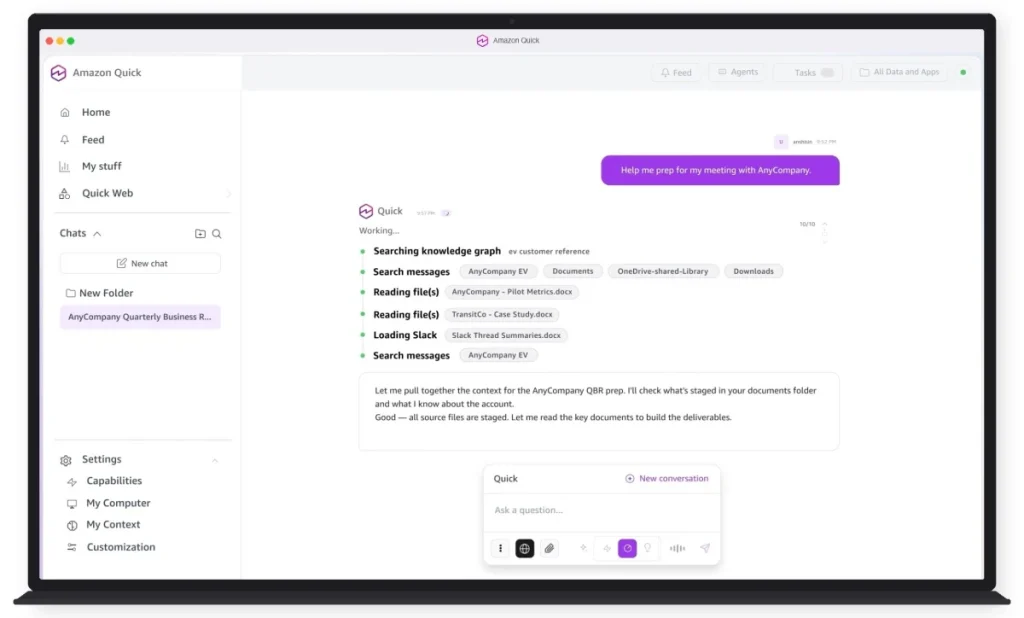
As generative artificial intelligence descends from the nebulous clouds to the tangible desktop, AWS has finally unveiled its heavyweight contender in the enterprise productivity arena: the all-new desktop AI assistant, Amazon Quick. Diverging from the insular ecosystems of its contemporaries—such as Microsoft or Google—Amazon Quick champions a “borderless” philosophy. It not only possesses the faculty to access local files directly but also orchestrates a seamless symphony across third-party giants like Slack, Teams, and Salesforce. More disruptive still is its endowment of “long-term memory” and “proactive anticipation,” a strategic pivot intended to transmute AI from a reactive interlocutor into an omnipotent secretary that actively propels workflows forward.
While the market is currently saturated with AI tools confined within their respective “Walled Gardens”—where Microsoft’s Copilot reigns over Office and Google’s Gemini masters Workspace—Amazon Quick adopts a “neutral and comprehensive” trajectory. Operating as a standalone desktop application, this assistant synchronizes with local documents, calendars, and missives while maintaining deep integration with the most ubiquitous SaaS platforms, including Outlook, Gmail, ServiceNow, Asana, Jira, and the recently incorporated Google Workspace and Zoom.
This architectural openness empowers users to issue extraordinarily complex, cross-platform directives. One might command: “Exfiltrate the latest metrics from the internal browser system, analyze them using a local Python script, and encapsulate the results in a nascent document.” Amazon Quick executes these multi-stage maneuvers across disparate applications under a singular mandate, eliminating the friction of window-switching or manual file uploads.
A pivotal brilliance of Amazon Quick resides in its capacity for continuous erudition through “long-term memory.” By perpetually indexing documents and distilling insights from every interaction, it constructs a bespoke “Personal Knowledge Graph.” In a sales context, should a representative request a draft for a client follow-up, the assistant can autonomously recall Slack deliberations from the previous week, retrieve successful historical precedents, and preemptively include relevant stakeholders in the correspondence.
Furthermore, Amazon Quick shatters the traditional, passive “query-and-response” paradigm. Operating discreetly in the background, it proactively anticipates user exigencies. Prior to a scheduled symposium, it might present pertinent Slack threads, the most recent slide decks, and an executive summary. Should it detect scheduling conflicts or an impending deadline, it intervenes with a timely alert or initiates preliminary task handling.
To further amplify industrial output, AWS has fortified Amazon Quick with formidable content generation and extension capabilities:
- Natural Language Application and Dashboard Synthesis (Preview): Users may describe a functional requirement in plain prose, and Amazon Quick will aggregate real-time data to forge interactive, intelligent dashboards or applications within seconds—rendering coding expertise obsolete.
- Instant Presentation and Visual Asset Creation: With robust internal generative engines, users can command the creation of meticulously formatted PowerPoint decks, infographics, and imagery directly within the chat interface, all while strictly adhering to corporate brand guidelines.
- Seamless Microsoft 365 Entrenchment: Although it thrives as a standalone entity, AWS has released extensions that embed Amazon Quick directly within Outlook, Word, Excel, and PowerPoint, providing proximal assistance precisely where work is conducted.
Support Our Threat Intelligence
Find our tech and OS security coverage helpful? Support our work today and unlock a 100% ad-free reading experience!
 Buy Me a Coffee
