ChatGPT Launches “Study Mode”: AI Assistant Shifts from Giving Answers to Guiding Learning
 Do Son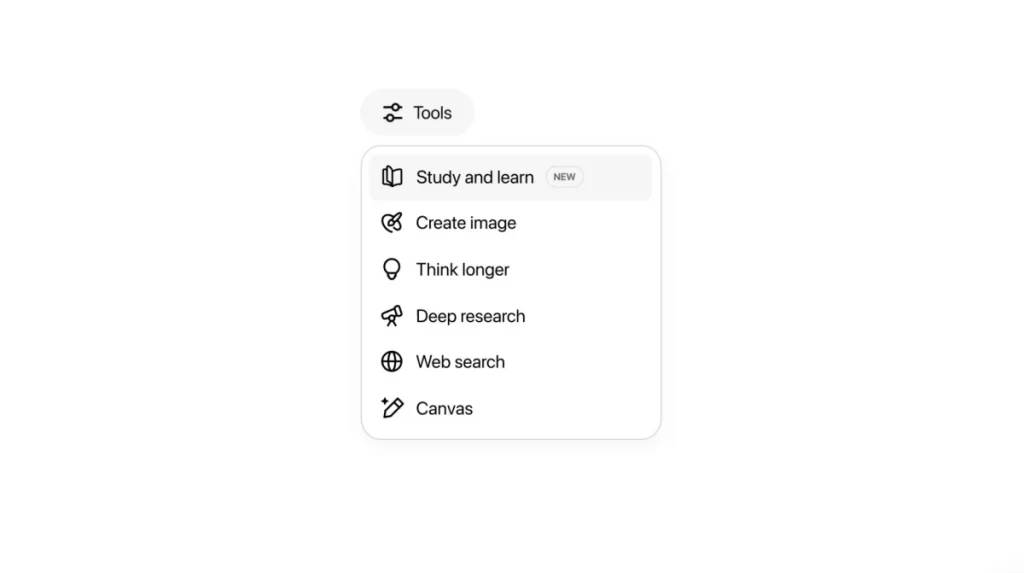
As AI tools increasingly permeate various academic disciplines—at times even being misused for completing assignments or facilitating exam cheating, and drawing criticism for their potential to erode critical thinking skills—OpenAI has announced the launch of a new feature called “Study Mode.” This initiative aims to foster deeper learning by guiding students through the reasoning behind academic problems, rather than simply supplying answers.
This feature is now being gradually rolled out to users of the Free, Plus, Pro, and Team plans, with availability for ChatGPT Edu subscribers expected in the coming weeks.
Much like the “Learning Mode” introduced by Anthropic in Claude this April, OpenAI’s Study Mode is not designed to dispense correct answers outright. Instead, it adopts a Socratic method, gently leading users through a step-by-step exploration of the problem’s underlying principles and prompting them to uncover solutions independently.
Upon activation, ChatGPT begins by asking a few targeted questions to assess the learner’s existing knowledge and educational goals. It then engages the student in a dialogue structured around scaffolded learning—a pedagogical approach that gradually reveals information based on the learner’s capacity, thereby reducing cognitive overload and enhancing comprehension.
OpenAI emphasizes that the central aim of this design is to empower students to “discover the answers on their own,” thereby reinforcing their understanding and promoting long-term retention, rather than relegating ChatGPT to the role of a mere answer-generating tool.
Unlike previous iterations of large language model-powered features, Study Mode is not built on a separate model. Instead, it leverages system instructions to adjust ChatGPT’s behavior. This allows for rapid adaptation based on real-time user interactions and feedback, enabling iterative improvements in conversational strategy and user experience.
OpenAI explains: “Study mode is powered by custom system instructions. We chose this approach because it lets us quickly learn from real student feedback and improve the experience—even if it results in some inconsistent behavior and mistakes across conversations. We plan on training this behavior directly into our main models once we’ve learned what works best through iteration and student feedback.”
Currently, OpenAI is collaborating with educators, scientists, and learning specialists to better understand users’ academic needs across subjects and proficiency levels. Future updates may include tailored guidance for domains such as mathematics, language learning, and natural sciences.
A recent feature in New York Magazine noted that AI tools have become a major catalyst for academic dishonesty at universities across the United States, prompting many faculty members and institutions to respond with heightened vigilance—some even contemplating blanket bans on tools like ChatGPT.
In this light, OpenAI’s rollout of Study Mode appears to be a direct response to criticisms of AI as a cheating enabler, attempting instead to reframe generative AI as a learning companion. Looking ahead, OpenAI also plans to incorporate more personalized features into Study Mode, such as adaptive dialogue strategies, goal-setting based on individual progress, and performance tracking.
Importantly, Study Mode is optional—users can switch back to the traditional ChatGPT interaction style at any time. This ensures user autonomy, though the success of the guided learning approach will ultimately depend on the student’s mindset and motivation.
More than just a countermeasure against academic misconduct, the release of Study Mode signals OpenAI’s strategic expansion into the educational sector. As ChatGPT Edu continues to grow, deeper integrations with online learning platforms, Learning Management Systems (LMS), and course materials are on the horizon—enabling ChatGPT to function as a real-time, interactive learning assistant.
For educators, the arrival of Study Mode could also herald a shift in how student learning outcomes are assessed. If AI can help clarify concepts and strengthen critical thinking, teachers may soon reconsider their instructional priorities and the nature of academic evaluation itself.
Related Posts:
- NSA to set up Artificial Intelligence Security Center
- AI’s Dark Side: Hackers Harnessing ChatGPT and LLMs for Malicious Attacks
Support Our Threat Intelligence
Find our tech and OS security coverage helpful? Support our work today and unlock a 100% ad-free reading experience!
 Buy Me a Coffee
