 Do Son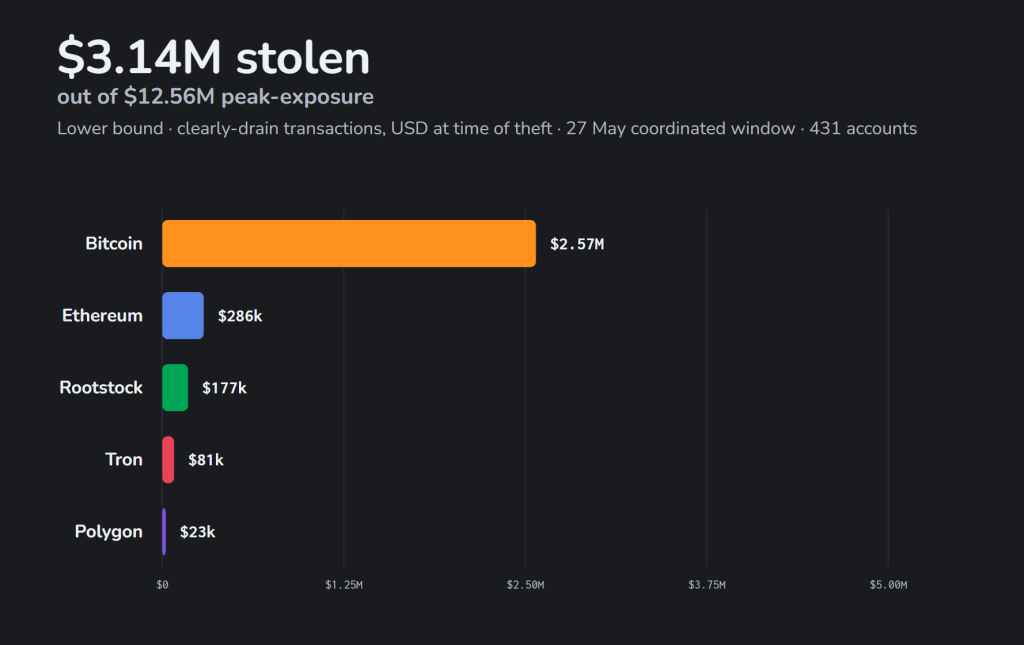
TL;DR
A weak random number generator inside CryptoJS produced predictable wallet seed phrases for over a decade. Attackers confirmed exploitation on-chain as early as May 27, 2026. Users who generated wallets with affected software across 14 blockchains should treat those funds as at risk and migrate immediately.
CISA KEV isn't the only exploit signal. Pro/Team adds a second confirmed-exploit feed.
Try free for 14 daysWhy this matters
Wallets are only as secure as the randomness used to create them. CryptoJS, a widely used JavaScript cryptography library, shipped a broken pseudo-random number generator (PRNG) for years. Some downstream wallet apps kept pulling from old, unmaintained versions of the library long after the flaw was fixed.
The result is simple: those wallets generated seed phrases with far less cryptographic strength than users expected. An attacker who knows the weak PRNG can reproduce likely seed phrases, derive wallet addresses, check balances on-chain, and drain funds – without ever breaking encryption or phishing anyone.
Coinspect, the firm that led this investigation, named the research Ill Bloom – a reference to the first recovery phrase the broken PRNG produces, which begins with the words “illness blossom.”
How the attack works
The root cause is a flawed randomness function in CryptoJS. When a wallet app calls this function to generate entropy for a new seed phrase, it does not produce true randomness. The output space is far smaller than it should be.
An attacker can run the same flawed function across its entire predictable output space. From those outputs, they derive the corresponding blockchain addresses. Then they scan public blockchain data to find which addresses hold funds.
Because a single seed phrase controls addresses across many networks, one vulnerable wallet can expose funds on Bitcoin, Ethereum, Tron, Solana, BNB Chain, Polygon, and nine more chains simultaneously. No phishing or social engineering is needed. The math does the work.
No public proof-of-concept exploit code has been published by Coinspect. However, exploitation in the wild has been confirmed, with the first on-chain evidence dating to May 27, 2026.
Affected software and versions
The CryptoJS randomness flaw existed for approximately twelve years. Maintainers fixed it six years before this disclosure, and the library has been unmaintained since 2023. The problem is that some wallet-related npm packages continued to depend on the old, unfixed code rather than the corrected version.
Coinspect confirmed that several wallet applications used the vulnerable generation path. Some have released fixes. Others are discontinued with no remediation available. The firm notes that hardware wallet users are not affected, and most current mainstream software wallets are also not vulnerable. The highest-risk group is users who generated seed phrases in less widely used mobile software wallets.
Coinspect documents the full attribution process and supporting evidence in the Ill Bloom investigation write-up, including the methodology used to link vulnerable addresses to specific wallet applications.
What you should do now
First, check whether your wallet address appears in the Ill Bloom address sets using the public checker at the Ill Bloom research site. A match means funds controlled by the same seed phrase are at risk across every chain that seed covers.
A negative result does not guarantee safety. The address sets are not exhaustive and continue to expand as research progresses.
Steps to protect your funds
If your address matches – or if you are unsure – take these steps now. Create a completely new wallet using a trusted application. You will see a new set of 12 to 24 words you have never seen before. Write them down securely.
Next, transfer all funds from the old addresses to the new wallet. Do not import your existing seed phrase into another app – that restores the old vulnerable wallet, not a new safe one. Consider a hardware wallet for long-term storage.
Projects that may still depend on old CryptoJS packages should audit their dependency trees. Any wallet generation code that calls a CryptoJS randomness function should be replaced with a cryptographically secure source of entropy from the host platform.
Support Our Threat Intelligence
Find our vulnerability reports and weekly recaps helpful? Support our work today and unlock a 100% ad-free reading experience!
 Buy Me a Coffee
