• About WordPress
    • WordPress.org
    • Documentation
    • Learn WordPress
    • Support
    • Feedback
Skip to content
May 26, 2026
  • Linkedin
  • Twitter
  • Facebook
  • Youtube

Daily CyberSecurity

Zero-hour alerts. Unmatched analysis.

Primary Menu
  • Home
  • CVE Watchtower
  • Cyber Criminals
  • Data Leak
  • Linux
  • Malware
  • Vulnerability
  • Submit Press Release
  • Vulnerability Report
Light/Dark Button
  • Home
  • News
  • Malware
  • DeadBolt ransomware is threatening QNAP users
  • Malware

DeadBolt ransomware is threatening QNAP users

Ddos January 30, 2022 3 minutes read
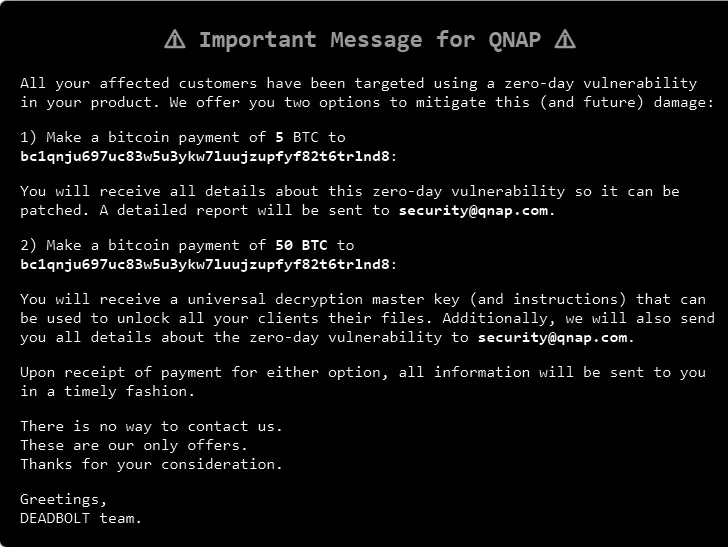
DeadBolt ransomware

NAS maker QNAP continues to issue security alerts, and QNAP says ransomware called DeadBolt is looking for NAS servers exposed on the public internet. Earlier this month, QNAP issued an alert saying it had detected a large number of attacks of unknown origin, which sought to exploit vulnerabilities and weak passwords in devices exposed on the public Internet.

QNAP did not mention whether the ransomware in the warning was related to the attack at the beginning of the month, but judging from the content of the two warnings, it should be the same batch of attacks.

“DeadBolt has been widely targeting all NAS exposed to the Internet without any protection and encrypting users’ data for Bitcoin ransom,” the company said. “QNAP urges all QNAP NAS users to […] immediately update QTS to the latest available version.”

DeadBolt ransomware

QNAP said in the announcement that the ransomware called DeadBolt ransomware is looking for exposed NAS on the network, and then looking for potential vulnerabilities to try to launch an attack. The company said that the ransomware is not complicated and mainly relies on the vulnerabilities of the old QTS system, so it is very important for users to update the QTS system in a timely manner. It is worth noting that in the two warnings, QNAP strongly advised users not to expose their devices to the public Internet.  However, for users, not being exposed to the public network means that they cannot connect to the public network, and it is very difficult and inconvenient to access the server content when going out. QNAP even suggested that users turn off the UPnP function of the router.
The following are safety recommendations:

Use the built-in security advisory function of the QNAP device to scan the potential risks of the device, including detecting whether the device is exposed to the public network and specific open ports. If the scanning shows that the system management service can be accessed from an external address then the device is at high risk and the user should follow the security advisor guidelines to disable public network access. Including disabling external address access, disabling exposed ports, turning off port forwarding or UPnP on the router, and DMZ to ensure that the internal network cannot be accessed from the outside. Of course, the result of this is that users will not be able to access QNAP devices through the external network. If you really need external network access, you can try other methods to strengthen security. Including but not limited to using multi-factor authentication, using high-strength passwords, non-repeating passwords, or using encrypted tunnels to connect to the intranet before using the intranet to access.

Rate this post

Support Our Threat Intelligence

If you find our CVE report and cybersecurity news helpful, consider supporting our work.

Buy Me a Coffee Logo Buy Me a Coffee PayPal
Crypto QR Code
USDT (TRC20):
TN8BdV8cp4T1Cd28gK9qTAnZknzzuwyUtm
USDT (ERC20):
0x3725e1a7d3bc5765499fa6aaafe307fabcd75bce

Share this article:

Facebook Post LinkedIn Telegram

Related posts:

  1. Russian Telegrab Malware Gather Telegram Credentials, Cookies, Desktop Cache, and Critical Files
  2. SolarMarker Impersonates Indeed to Spread Malware
  3. North Korean Hackers Launch Job Interview Scam to Deploy BeaverTail and InvisibleFerret Malware
  4. Predator Spyware Roars Back: New Infrastructure, Evasive Tactics
  5. Head Mare and Twelve: Inside the Collaboration Targeting Russian Companies

Search

Translation

CVE WATCHTOWER
🚨

Receive alerts for vulnerabilities being exploited in the wild.

⚑

Get notified instantly when a Proof of Concept (PoC) exploit is published.

πŸ”

Access critical info on vulnerabilities even when marked as "RESERVED".

🧠

Insights powered by decades of expertise and global intelligence sources.

🎯

Customize alerts with up to 10 keywords for your specific tech stack.

πŸ“Š

Export the raw CVE database for SIEM integration and reporting.

Upgrade Package

πŸ”΄ Live Critical Threats

  • CVE-2026-7374CVSS 9.9
    A flaw was found in KubeVirt's virt-handler component. This vulnerability allows an...
  • CVE-2026-45247CVSS 9.8
    Mirasvit Full Page Cache Warmer for Magento 2 before version 1.11.12 contains...
  • CVE-2026-9543CVSS 9.8
    A vulnerability has been found in Totolink N300RH 6.1c.1353_B20190305. Affected is the...
  • CVE-2026-42773CVSS 9.3
    Improper Neutralization of Special Elements used in an SQL Command ('SQL Injection')...
  • CVE-2026-42774CVSS 9.3
    Improper Neutralization of Special Elements used in an SQL Command ('SQL Injection')...
  • CVE-2026-9478CVSS 9.8
    A weakness has been identified in Totolink A8000RU 7.1cu.643_b20200521. Impacted is the...
  • CVE-2026-9477CVSS 9.8
    A security flaw has been discovered in Totolink A8000RU 7.1cu.643_b20200521. This issue...
  • CVE-2026-9476CVSS 9.8
    A vulnerability was identified in Totolink A8000RU 7.1cu.643_b20200521. This vulnerability affects the...
  • CVE-2026-9475CVSS 9.8
    A vulnerability was determined in Totolink A8000RU 7.1cu.643_b20200521. This affects the function...
  • CVE-2026-9458CVSS 9.8
    A vulnerability was identified in Totolink A8000RU 7.1cu.643_b20200521. The impacted element is...
Powered by CVE WATCHTOWER

Recent Zero-Day Vulnerabilities

  • Exploited in the Wild: Critical OWA Spoofing Flaw (CVE-2026-42897) Hits On-Premises Exchange Servers
  • Exploited in the Wild: Maximum CVSS 10 SD-WAN Flaw (CVE-2026-20182) Grants Admin Control
  • Exploited in the Wild: Critical 9.8 CVSS RCE Hits Canon GUARDIANWALL MailSuite
  • Exploit Code Released: Public PoC Dumps for Windows BitLocker Bypass and SYSTEM Elevation Zero-Days
  • Exploited in the Wild: “Dirty Frag” Linux Vulnerability Grants Instant Root Access
  • Under Active Attack: Ivanti EPMM Zero-Day Exploited in the Wild via Harvested Admin Credentials
Our Websites
  • Penetration Testing Tools
  • The Daily Information Technology
  • Daily CyberSecurity

    • About SecurityOnline.info
    • Advertise with us
    • Announcement
    • Contact
    • Contributor Register
    • Login
    • About SecurityOnline.info
    • Advertise on SecurityOnline.info
    • Contact Us

    When you purchase through links on our site, we may earn an affiliate commission. Here’s how it works

    • Disclaimer
    • Privacy Policy
    • DMCA NOTICE
    • Linkedin
    • Twitter
    • Facebook
    • Youtube
    Copyright Daily CyberSecurity Β© All rights reserved.