 Do Son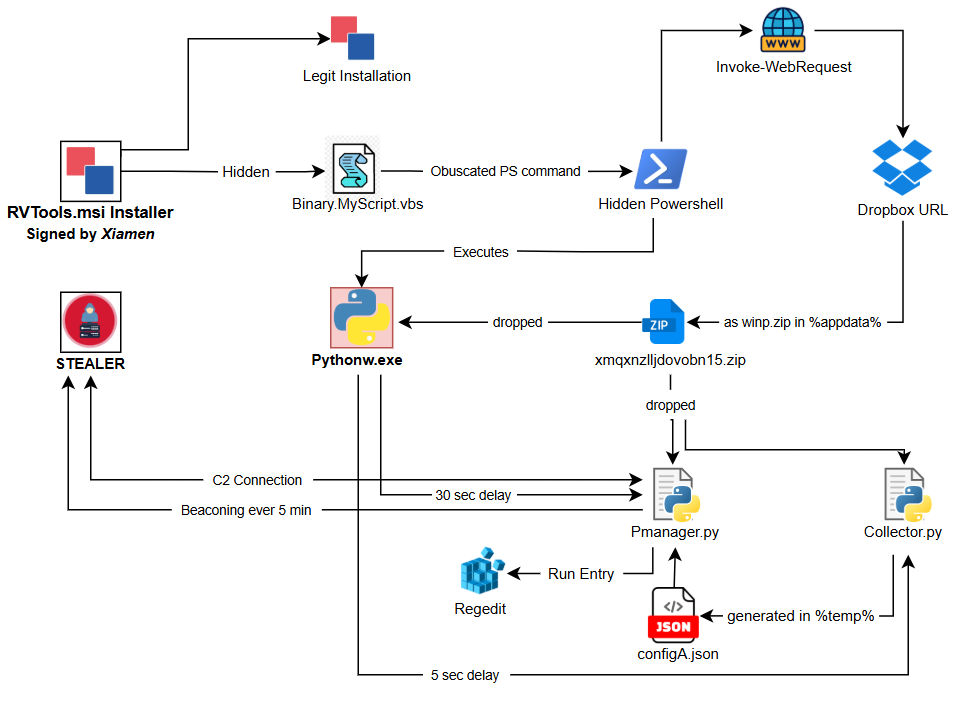
Execution Flow of RAT | Image: K7 Security Labs
Cybersecurity researchers recently discovered a sophisticated corporate espionage campaign targeting virtualization administrators. Specifically, threat actors are distributing a malicious payload disguised as a fake RVTools installer to compromise enterprise infrastructure. This dangerous operation successfully slips past standard endpoint security parameters by exploiting a valid digital signature. Consequently, IT teams must implement advanced telemetry monitoring to prevent total network takeover.
Abusing Digital Trust Components
To bypass security screening filters, the adversary signed the malicious package with a valid enterprise credential. Specifically, the campaign utilized a legitimately issued Sectigo code-signing certificate. “What made this campaign particularly effective was the use of a legitimately issued Sectigo code-signing certificate, registered under what appears to be a shell entity”. Consequently, Windows SmartScreen trusted the binary completely during the initial execution phase. However, unprotected systems remain highly vulnerable without real-time validation checks.
The Multi-Stage Infection Routine
The attack executes a strictly timed sequence to establish a permanent foothold within the target network. To begin with, the malicious fake RVTools installer package triggers an internal visual basic script via a custom action utility. This specific script uses complex decimal obfuscation to mask its underlying malicious code from static scanners. As a result, standard security filters fail to flag the installer before execution.
Spawning the Hidden Downloader
Subsequently, the initial script launches a hidden PowerShell script to connect with external servers. This stealth process retrieves a heavily compressed archive file from a standard Dropbox account URL. Once downloaded, the routine unzips the massive operational core directly into the user application data directory. Interestingly, this package bundles an entire portable development ecosystem to run its custom components autonomously.
Thorough System Reconnaissance
After staging the payload, a dedicated module named collector.py begins a deep exploration of the host machine. Furthermore, this module operates silently by utilizing hidden window startup configurations to evade user detection. The agent gathers critical metrics including active processes, running network utilities, and user privileges. Therefore, the actors gain complete situational awareness of the compromised node.
Mapping Active Directory Infrastructure
Additionally, the malware aggressively evaluates the scale of the domain target. It determines local permission levels and targets domain controller setups. For instance, the script executes a specialized query to count every workstation registered in the network directory. K7 Security Labs notes in its analysis, “The function ievoqbsct…250 is fully capable of enumerating the total number of computer objects within a domain environment”. Finally, it writes this extensive data into a hidden localized intelligence ledger.
Command and Control Architecture
In the final phase, a separate component named Pmanager.py initializes persistent communications. This robust script acts as the main gateway for the modular Python RAT to receive manual operator commands. To secure the outbound traffic channel, the utility utilizes a hardcoded symmetric stream cipher engine. Specifically, the malware applies a random salt alongside zlib compression to transform the stolen files into random binary noise.
Network Resilience Protocols
Consequently, network defenders face immense difficulty when monitoring these encrypted streams. The agent regularly transmits heartbeat packets to the threat actors every five minutes. Furthermore, it maintains a structured backup list consisting of five unique command addresses to ensure operational stability. If a primary connection server drops, the malware automatically rotates through its hardcoded infrastructure array to preserve access.
Defending the Virtual Perimeter
Enterprise administrators must look beyond simple signature verification tools to stop this fake RVTools installer threat. Because the adversary wraps malicious scripts inside legitimate software, behavioral threat hunting becomes absolutely vital. Therefore, monitoring unauthorized registry run entries and unexpected PowerShell downloads can block the attack sequence early. Ultimately, strict internal execution policies will keep your virtual environment completely secure.
Support Our Threat Intelligence
Find our threat intelligence and malware analysis helpful? Support our work today and unlock a 100% ad-free reading experience!
 Buy Me a Coffee
