Skip to content
October 17, 2026
  • Bluesky
  • Facebook
  • Linkedin
  • Mastodon
  • RSS
  • Twitter
  • Youtube

Daily CyberSecurity

Zero-hour alerts. Unmatched analysis.

Primary Menu
  • Home
  • CVE Data
    • CVE Watchtower
    • Top Exploited CVEs
    • CVE Stats by Vendor
    • Q2 2026 Report
    • CVE Alerts
    • CVE Alert Settings
    • Pricing
  • Cyber Criminals
  • Data Leak
  • Free Tools
    • CVSS 3.1 Calculator
    • Certificate Viewer
    • DNS Lookup
    • Encoder & Hash Generator
    • IP / Subnet Calculator
    • Whois Lookup
  • Linux
  • Malware
  • Vulnerability
  • Submit Press Release
  • Weekly Recap
Light/Dark Button
  • Home
  • News
  • Android
  • Google Enables TLS by Default on Android P
  • Android

Google Enables TLS by Default on Android P

Do Son April 16, 2018 2 minutes read
Android P navigation bar
Add Daily CyberSecurity as a preferred source on Google

Google said [1, 2] on Thursday that in order to ensure the security of user data and devices, applications targeting the next generation of Android systems (Android P) will require the use of encrypted connections by default, which means that Android P will prohibit applications from using all unencrypted connections. Therefore, Android devices running the Android P system, whether receiving or sending traffic, cannot be transmitted in the clear in the future. The transport layer security (Transport Layer Security) security protocol is required, while Android Nougat and Oreo are not affected.

Some people think that all applications on Android P need to use TLS encryption will reduce the Internet experience, in fact, this is a misunderstanding, as for the App for a few old server connections if you have to use clear text transmission, developers need to change the network security configuration of the App To allow this type of connection.

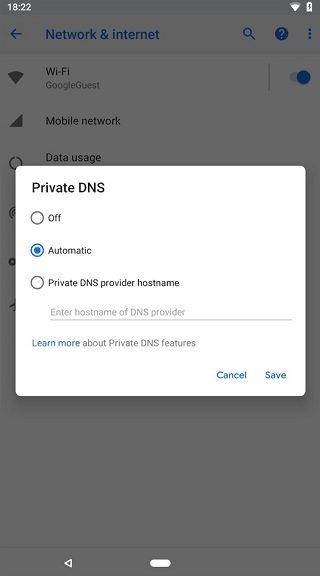
DNS over TLS in Android P

Android P Developer Preview has built-in support for DNS over TLS and adds the Private DNS mode for network settings.

By default, the device automatically uses DNS over TLS if the network’s DNS server supports it, but if users do not want to use DNS over TLS, they can choose to turn it off.

Google also expressed the hope that future operating systems will include secure transmissions in order to provide better privacy protection for all users.

Related coverage

  • Android Zero-Day Flaw Exploited in the Wild: June 2026 Patches Released
  • Android AI Scam Defense Blocks 10 Billion Monthly Threats; Users 58% More Likely to Avoid Scam Texts Than iOS
  • Google pushes Android P Developer Preview 3
  • Google Play Upgrades: Find Widget Apps Easier, New Search & Icons
  • The “Headless” Revolution: How Google’s AAOS SDV is Rewiring the Brain of the Modern Car
  • Android App Bundles and Dynamic Delivery will customize application packages for different versions of Android
Track all actively exploited CVEs →

Support Our Threat Intelligence

Find our tech and OS security coverage helpful? Support our work today and unlock a 100% ad-free reading experience!

Buy Me a Coffee Logo Buy Me a Coffee
Select your plan
Free Pro Team

Hover over a plan to see its benefits.

Get Zero-Hour Vulnerability Alerts

Critical CVEs, CVSS scores, and PoC updates — straight to your inbox every week.

We respect your inbox. Unsubscribe anytime.

SHARE
Share on FacebookShare on XShare on LinkedInShare on TelegramShare on BlueskyShare on Mastodon
Written by
@DdoS · Security Researcher

Do Son

Do Son is the Founder and Editor of SecurityOnline.info. Working in cybersecurity since 2013, he reports on vulnerabilities, malware, and emerging threats, providing timely analysis to help organizations and individuals stay ahead of evolving risks.

Tags: Android P

Search

Translation

CVE ALERTS
📈

EPSS Spike Alerts
Catch risk spikes before they make headlines.

🎯

Custom EPSS/CVSS
Set score thresholds to effectively filter noise.

🛡️

Exploit Intel
Real-world exploit signals beyond the KEV catalog.

🐙

GitHub Issues
Auto-create alert tickets without duplication.

📬

Weekly Digest
Clean summaries, eliminating email spam.

🏷️

Watchlist Groups
Tag vulnerabilities by team (Infra/AppSec/SOC).

🔀

Smart Routing
Route chat channels based on severity levels.

🚨

RBP Tracker
Early warning detection and tracking system.

Subscribe – $7/mo or try free for 14 days →

🚨 Active Exploits in the Wild

  • CVE-2020-13125CVSS 7.2
    An issue was discovered in the "Ultimate Addons for Elementor" plugin before 1.24.2 for WordPress, as exploited in...
    Watchtower Verified📅 Updated: Oct 17, 2026
  • CVE-2020-13126CVSS 9.9
    An issue was discovered in the Elementor Pro plugin before 2.9.4 for WordPress, as exploited in the wild...
    Watchtower Verified📅 Updated: Oct 17, 2026
  • CVE-2019-20180CVSS 8.0
    The TablePress plugin for WordPress is vulnerable to CSV Injection in versions up to and including 1.14 via...
    Watchtower Verified📅 Updated: Oct 17, 2026
  • CVE-2026-111862CVSS 9.8
    Rank Math SEO PRO for WordPress is affected by a supply-chain compromise in a subset of version 3.0.123...
    Admin intel📅 Updated: Oct 17, 2026
  • CVE-2026-111357CVSS 7.0
    Ivanti Connect Secure 22.8R2.4 mishandles the manner in which the dsinvoked broker trusts DSCache configuration data, leading to...
    Watchtower Verified📅 Updated: Oct 17, 2026
  • CVE-2025-61624CVSS 6.0
    An Improper Limitation of a Pathname to a Restricted Directory (\'Path Traversal\') [CWE-22] vulnerability in Fortinet FortiOS 7.6.0...
    CISA KEV📅 Added to KEV: Oct 16, 2026
  • CVE-2026-102764CVSS 9.3
    The vulnerability exists within internal components of BeyondTrust’s Remote Support product. The components did not adequately validate the...
    CISA KEV📅 Added to KEV: Oct 16, 2026
  • CVE-2026-106931CVSS 8.5
    SiteGuard Server Edition contains an OS command injection vulnerability, which may allow an attacker to execute arbitrary OS...
    Admin intel📅 Updated: Oct 15, 2026
Powered by CVE Watchtower

Critical Vulnerabilities

  • CVE-2026-111862CVSS 9.8
    Rank Math SEO PRO for WordPress is affected by a supply-chain compromise in a subset of version 3.0.123...
    Admin intel📅 Updated: Oct 17, 2026
  • CVE-2026-104736CVSS 9.8
    The LearnPress plugin for WordPress is vulnerable to PHP Object Injection in versions up to, and including, 4.4.10...
    📅 Updated: Oct 17, 2026
  • CVE-2026-101950CVSS 9.3
    A Heap-based Buffer Overflow vulnerability in the SVR component of Juniper Networks Junos OS on SRX Series allows...
    📅 Updated: Oct 17, 2026
  • CVE-2026-110653CVSS 9.1
    The Appointment Booking Plugin – LatePoint | Calendar & Scheduling for WordPress plugin for WordPress is vulnerable to...
    📅 Updated: Oct 17, 2026
  • CVE-2026-97381CVSS 9.9
    Legacy Update is a tool for activating and installing updates on legacy Windows PCs. Legacy Update 1.12.0 through...
    📅 Updated: Oct 17, 2026
  • CVE-2026-93895CVSS 9.1
    IBM WebSphere Application Server - Liberty 20.0.0.12 through 26.0.0.10 could allow an unauthenticated remote attacker to bypass access...
    📅 Updated: Oct 17, 2026
  • CVE-2026-111823CVSS 9.8
    Mage OSS through 0.9.80 before 76c4f46 can proceed with session creation upon encountering an unknown OAuth provider.
    📅 Updated: Oct 17, 2026
  • CVE-2026-106629CVSS 9.3
    Adobe Experience Manager is affected by a stored Cross-Site Scripting (XSS) vulnerability that could be abused by an...
    📅 Updated: Oct 17, 2026
Powered by CVE Watchtower

Daily CyberSecurity

  • About SecurityOnline.info
  • Advertise with us
  • Announcement
  • Contact
  • Contributor Register
  • Login
  • Disclaimer
  • DCMA
  • Privacy Policy
  • About SecurityOnline.info
  • Advertise on SecurityOnline.info
  • Contact Us

When you purchase through links on our site, we may earn an affiliate commission. Here’s how it works

  • CVE Watchtower
  • CVE Statistics by Vendor 2026
  • Q3 2026 Report
  • Top Exploited CVEs
  • Bluesky
  • Facebook
  • Linkedin
  • Mastodon
  • RSS
  • Twitter
  • Youtube
© 2017 - 2026 Daily CyberSecurity. All Rights Reserved.