 Do Son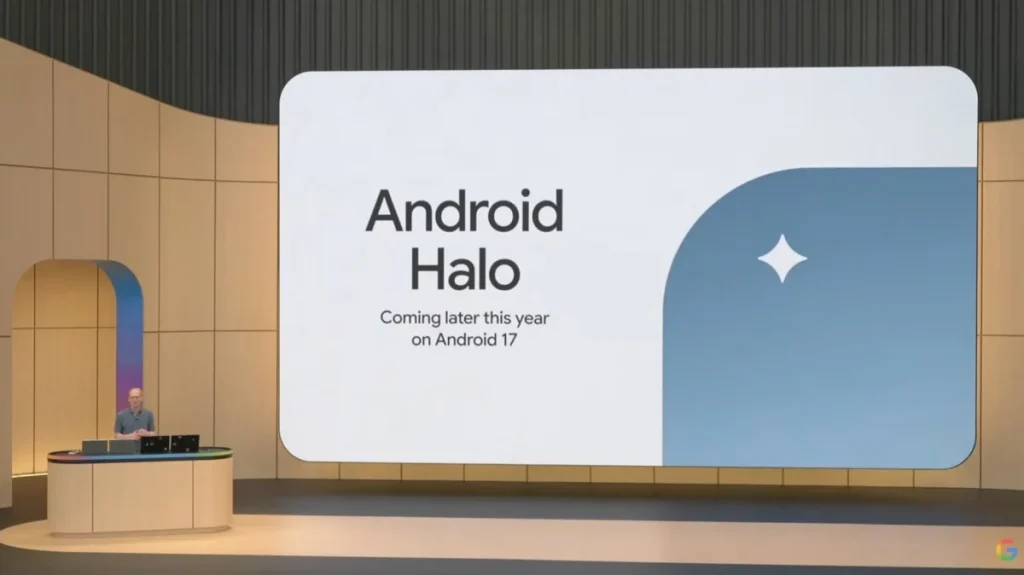
As artificial intelligence entities transition from passive conversational engines into autonomous, background-executing agents, a critical question emerges: how can a user monitor their invisible workflows? To address this orchestration challenge, Google has provided an exclusive preview of “Android Halo,” a revolutionary user-interface paradigm engineered specifically for the Android operating system.
This avant-garde interface architecture operates fluidly beneath the user’s active attention layer, projecting nuanced visual indicators along the upper perimeter of the smartphone display to render the real-time operational status of background agents—such as Gemini Spark—discernible at a transient glance.
Historically, invoking a legacy voice assistant mandated a destructive full-screen or bottom-sheet overlay, forcefully interrupting active user workflows. Conversely, the design philosophy anchoring Android Halo prioritizes absolute continuity and non-intrusive surveillance:
- Persistent Ambient Telemetry: Based on Google’s technical expositions, Android Halo manifests as an elegant, understated visual aura tracking along the upper boundaries of the viewport, materializing as a low-overhead indicator of agentic execution states.
- Contextual Polymorphism: Whether an autonomous proxy has newly ingested a high-level delegation, transitioned into a synchronous Live Mode, or concluded a protracted background workflow to transmit an analytical brief, Android Halo renders instantaneous state feedback. Consequently, users can actively engage in multimedia consumption or social graph navigation while maintaining peripheral awareness of their delegated digital labor.
As a foundational infrastructure piece designed to bridge current architectures with upcoming spatial and agentic applications, Android Halo possesses vast architectural compatibility and horizontal scaling potential:
- Imminent Release Horizon: Google confirmed that the Android Halo interface layer is slated for a formal upstream merge into the Android operating system later this year.
- Universal Agentic Framework Interoperability: This specialized display canopy is engineered not merely to interface flawlessly with Google’s newly introduced 24/7 personal proxy, Gemini Spark, but is architected to seamlessly accommodate compliant third-party artificial intelligence frameworks.
- Premium Hardware Exclusivity: Crucially, Google indicated that on premium flagship Android devices harboring dedicated, high-throughput Gemini Intelligence silicon, Android Halo will unlock augmented, high-fidelity feature expansions. The enterprise deferred granular technical hardware prerequisites and deep-tier operational methodologies to a subsequent documentation release scheduled for late 2026.
Support Our Threat Intelligence
Find our tech and OS security coverage helpful? Support our work today and unlock a 100% ad-free reading experience!
 Buy Me a Coffee
