 Do Son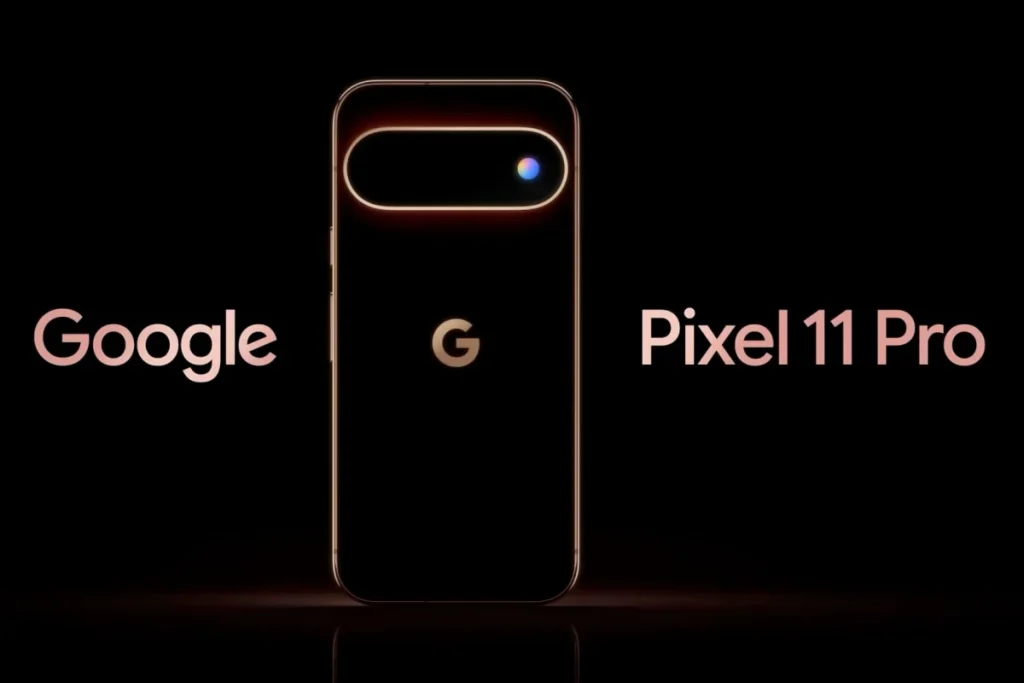
Google has officially distributed invitations for its annual hardware launch event, confirming the debut of the next-generation flagship Pixel 11 series on August 12. Prior to the event, Google preemptively released a captivating teaser video, officially unveiling the back cover design of the Pixel 11 Pro. However, the most striking element of the video is not the familiar iconic camera bar. Instead, it is a completely new, “mysterious circular indicator light” positioned adjacent to the lenses, continuously rotating with a vibrant spectrum of colors.
“The Next Obvious Move”: Decoding the Spinning Light
In this brief official teaser video for the Pixel 11 Pro, the background narration recounts how users rely on their phones for accessing Gmail, Google Maps, Search, Calendar, and Gemini AI services daily. Subsequently, the camera focuses closely on the Pixel 11 Pro’s triple-lens module. Nestled beside the camera sensors is an additional annular indicator area, emitting a swirling, multi-colored glow.
The video provocatively titles this element “the next obvious move” without providing explicit answers, instantly igniting intense speculation:
- Hypothesis 1: Gemini On-Device Processing Status Indicator. This colorful, spinning visual vocabulary immediately evokes the iconic “spinning beach ball” on macOS or the signature colors of Gemini during cross-modal inference. Analysts speculate this could provide physical light feedback when Gemini executes background computations, voice recognition, or screen-aware reasoning on-device.
- Hypothesis 2: Glyph-Style Interactive Lighting. Another theory suggests Google might be drawing inspiration from the Nothing Phone’s Glyph lighting concept. This circular light could offer customized color notifications tailored to specific contacts, alert types, or the priority level assigned by the AI.
- Hypothesis 3: Mixed Reality (MR) and Spatial Awareness Tally Light. Given Google’s recent intensive focus on mixed reality and spatial computing, this light might function as a safety indicator. It could illuminate to warn bystanders when the phone engages in 3D spatial recording, environmental scanning, or synchronizes with smart glasses (such as the forthcoming Google-Samsung collaboration).
Pixel 11 Pro Specifications: Tensor G6 Meets Rising Costs
Beyond this enigmatic glowing ring, the broader hardware profile of the Pixel 11 Pro has become relatively clear, corroborating current supply chain intelligence:
- Display Specifications: It will reportedly feature a 6.3-inch LTPO OLED screen. Peak brightness is expected to leap significantly to 3,600 nits, drastically improving legibility under harsh outdoor sunlight.
- Core Computing: The device will be powered by the all-new Tensor G6 chip, manufactured using TSMC’s advanced semiconductor process. This shift is anticipated to resolve historical power consumption and thermal management issues while substantially bolstering local NPU processing capabilities.
- Chassis Colors: According to leaked retail inventories, the device will debut in three novel colorways: Pink-beige, Forest green, and Gray-lavender.
However, the global AI industry’s current ravenous appetite for DRAM memory, high-end storage chips, and advanced semiconductor manufacturing capacity has triggered a surge in supply chain costs. Consequently, market analysts project that retail prices for the Pixel 11 series, alongside the simultaneously launching Pixel Watch 5, will likely increase compared to their predecessors.
Materializing AI Computations: From Design Symbol to Interactive Interface
Google’s decision to integrate this colored light onto the camera module is demonstrably not just a visual gimmick. Historically, the horizontal camera bar primarily functioned as a stabilizing kickstand and a powerful brand identifier. Yet, as “On-device AI” and “Agentic AI” increasingly become the very core of the modern smartphone experience, devices will silently execute massive sensory and automation tasks in the background, often without the user actively illuminating the main screen.
Therefore, a new human-computer interaction challenge arises: How can the device communicate “what the AI is currently doing” or signal the “completion of an important agentic task” to the user and potentially bystanders without turning on the display?
If this “spinning colored ring” succeeds in materializing Gemini’s inference state, message categorization, or mixed reality recording status into physical light, it will represent another fascinating experiment by Google in hardware interaction design.
Support Our Threat Intelligence
Find our tech and OS security coverage helpful? Support our work today and unlock a 100% ad-free reading experience!
 Buy Me a Coffee
