Skip to content
November 19, 2026
  • Bluesky
  • Facebook
  • Linkedin
  • Mastodon
  • RSS
  • Twitter
  • Youtube

Daily CyberSecurity

Zero-hour alerts. Unmatched analysis.

Primary Menu
  • Home
  • ADVISORIES
    • Microsoft
    • Fortinet
    • Ivanti
    • Cisco
    • Linux
    • Citrix
  • CVE Data
    • CVE Watchtower
    • Top Exploited CVEs
    • CVE Stats by Vendor
    • Q3 2026 Report
    • CVE Alerts
    • CVE Alert Settings
    • Pricing
  • Cyber Criminals
  • Data Leak
  • Free Tools
    • CVSS 3.1 Calculator
    • Certificate Viewer
    • DNS Lookup
    • Encoder & Hash Generator
    • IP / Subnet Calculator
    • Whois Lookup
  • Malware
  • Vulnerability News
  • Submit Press Release
Light/Dark Button
  • Home
  • News
  • Data Leak
  • Google responds to third-party app developers’ ability to access user Gmail
  • Data Leak

Google responds to third-party app developers’ ability to access user Gmail

Do Son July 4, 2018 3 minutes read
third-party mail

Google released a new blog post on Tuesday to respond to a previous report in The Wall Street Journal, which details the typical situation in which third-party application developers can read and analyze the content of users’ Gmail messages.

While there is no substantial new insight into industry practices, Google does outline the use of G Suite to protect the privacy and security of users and business organisations. The company also reiterated its commitment to review third-party applications and services that have access to sensitive Gmail data.

third-party mail

Google’s blog post was written by Suzanne Frey, head of the company’s Google Cloud security, trust and privacy department.

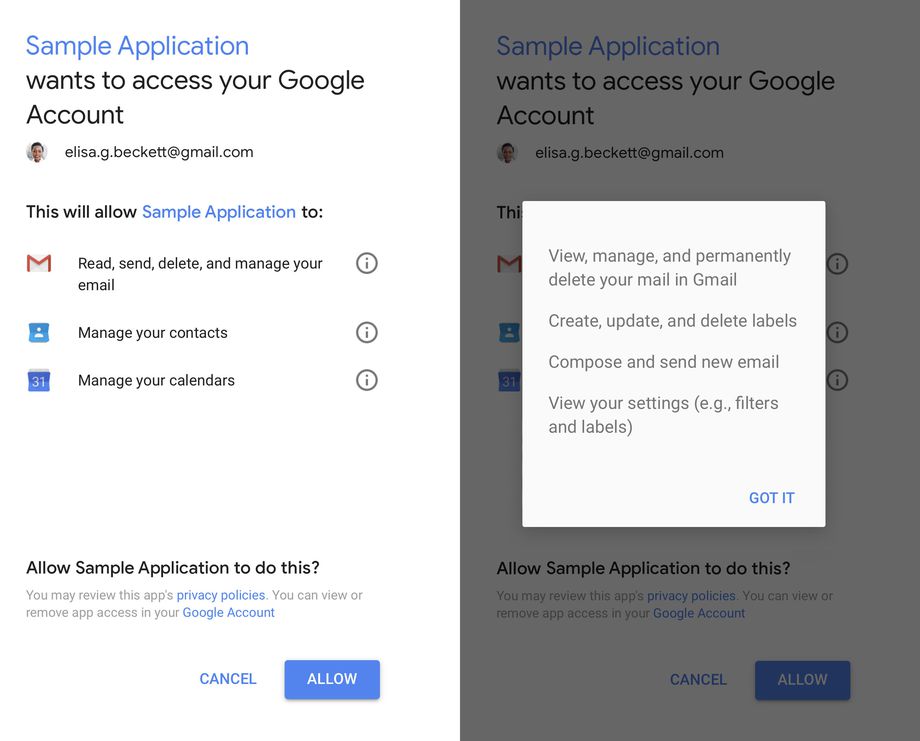
“A vibrant ecosystem of non-Google apps gives you choice and helps you get the most out of your email. However, before a published, non-Google app can access your Gmail messages, it goes through a multi-step review process that includes automated and manual review of the developer, assessment of the app’s privacy policy and homepage to ensure it is a legitimate app, and in-app testing to ensure the app works as it says it does.“

Frey provides some tips to ensure that users’ data is in the hands of reliable sources. This includes viewing the permissions screen before accessing non-Google apps and using the company’s security checker to check which devices logged into the user’s account, which third-party apps can access the user’s Gmail, and what permissions those apps have. She also said that Google’s review process is designed to ensure that companies and individuals only request data related to the features they provide.

Last year, Google announced that it would stop scanning Gmail user mail content for advertising purposes as part of its strategy to make its G Suite products more attractive to corporate customers. Before the Cambridge analysis scandal, Google believed that targeting ads based on people’s private conversations were not a particularly smart business strategy, especially when some users didn’t have a good grasp of how Gmail monetized. Frey reiterated this in her blog post on Tuesday, and she cautiously pointed out that “Gmail’s primary business model is to sell our paid email service to organizations as a part of G Suite.”

Frey writes: “The practice of automatic processing has caused some to speculate mistakenly that Google ‘reads’ your emails. To be absolutely clear: no one at Google reads your Gmail, except in very specific cases where you ask us to and give consent, or where we need to for security purposes, such as investigating a bug or abuse.”

Source: theverge

Add Daily CyberSecurity as a preferred source on Google

Related coverage

  • U.S. and Britain investigate Facebook data breach, Zuckerberg was summoned
  • Okta’s Security Breach Puts Businesses on Alert
  • Research finds that thousands of Android apps violate child privacy
  • Google Pays $10,633 for YouTube Security Vulnerabilities
  • Taiwan Warns Public: Popular Chinese Apps (TikTok, WeChat, Rednote) Pose National Security Risk Via Data Transfer to China
  • Data Breach at Ofuji Fishing: 200,000 Customers’ Information Compromised
Track all actively exploited CVEs →

Support Our Threat Intelligence

Find our threat intelligence and malware analysis helpful? Support our work today and unlock a 100% ad-free reading experience!

Buy Me a Coffee Logo Buy Me a Coffee
Select your plan
Free Pro Team

Hover over a plan to see its benefits.

Get Zero-Hour Vulnerability Alerts

Critical CVEs, CVSS scores, and PoC updates — straight to your inbox every week.

We respect your inbox. Unsubscribe anytime.

SHARE
Share on FacebookShare on XShare on LinkedInShare on TelegramShare on BlueskyShare on Mastodon
Written by
@DdoS · Security Researcher

Do Son

Do Son is the Founder and Editor of Daily CyberSecurity. Working in cybersecurity since 2013, he reports on vulnerabilities, malware, and emerging threats, providing timely analysis to help organizations and individuals stay ahead of evolving risks.

Tags: gmail

🚨 Active Exploits in the Wild

  • CVE-2026-114938CVSS 8.1
    Vulnerability in the Oracle Java SE, Oracle GraalVM for JDK, Oracle GraalVM Enterprise Edition product of Oracle Java...
    Admin intel📅 Updated: Nov 19, 2026
  • CVE-2010-20126CVSS 5.1
    Virtual Keyboard plugin for SquirrelMail through 0.9.1 contains a reflected cross-site scripting vulnerability that allows unauthenticated attackers to...
    Watchtower Verified📅 Updated: Nov 18, 2026
  • CVE-2012-20007CVSS 9.3
    ThinkPHP 2.0 through 2.2 and 3.0 Lite mode contains an eval injection vulnerability in the Dispatcher PATH_INFO parsing,...
    Watchtower Verified📅 Updated: Nov 18, 2026
  • CVE-2012-20008CVSS 8.7
    openSIS 5.1 before 9.0 contains a local file inclusion vulnerability that allows authenticated users to include arbitrary files...
    Watchtower Verified📅 Updated: Nov 18, 2026
  • CVE-2026-119618CVSS 8.1
    Concurrent Execution using Shared Resource with Improper Synchronization vulnerability in Apache HTTP Server's mod_http2 in assign_headers() can lead...
    Admin intel📅 Updated: Nov 18, 2026
  • CVE-2024-10441CVSS 9.8
    Improper encoding or escaping of output vulnerability in the system plugin daemon in Synology BeeStation OS (BSM) before...
    CISA KEV📅 Added to KEV: Nov 18, 2026
  • CVE-2026-40217CVSS 8.8
    LiteLLM through 2026-04-08 allows remote attackers to execute arbitrary code via bytecode rewriting at the /guardrails/test_custom_code URI.
    CISA KEV📅 Added to KEV: Nov 18, 2026
  • CVE-2026-90817CVSS 9.8
    An unauthenticated Remote Code Execution vulnerability was found in the survey passthrough routing and Data Import processing logic,...
    CISA KEV📅 Added to KEV: Nov 18, 2026
Powered by CVE Watchtower

Search

CVE ALERTS
📈

EPSS Spike Alerts
Catch risk spikes before they make headlines.

🎯

Custom EPSS/CVSS
Set score thresholds to effectively filter noise.

🛡️

Exploit Intel
Real-world exploit signals beyond the KEV catalog.

🐙

GitHub Issues
Auto-create alert tickets without duplication.

📬

Weekly Digest
Clean summaries, eliminating email spam.

🏷️

Watchlist Groups
Tag vulnerabilities by team (Infra/AppSec/SOC).

🔀

Smart Routing
Route chat channels based on severity levels.

🚨

RBP Tracker
Early warning detection and tracking system.

Get free CVE alerts Pro from $7/mo

Critical Vulnerabilities

  • CVE-2026-120382CVSS 9.8
    An improper neutralization of argument delimiters in a command vulnerability in the OAuth API in Synology DiskStation Manager...
    📅 Updated: Nov 19, 2026
  • CVE-2026-129048CVSS 9.9
    Improper Control of Generation of Code ('Code Injection') vulnerability in Jacob N. Breetvelt WP Photo Album Plus wp-photo-album-plus...
    📅 Updated: Nov 19, 2026
  • CVE-2026-117666CVSS 9.1
    Improper Validation of Certificate with Host Mismatch vulnerability in deadtrickster ssl_verify_fun allows an adversary in the middle to...
    📅 Updated: Nov 19, 2026
  • CVE-2026-119446CVSS 9.4
    Session Fixation vulnerability in the CLI login flow in nerves-hub nerves_hub_web allows an unauthenticated attacker to obtain an...
    📅 Updated: Nov 19, 2026
  • CVE-2026-18948CVSS 9.9
    A flaw was found in Feast. The system improperly deserializes user-defined functions (UDFs) stored in its registry, which...
    📅 Updated: Nov 19, 2026
  • CVE-2026-117656CVSS 9.3
    Acceptance of Extraneous Untrusted Data With Trusted Data vulnerability in the Sign in with Apple strategy in pow-auth...
    📅 Updated: Nov 19, 2026
  • CVE-2026-110461CVSS 9.3
    The Comelit 1456B Multi-User Gateway, in firmware versions up to and including 2.10.0, is configured with static default...
    📅 Updated: Nov 19, 2026
  • CVE-2026-123007CVSS 9.2
    This issue affects NGINX Plus or NGINX Open Source configurations that use HTTP/2. When NGINX processes undisclosed traffic,...
    📅 Updated: Nov 19, 2026
Powered by CVE Watchtower

Daily CyberSecurity

  • About Daily CyberSecurity
  • Advertise with us
  • Announcement
  • Contact
  • Contributor Register
  • Login
  • Disclaimer
  • DMCA
  • Privacy Policy

When you purchase through links on our site, we may earn an affiliate commission. Here’s how it works

  • CVE Watchtower
  • CVE Statistics by Vendor 2026
  • Q3 2026 Report
  • Top Exploited CVEs
  • Bluesky
  • Facebook
  • Linkedin
  • Mastodon
  • RSS
  • Twitter
  • Youtube
© 2017 - 2026 Daily CyberSecurity. All Rights Reserved.