 Do Son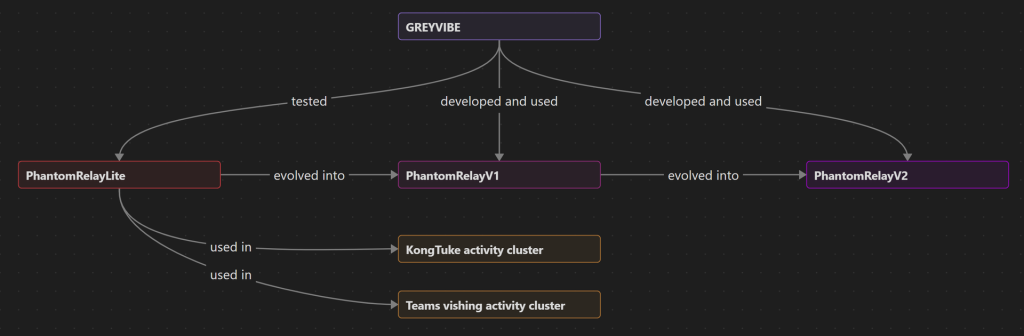
Perceived relationship between PhantomRelay variants and associated activity clusters | Image: WithSecure
WithSecure recently exposed an active cyber espionage operation targeting Eastern Europe. Specifically, the GREYVIBE threat actor group actively targets Ukrainian entities since August 2025. These malicious operations leverage a complex mix of social engineering and custom-coded implants. Furthermore, the threat actors demonstrate a unique blend of state-aligned intelligence goals and cybercriminal behaviors. Security teams must analyze these evolving activities to protect critical networks.
Deconstructing the Multi-Vector Attack Framework
The adversaries utilize diverse distribution mechanisms to achieve initial network entry. Specifically, researchers grouped the group’s malicious activity into distinct concurrent campaigns. Each campaign deploys realistic social engineering lures to trick unsuspecting targets. Moreover, the operators consistently combine their decoys with covert installation scripts. According to the technical report, “the group has consistently used appropriate lures for deception and implemented a decoy-and-payload execution logic”. Consequently, victims remain completely unaware of the background exploitation process.
PhantomMail and Spear-Phishing Infiltrations
The email operations present immediate operational challenges for enterprise defenders. Initially, the threat actors initiated at least six unique email-based campaigns. These malicious messages deliver dangerous compression archives hosted on popular public storage services. Furthermore, the files contain automated script loaders that deploy localized documents. These lures frequently impersonate legitimate organizations like the Kyiv City Council. Thus, the threat group establishes a baseline of high trust with targets.
PhantomClick and CAPTCHA Exploitation
Alternatively, the actors deploy deceptive verification interfaces to automate infections. During October 2025, the team briefly weaponized fake security verification pages. These malicious domains effectively masqueraded as popular teleconferencing platforms like Zoom. Subsequently, the interface instructs landing users to execute localized commands. These commands quietly spawn the primary backdoor client while redirecting users to safe destinations. Therefore, this interactive trap forces victims to compromise their own endpoints.
Deceptive Social Ecosystems and Web Operations
The PrincessClub Android Campaigns
A highly persistent segment of this activity relies heavily on romantic social engineering lures. Specifically, the PrincessClub campaign hosts fraudulent adult entertainment websites. The threat operators create fake female personas on popular chat channels like Telegram. Then, they interact directly with targets to build interpersonal trust. This coordinated operation primarily targets active Ukrainian combatants located in Kharkiv. Consequently, the victims visit the platform and download malicious application installers.
The mobile infrastructure harvests a wide array of private information from connected devices. For example, the custom FallSpy Android malware extracts local contact lists and call logs. Additionally, later website configurations introduced advanced web real-time communication modules. This live tool can actively record victim microphone feeds and video captures. The report explains that this feature turns “the lure site from a static decoy into a potential human intelligence (HUMINT) collection mechanism”.
DroneLink and Military Charade Techniques
The GREYVIBE threat actor group also exploits local patriotism to infect security installations. Specifically, the DroneLink campaign sets up fake charitable foundation portals. These platforms falsely promise direct hardware support for the Armed Forces of Ukraine. However, the pages actually host hidden malicious scripts to compromise visitors. Furthermore, investigators confirmed significant technical overlaps between these donation portals and the group’s central backend networks. Therefore, this convergence links separate frontline activities directly to the same authors.
Weaponizing Generative AI across the Attack Cycle
Modern artificial intelligence tools play a major role throughout the malicious operational lifecycle. Indeed, this Russia nexus threat group utilizes multiple commercial platforms including ChatGPT and Google Gemini. They integrate generative systems to develop lookalike layouts and create deepfake imagery. Additionally, the actors leverage large language models to construct their custom obfuscation modules. The technical analysts found strong evidence that these code frameworks were built with automation help. Specifically, “WithSecure identified design flaws in LegionRelay… that WithSecure assesses was likely developed with LLM assistance”.
This automated approach allows the gang to accelerate its development cycles significantly. Moreover, it helps them rotate code structures quickly to break traditional fingerprinting methods. Consequently, defenders face immense difficulties during continuous tracking operations. However, these systems also create unique programming errors within the final code. These software flaws exposed critical backends and provided investigators with extended monitoring visibility. Thus, automated development can accidentally expose a group’s activities.
Custom Malware Suites and Command Infrastructure
Dynamic Backdoor Components
The GREYVIBE threat actor group relies on a tight family of specialized tools to control endpoints. For instance, PhantomRelay operates as a modular PowerShell-based remote access tool. This client establishes secure websocket connections to interact with command servers. Furthermore, operators can push down extra modules to perform customized tasks on demand. Alternatively, the actors deploy a lightweight REST client called LegionRelay. This compact binary facilitates file theft, screenshot extraction, and messaging database enumeration. Therefore, the toolkit provides robust data gathering capabilities.
Blurring State Interests with Cybercriminal Ecosystems
The underlying profile of these threat actors presents a complex attribution puzzle. Clearly, the operational timeline and language files align directly with Moscow working hours. “WithSecure found associated operators and developers are Russian-speaking and operate within the Russian (Moscow) time zone”. Additionally, the overall targeting priorities fully match real-world state intelligence requirements. However, several behavioral elements point strongly toward standard digital underground circles. For example, early test samples contain common internet slang terms.
Furthermore, researchers spotted identical backdoor components inside unrelated commercial voice-phishing campaigns. The operators even deployed common cryptocurrency miners on a limited subset of target machines. Thus, this group occupies a messy middle ground between government tasking and underground commerce. This hybrid structure makes long-term containment highly challenging for network security teams. Ultimately, defenders must look beyond static indicators to block these adaptable AI-assisted threats.
Support Our Threat Intelligence
Find our threat intelligence and malware analysis helpful? Support our work today and unlock a 100% ad-free reading experience!
 Buy Me a Coffee
