 Do Son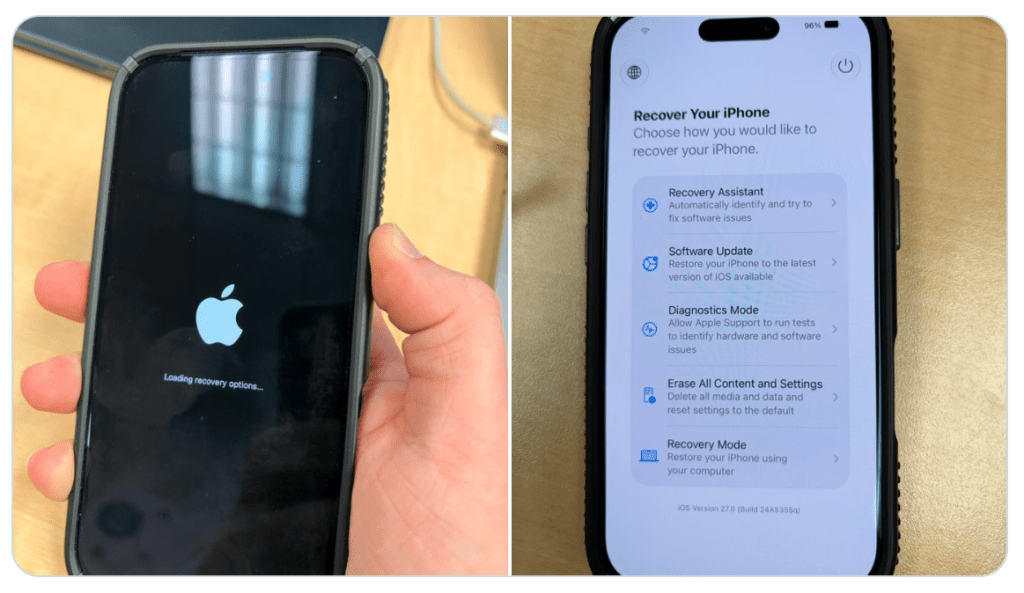
Image: @aaronp613
Numerous developers have already deployed the iOS 27 preview branch. Consequently, several undocumented capabilities are steadily coming to light. Chief among these novelties is an On-Device Recovery Mode option. This utility diagnoses and resolves critical system anomalies without requiring a host computer. Therefore, it provides an invaluable safety net for users away from a desktop environment.
Architectural Features of the iOS 27 Recovery Matrix
The newly engineered environment partitions its restoration toolkit into five distinct operational modalities:
- Recovery Assistant
This module automatically isolates and attempts to rectify severe software corruptions that prevent successful boot cycles.
- Software Update
This path restores the iPhone utilizing the latest stable operating system payload. However, it targets system revitalization rather than a destructive factory reset.
- Diagnostics Mode
This layer permits Apple Support technicians to execute detailed hardware and software telemetry evaluations during service appointments.
- Erase All Content and Settings
This destructive command expunges all user media, clears local databases, and reverts system configurations back to factory defaults.
- Recovery Mode
This option exposes the traditional device state. Subsequently, users can interface with a PC or Mac to flash the operating system via legacy tools.
Eliminating the Desktop Dependency
Historically, mitigating a severe firmware failure mandated a physical connection to a computer. Developers had to deploy tools like iTunes or Finder to overwrite the system with a raw IPSW firmware file. Naturally, this dependency introduced immense friction for users lacking immediate access to a desktop. In contrast, the integrated Recovery Assistant evaluates and addresses firmware anomalies locally. It successfully untethers the remediation process from external hardware dependencies.
Furthermore, this localized mechanism focuses on surgical error correction rather than a total system reinstallation. Consequently, the routine preserves sensitive user telemetry and individual configurations throughout the repair cycle. This approach proves infinitely more elegant than destructive firmware overwriting. Nonetheless, if the automated script encounters an unresolvable corruption, defenders must ultimately pivot back to the legacy Recovery Mode.
Support Our Threat Intelligence
Find our tech and OS security coverage helpful? Support our work today and unlock a 100% ad-free reading experience!
 Buy Me a Coffee
