 Do Son
In the ever-evolving landscape of cyber threats, defenders are constantly tracking novel sophisticated tools deployed by elite threat actors. Recently, researchers uncovered a highly advanced threat designed to infiltrate and maintain persistence in corporate environments. According to official reports, “In May 2026, Zscaler ThreatLabz identified a new malware family that we track as MLTBackdoor that is likely leveraged by a ransomware-related threat actor.” This newly discovered MLTBackdoor malware family showcases sophisticated evasion tactics, complex network communication protocols, and modular capabilities designed to establish a persistent foothold for lateral movement.
The Multi-Stage Delivery Mechanism
The initial compromise relies on highly deceptive social engineering tactics rather than traditional vulnerability exploitation. Specifically, the report notes that “MLTBackdoor has been observed by ThreatLabz being delivered in a multi-stage ClickFix infection chain.” The ClickFix technique typically involves displaying fake error messages or fraudulent browser updates to unsuspecting users. These deceptive prompts trick the victim into copying and pasting malicious PowerShell scripts directly into their terminal. Once executed, the script silently initiates the download and deployment of the backdoor, bypassing many traditional perimeter defenses.
Advanced Obfuscation and Anti-Analysis
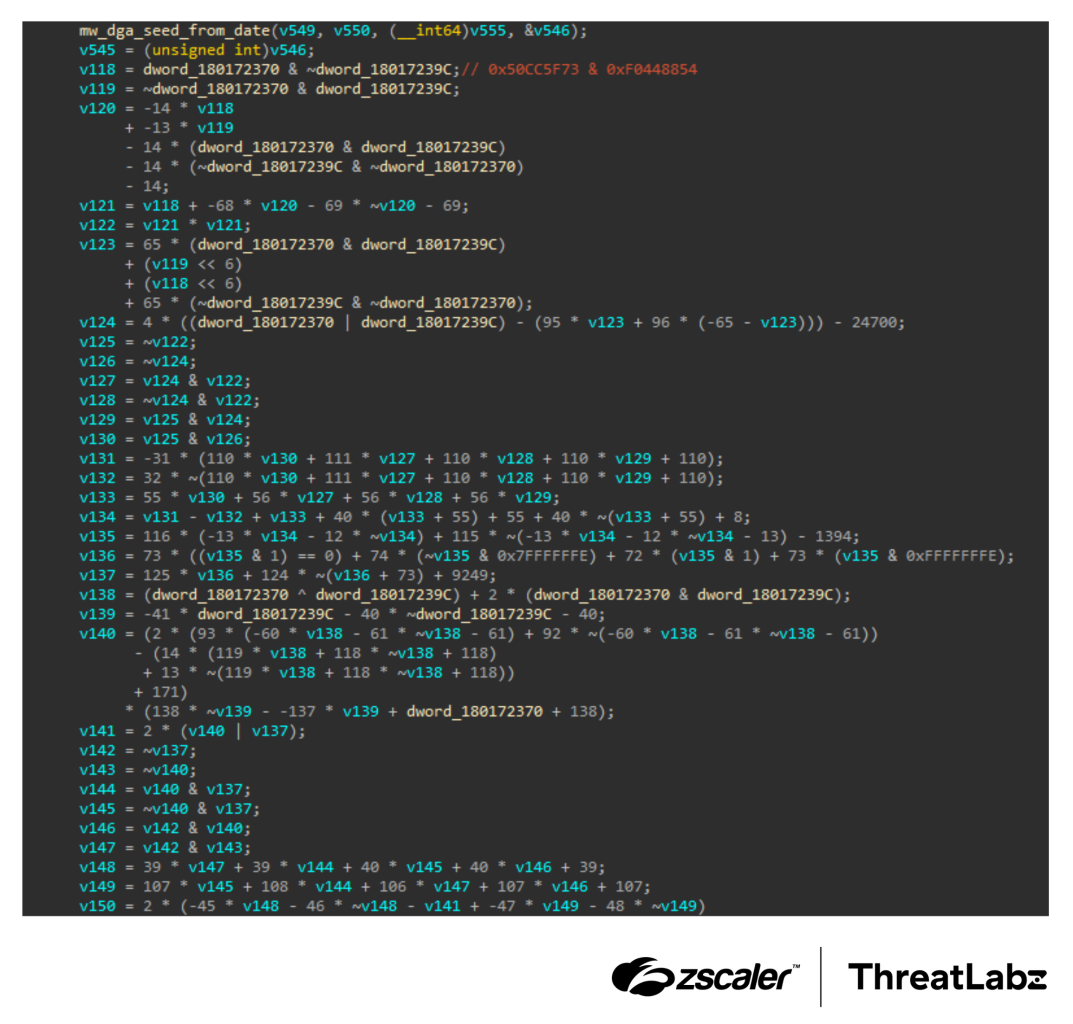
What sets the MLTBackdoor malware family apart from run-of-the-mill trojans is its extreme dedication to remaining undetected by security analysts. The developers went to great lengths to frustrate reverse engineering efforts. The analysis states that “MLTBackdoor is heavily obfuscated using both Mixed Boolean-Arithmetic (MBA) and Control Flow Flattening (CFF) techniques.”
Mixed Boolean-Arithmetic replaces simple mathematical operations with incredibly complex, convoluted algebraic expressions that are mathematically equivalent but extremely difficult for human analysts to decipher. Furthermore, Control Flow Flattening breaks the program’s logical execution flow into small blocks and embeds them inside a massive, chaotic switch statement. In addition to these code-level obfuscations, “MLTBackdoor also employs different tricks to thwart analysis, making static and dynamic analysis harder.”
Modular Capabilities and BOF Loading
Once successfully implanted on a victim’s machine, the backdoor offers the attackers a wide array of remote management tools. It supports a comprehensive set of filesystem commands, allowing the threat actors to freely download and upload sensitive files. “However, one of the most powerful features is the ability to load Beacon Object Files (BOFs) to expand its capabilities.”
By supporting BOFs, the attackers can dynamically inject and execute compiled C code directly in the system’s memory without ever touching the hard drive. This fileless execution turns the backdoor into a highly extensible post-exploitation framework, allowing the ransomware operators to run advanced reconnaissance and privilege escalation tools on the fly.
Resilient C2 Communication
Maintaining a reliable connection to the command-and-control (C2) server is critical for any malware operation. To ensure they never lose access to compromised hosts, the developers built in a robust fallback mechanism. “MLTBackdoor makes use of a domain generation algorithm (DGA) to avoid losing contact when the hardcoded command-and-control (C2) domains are unreachable.” If the primary infrastructure is seized or blocked by defenders, the malware autonomously generates new domains to re-establish the connection.
When communicating, the malware ensures absolute operational security through advanced cryptography. The initial connection utilizes an Elliptic-Curve Diffie-Hellman (ECDH) key exchange to negotiate a secure session. The packet headers meticulously define the client’s P-256 keys and incorporate anti-analysis flags. “Once this key exchange is complete, MLTBackdoor uses the shared AES-256-GCM key to encrypt and decrypt subsequent messages.” This military-grade encryption ensures that network defenders cannot easily inspect the payload traffic.
Ultimately, the emergence of this complex backdoor highlights the growing technical sophistication of modern ransomware syndicates. Organizations must prioritize advanced endpoint detection, strictly monitor for anomalous PowerShell activity, and educate users on the dangers of the ClickFix infection chain to defend against this formidable new threat.
Support Our Threat Intelligence
Find our threat intelligence and malware analysis helpful? Support our work today and unlock a 100% ad-free reading experience!
 Buy Me a Coffee
