OpenAI Debuts “Finances” Feature to Turn ChatGPT into Your Personal Wealth Manager
 Do Son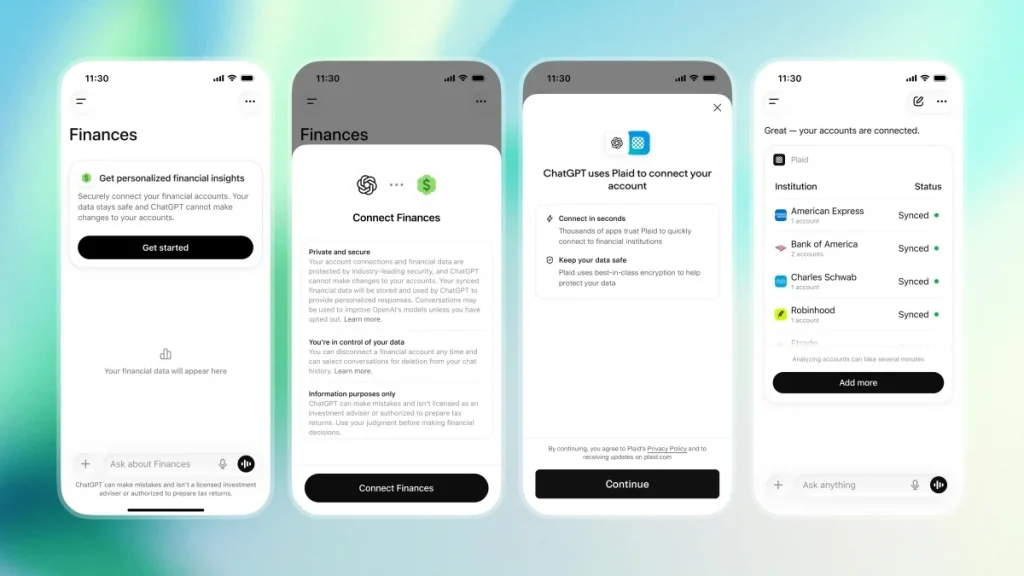
OpenAI has announced the debut of a pioneering personal wealth preview feature dubbed Finances, currently available exclusively to Pro plan subscribers within the United States. Orchestrated through a foundational alliance with the prominent financial data infrastructure provider Plaid, ChatGPT has been endowed with the capacity to directly read user banking, credit card, and investment portfolios. Consequently, the platform transcends rudimentary, generic maxims on asset accumulation, offering instead meticulously tailored, highly personalized, and actionable fiscal optimization trajectories predicated upon one’s authentic economic landscape.
According to OpenAI, a cohort exceeding 200 million monthly active users routinely solicits financial and wealth management advisement from ChatGPT. To infuse these interactions with pragmatic value, OpenAI has pursued the most direct avenue: establishing an architectural conduit to real-time financial telemetry:
- Comprehensive Data Synthesization: Leveraging Plaid’s robust infrastructure, this nascent functionality interfaces with over 12,000 financial institutions, encompassing traditional banking monoliths such as Citi and Chase, alongside contemporary fintech and brokerage vectors like Affirm and Robinhood.
- Visual Fiscal Dashboards: Users can summon this feature via the peripheral sidebar or by initiating the directive
@Finances, connect my accounts. Upon successful authentication, ChatGPT swiftly generates a visual matrix delineating assets, liabilities, and cash-flow structures, empowering users to interact with embedded contextual prompts or engage in nuanced dialogues regarding their economic pain points.
Surrendering highly sensitive banking telemetry to an artificial intelligence enterprise inevitably precipitates profound privacy and security anxieties. To assuage these concerns, OpenAI has institutionalized uncompromising boundaries within its product design:
- Immutable Read-Only Access: The privileges secured via Plaid are strictly confined to passive analysis. While the system can interpret account balances, transaction ledgers, investment allocations, and debt ratios, it remains blind to complete account numbers and is categorically barred from executing fiscal transfers or account modifications.
- Data Sovereignty: Users retain the absolute right to unilaterally sever financial connections at their discretion. Furthermore, any historical contextual attributes or “memories” retained by ChatGPT concerning one’s fiscal architecture can be reviewed or permanently expunged via a dedicated control panel.
- Model Training Exemptions: Provided a user has previously deactivated model training permissions within their privacy settings, all correspondence and economic telemetry ingested by this virtual comptroller are strictly excluded from future foundation model optimizations.
OpenAI’s expansion into the domain of consumer finance represents a logical evolution, arriving on the heels of its acquisition of Hiro—a fintech startup specializing in AI-driven wealth architecture—though spokespersons maintain that the development of the Finances feature predated this acquisition.
From a macroeconomic vantage point, OpenAI is racing to construct an unassailable “data rampart.” As the raw cognitive capacities of Large Language Models begin to converge and industry rivals like Google Gemini and Anthropic Claude attain functional parity, user retention will be dictated by an AI’s comprehension of an individual’s personal life context. Few data repositories possess the profound intimacy and value of an individual’s authentic transaction and investment behaviors.
When ChatGPT can precisely identify capital inefficiencies within subscription services or proactively signal an impending credit card maturation—advising precisely which liquid asset pool to draw from—it transcends the boundaries of a mere productivity utility to become an indispensable, deeply trusted digital advisory council.
Presently restricted to a preview phase for domestic Pro subscribers, with subsequent roadmaps encompassing Plus members, the ultimate longevity of this endeavor hinges not on cognitive or reasoning proficiency, but on whether OpenAI—navigating a landscape of corporate governance shifts and intellectual property contentions—can secure sufficient consumer trust in this most sacrosanct of domains.
Support Our Threat Intelligence
Find our tech and OS security coverage helpful? Support our work today and unlock a 100% ad-free reading experience!
 Buy Me a Coffee
