 Do Son
TL;DR
Federal agents arrested an OpenAI engineer on October 9 for allegedly placing hidden bugs in executive conference rooms. Investigators recovered an OpenAI recording device plugged directly into a television screen. Consequently, the defendant now faces up to five years in federal prison.
What Happened
On September 30, OpenAI security personnel found an electronic bug inside an executive conference room in San Francisco. Someone had inserted the encrypted device into a television USB port and wrapped it in toilet paper. Security staff quickly recognized the hardware as an unauthorized OpenAI recording device and alerted federal agents. Internal cameras revealed that engineer Abdulrahman Alfozan entered the area multiple times without authorization.
According to a press release from the Department of Justice, Alfozan searched internal systems for executive meeting schedules and room calendars. Furthermore, a chatbot account linked to his spouse requested instructions on building continuous audio recorders and encrypting SD cards. On October 5, cameras captured Alfozan inspecting the television where the bug was found. Later that day, security officers checked an unattended bag holding his ID and discovered a second recording tool.
Who Is Behind the Breach
Prosecutors charged Abdulrahman Alfozan, a Saudi citizen who joined OpenAI in July 2025. Investigators hold high attribution confidence because physical devices, video footage, and account activity directly point to him.
“According to the complaint unsealed today, Abdulrahman Alfozan allegedly concealed a covert recording device inside his employer’s executive conference room to secretly capture sensitive communications about the company’s super intelligence technology,” said FBI Director Kash Patel.
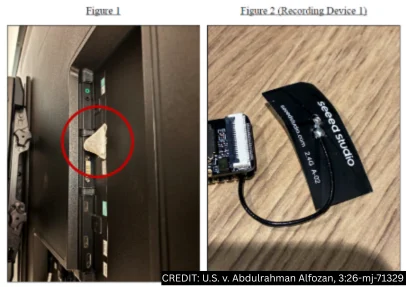
Federal officials framed the case as a critical national security matter. “This serious situation underscores why winning the global super intelligence race is a national security prerogative,” said Director of National Intelligence Jay Clayton.
Impact and Corporate Scale
The targeted conference room hosted sensitive discussions regarding proprietary research, product roadmaps, and government partnerships. Therefore, the eavesdropping operation risked exposing valuable commercial and state-level secrets. Fortunately, rapid internal detection prevented broader intelligence losses. If convicted, Alfozan faces up to five years in prison and a $250,000 fine.
Recommended Protection Steps
This high-profile OpenAI recording device arrest highlights growing insider risks for artificial intelligence firms. Security administrators should implement strict physical controls around executive suites. In addition, security teams must regularly inspect conference room displays and USB ports for rogue electronics. Finally, organizations should audit internal access logs to detect unusual queries regarding executive calendars and floor plans.
Support Our Threat Intelligence
Find our threat intelligence and malware analysis helpful? Support our work today and unlock a 100% ad-free reading experience!
 Buy Me a Coffee
