• About WordPress
    • WordPress.org
    • Documentation
    • Learn WordPress
    • Support
    • Feedback
Skip to content
May 26, 2026
  • Linkedin
  • Twitter
  • Facebook
  • Youtube

Daily CyberSecurity

Zero-hour alerts. Unmatched analysis.

Primary Menu
  • Home
  • CVE Watchtower
  • Cyber Criminals
  • Data Leak
  • Linux
  • Malware
  • Vulnerability
  • Submit Press Release
  • Vulnerability Report
Light/Dark Button
  • Home
  • News
  • Malware
  • Over 20 million Google Chrome users install malicious ad blocker extensions
  • Malware

Over 20 million Google Chrome users install malicious ad blocker extensions

Ddos April 21, 2018 2 minutes read
malicious ad blocker extensions

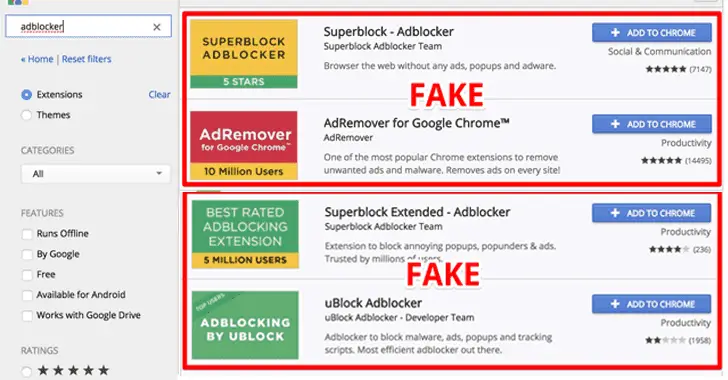
Most users will choose to install the ad blocking extension tool immediately after installing Google Chrome and Firefox browser to block ads on the webpage. However, if you directly search the Google Chrome online store for keywords such as ADBLOCK and other popular ad-blocking tools, you may be deceived. Currently, researchers have found 5 malicious adware interceptors in the browser store. The total number of download and installation of these interceptors has reached 20 million.

These ad blockers mainly evade Google’s review by modifying the script. These scripts are so common that auditors do not look closely. But in fact, these scripts have been modified and malicious code has been implanted. These malicious codes will upload the websites visited by users to the attacker’s server. In order to avoid all the remote control commands issued by the attacker being hidden in the picture, the picture itself is harmless but the malicious code can read the content. The malicious script finally loaded has the ability to allow an attacker to change the browser in any way. The attacker can also issue commands to perform remote operations at any time. Infected users form botnets for use by attackers, but no investigation has been conducted to confirm what the attackers did with botnets.


Being able to download 20 million times naturally cannot rely on simple camouflage. These malicious ad blockers mainly rely on popular keywords to induce users to actively install.

At the same time, users will find that they can actually block advertisements after installation because these malicious interceptors are modified based on ADBLOCK and the like.

Therefore, some of the popular Li ghost interceptors have thousands of or even tens of thousands of five-star praise, these five-star praise for later users more easily attracted and fooled.


  • AdRemover for Google Chrome™ (10 million+ users)
  • uBlock Plus (8 million+ users)
  • [Fake] Adblock Pro (2 million+ users)
  • HD for YouTube™ (400,000+ users)
  • Webutation (30,000+ users)
Rate this post

Support Our Threat Intelligence

If you find our CVE report and cybersecurity news helpful, consider supporting our work.

Buy Me a Coffee Logo Buy Me a Coffee PayPal
Crypto QR Code
USDT (TRC20):
TN8BdV8cp4T1Cd28gK9qTAnZknzzuwyUtm
USDT (ERC20):
0x3725e1a7d3bc5765499fa6aaafe307fabcd75bce

Share this article:

Facebook Post LinkedIn Telegram

Related posts:

  1. Android malware developed with Kotlin was found on Google Play
  2. Malware on npm “Patches” Local Packages with Reverse Shell
  3. EtherRAT Malware Hijacks Ethereum Blockchain for Covert C2 After React2Shell Exploit
  4. Wonderland Unleashed: New Android “Dropper” Malware Hijacks Telegram to Drain Bank Accounts
  5. “Contagious Interview” Goes macOS: North Korean Hackers Deploy Stealthy “DriverFixer” Stealer
Tags: malicious ad blocker extensions

Search

Translation

CVE WATCHTOWER
🚨

Receive alerts for vulnerabilities being exploited in the wild.

⚑

Get notified instantly when a Proof of Concept (PoC) exploit is published.

πŸ”

Access critical info on vulnerabilities even when marked as "RESERVED".

🧠

Insights powered by decades of expertise and global intelligence sources.

🎯

Customize alerts with up to 10 keywords for your specific tech stack.

πŸ“Š

Export the raw CVE database for SIEM integration and reporting.

Upgrade Package

πŸ”΄ Live Critical Threats

  • CVE-2026-42773CVSS 9.3
    Improper Neutralization of Special Elements used in an SQL Command ('SQL Injection')...
  • CVE-2026-42774CVSS 9.3
    Improper Neutralization of Special Elements used in an SQL Command ('SQL Injection')...
  • CVE-2026-9478CVSS 9.8
    A weakness has been identified in Totolink A8000RU 7.1cu.643_b20200521. Impacted is the...
  • CVE-2026-9477CVSS 9.8
    A security flaw has been discovered in Totolink A8000RU 7.1cu.643_b20200521. This issue...
  • CVE-2026-9476CVSS 9.8
    A vulnerability was identified in Totolink A8000RU 7.1cu.643_b20200521. This vulnerability affects the...
  • CVE-2026-9475CVSS 9.8
    A vulnerability was determined in Totolink A8000RU 7.1cu.643_b20200521. This affects the function...
  • CVE-2026-9458CVSS 9.8
    A vulnerability was identified in Totolink A8000RU 7.1cu.643_b20200521. The impacted element is...
  • CVE-2026-9457CVSS 9.8
    A vulnerability was determined in Totolink A8000RU 7.1cu.643_b20200521. The affected element is...
  • CVE-2026-9456CVSS 9.8
    A vulnerability was found in Totolink A8000RU 7.1cu.643_b20200521. Impacted is the function...
  • CVE-2026-9455CVSS 9.8
    A vulnerability has been found in Totolink A8000RU 7.1cu.643_b20200521. This issue affects...
Powered by CVE WATCHTOWER

Recent Zero-Day Vulnerabilities

  • Exploited in the Wild: Critical OWA Spoofing Flaw (CVE-2026-42897) Hits On-Premises Exchange Servers
  • Exploited in the Wild: Maximum CVSS 10 SD-WAN Flaw (CVE-2026-20182) Grants Admin Control
  • Exploited in the Wild: Critical 9.8 CVSS RCE Hits Canon GUARDIANWALL MailSuite
  • Exploit Code Released: Public PoC Dumps for Windows BitLocker Bypass and SYSTEM Elevation Zero-Days
  • Exploited in the Wild: “Dirty Frag” Linux Vulnerability Grants Instant Root Access
  • Under Active Attack: Ivanti EPMM Zero-Day Exploited in the Wild via Harvested Admin Credentials
Our Websites
  • Penetration Testing Tools
  • The Daily Information Technology
  • Daily CyberSecurity

    • About SecurityOnline.info
    • Advertise with us
    • Announcement
    • Contact
    • Contributor Register
    • Login
    • About SecurityOnline.info
    • Advertise on SecurityOnline.info
    • Contact Us

    When you purchase through links on our site, we may earn an affiliate commission. Here’s how it works

    • Disclaimer
    • Privacy Policy
    • DMCA NOTICE
    • Linkedin
    • Twitter
    • Facebook
    • Youtube
    Copyright Daily CyberSecurity Β© All rights reserved.