Skip to content
July 20, 2026
  • Linkedin
  • Twitter
  • Facebook
  • Youtube

Daily CyberSecurity

Zero-hour alerts. Unmatched analysis.

Primary Menu
  • Home
  • CVE Data
    • CVE Watchtower
    • Top Exploited CVEs
    • CVE Stats by Vendor
    • Q2 2026 Report
  • Cyber Criminals
  • Data Leak
  • Linux
  • Malware
  • Vulnerability
  • Submit Press Release
  • Weekly Recap
Light/Dark Button
  • Home
  • News
  • Malware
  • Researchers found that backdoors hijacks desktop shortcuts to infect user devices
  • Malware

Researchers found that backdoors hijacks desktop shortcuts to infect user devices

Do Son July 10, 2018 2 minutes read
hijacks desktop shortcuts
Add Daily CyberSecurity as a preferred source on Google

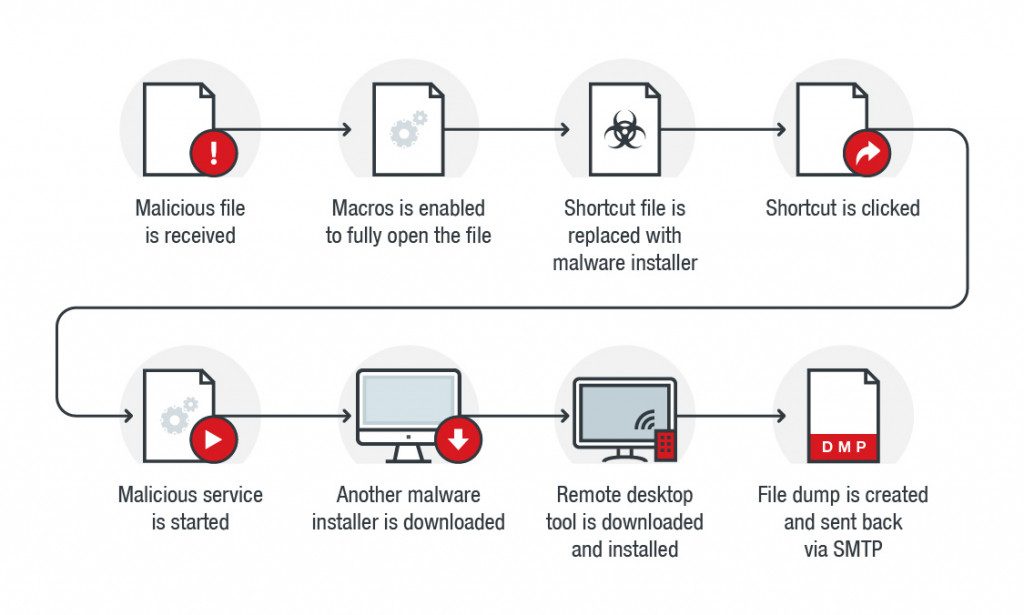
Trend Micro researchers have discovered that attackers use the malicious macro to load malicious code and then hijack the application shortcuts on the victim’s desktop.

Of course, the hijacking shortcut is only a transitional means for the attacker to infect the user device. When the user clicks on the shortcut, the backdoor program automatically download.

When the user opens the document containing the macro, the user will be prompted to execute the macro to enable the backup function. In fact, this operation is to hijack the shortcut.

Shortcuts to commonly used software such as Google Chrome and Firefox will be replaced with other commands to connect to the attacker’s server.

End users who click on these shortcuts that tampered with will infect the backdoor program, which is mainly used to steal the victim’s data.

At the same time, some researchers found that if the user clicks on the tamper-evident shortcut, the malicious code will immediately restore the path that the shortcut originally points to.

For the user, it found that the first click shortcut cannot open the corresponding program, and then click the shortcut again to open the program correctly.

Therefore, it is difficult for users to find that their computer infected with malicious programs, and eventually the backdoor program connects to the attacker server to download many other malicious components.

Researchers at Trend Micro said that the backdoor should be tested early, so no other malicious operations would be performed other than stealing the data.

However, it doesn’t rule out that future attackers will continue to enrich the functionality of this backdoor, such as loading more malicious components for monitoring users or even remotely operating the computer.

Source, Image: TrendMicro

Related coverage

  • Operation Takedown: DOJ and Global Allies Smash 30-Terabit IoT Botnet Empire
  • PyPI Under Attack: New Malware ‘SilentSync’ Is Stealing Credentials
  • New Android Malware “BadPack” Evades Security Analysis, Researchers Warn
  • CVE-2024-11667: Critical Vulnerability in Zyxel Firewalls Actively Exploited
  • Lumma Stealer Malware Expands Its Reach Through YouTube and Malvertising
Track all actively exploited CVEs →

Support Our Threat Intelligence

If you find our CVE report and cybersecurity news helpful, consider supporting our work.

Buy Me a Coffee Logo Buy Me a Coffee PayPal
Crypto QR Code
USDT (TRC20):
TN8BdV8cp4T1Cd28gK9qTAnZknzzuwyUtm
USDT (ERC20):
0x3725e1a7d3bc5765499fa6aaafe307fabcd75bce

Share this article:

Facebook Post LinkedIn Telegram
Written by
@DdoS · Security Researcher

Do Son

Do Son is the Founder and Editor of SecurityOnline.info. Working in cybersecurity since 2013, he reports on vulnerabilities, malware, and emerging threats, providing timely analysis to help organizations and individuals stay ahead of evolving risks.

Tags: hijacks desktop shortcuts

Search

Translation

CVE WATCHTOWER
🚨

Receive alerts for vulnerabilities being exploited in the wild.

⚡

Get notified instantly when a Proof of Concept (PoC) exploit is published.

🔍

Access critical info on vulnerabilities even when marked as "RESERVED".

🧠

Insights powered by decades of expertise and global intelligence sources.

🎯

Customize alerts with up to 10 keywords for your specific tech stack.

📊

Export the raw CVE database for SIEM integration and reporting.

Upgrade Package

🚨 Active Exploits in the Wild

  • CVE-2026-6875CVSS 9.5
    ServiceNow has addressed a remote code execution vulnerability that was identified in the ServiceNow AI platform. This vulnerability...
    Admin intel📅 Updated: Jul 18, 2026
  • CVE-2026-39808CVSS 9.8
    A improper neutralization of special elements used in an os command ('os command injection') vulnerability in Fortinet FortiSandbox...
    CISA KEV📅 Added to KEV: Jul 16, 2026
  • CVE-2026-25089CVSS 9.8
    A improper neutralization of special elements used in an os command ('os command injection') vulnerability in Fortinet FortiSandbox...
    CISA KEV📅 Added to KEV: Jul 16, 2026
  • CVE-2026-58644CVSS 9.8
    Deserialization of untrusted data in Microsoft Office SharePoint allows an unauthorized attacker to execute code over a network.
    CISA KEV📅 Added to KEV: Jul 16, 2026
  • CVE-2023-4346CVSS 7.5
    KNX devices that use KNX Connection Authorization and support Option 1 are, depending on the implementation, vulnerable to...
    CISA KEV📅 Added to KEV: Jul 15, 2026
  • CVE-2026-53362
    In the Linux kernel, the following vulnerability has been resolved: ipv6: account for fraggap on the paged allocation...
    Admin intel📅 Updated: Jul 14, 2026
  • CVE-2026-46242CVSS 7.8
    In the Linux kernel, the following vulnerability has been resolved: eventpoll: fix ep_remove struct eventpoll / struct file...
    Admin intel📅 Updated: Jul 14, 2026
  • CVE-2026-56155CVSS 7.8
    Insufficient granularity of access control in Active Directory Federation Services (AD FS) allows an authorized attacker to elevate...
    CISA KEV📅 Added to KEV: Jul 14, 2026
Powered by CVE Watchtower

🔴 Live Critical Threats

  • CVE-2026-12701CVSS 9.0
    A path traversal vulnerability was found in pulpcore. The relative_path_validator function only...
  • CVE-2026-64620CVSS 9.8
    FreeRDP before 3.28.0 (affected
  • CVE-2026-16242CVSS 9.4
    A flaw was found in the Konnectivity proxy-server configuration for hosted control...
  • CVE-2026-16235CVSS 9.8
    Crypt::Password versions through 0.28 for Perl generate insecure random values for salts....
  • CVE-2026-13147CVSS 9.1
    The Kirki WordPress plugin before 6.0.12 does not validate a user-supplied URL...
  • CVE-2026-44359CVSS 10.0
    Meshtastic is an open source mesh networking solution. Prior to version 2.7.21.1370b23,...
  • CVE-2026-64162CVSS 9.8
    In the Linux kernel, the following vulnerability has been resolved: idpf: fix...
  • CVE-2026-64160CVSS 9.8
    In the Linux kernel, the following vulnerability has been resolved: netfs: Fix...
  • CVE-2026-64150CVSS 9.8
    In the Linux kernel, the following vulnerability has been resolved: netfilter: nft_inner:...
  • CVE-2026-64142CVSS 9.8
    In the Linux kernel, the following vulnerability has been resolved: ksmbd: close...
Powered by CVE WATCHTOWER

Our Websites
  • Penetration Testing Tools
  • The Daily Information Technology
  • Top Exploited CVEs
  • Daily CyberSecurity

    • About SecurityOnline.info
    • Advertise with us
    • Announcement
    • Contact
    • Contributor Register
    • Login
    • Disclaimer
    • DCMA
    • Privacy Policy
    • About SecurityOnline.info
    • Advertise on SecurityOnline.info
    • Contact Us

    When you purchase through links on our site, we may earn an affiliate commission. Here’s how it works

    • CVE Watchtower
    • CVE Statistics by Vendor 2026
    • Q2 2026 Report
    • Top Exploited CVEs
    • Linkedin
    • Twitter
    • Facebook
    • Youtube
    © 2017 - 2026 Daily CyberSecurity. All Rights Reserved.