 Do Son
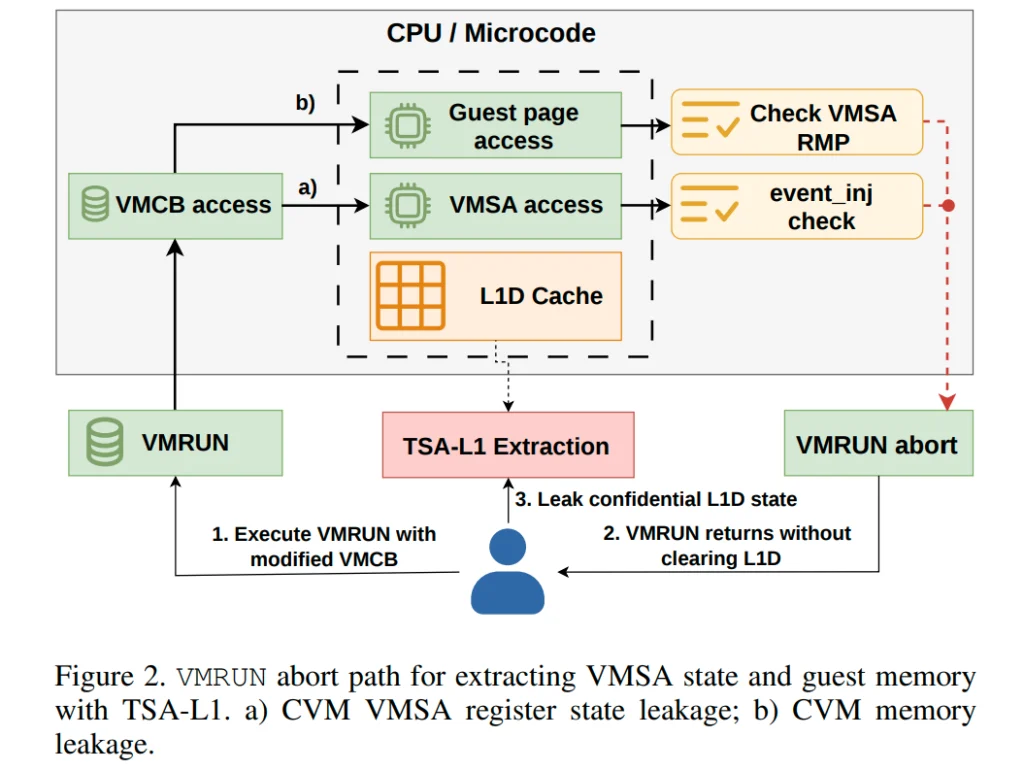
Image: ETH Zurich
TL;DR
Researchers from ETH Zurich and Google have disclosed Skyfall, a transient execution attack on AMD Zen 3 and Zen 4 server processors. The Skyfall attack lets a malicious host read data from AMD SEV-SNP confidential virtual machines, decrypted microcode updates and protected System Management Mode memory. AMD tracks the VM leak as CVE-2026-40671 and has released microcode fixes.
Skyfall bypasses AMD’s earlier fixes for Transient Scheduler Attacks (TSA) to leak data across hardware isolation boundaries. It requires a privileged attacker, such as a rogue hypervisor. The researchers have published proof-of-concept code, but no attacks in the wild have been reported.
- Product: TianoCore EDK2
- Vulnerabilities: 1 flaw (CVE-2026-18448)
- Highest severity: 5.6 (Medium · CVSSv4)
- Worst impact: Leak SMM RAM from the kernel (Simply TSA after an SMI)
- Status: No confirmed exploitation yet
- Action: See vendor advisories
| CVE | CVSS (CVSSv4) | Type | Status |
|---|---|---|---|
| CVE-2026-18448 | 5.6 | Leak SMM RAM from the kernel (Simply TSA after an SMI) | Not exploited |
Why It Matters
Confidential Computing at Stake
SEV-SNP exists to protect cloud tenants from the host itself. In theory, even the hypervisor cannot read a confidential VM’s data. However, the researchers note that these “security boundaries are ensured only at the architectural level.” Skyfall shows that CPU internals can still leak.
In their tests, the team recovered VM register values and a disk encryption key. According to The Hacker News, the key test used a modified guest kernel that paused while the key sat in registers.
Public Code
The paper states plainly: “Our code is public.” As a result, cloud providers and researchers can now test the attack themselves. Its methods are also visible to others.
How the Attack Works
Building on TSA
AMD first disclosed Transient Scheduler Attacks in July 2025. These flaws leak data from the L1 data cache and the store queue during speculative execution. AMD answered with microcode-based mitigations.
The ETH Zurich team, however, found gaps. They repurposed Instruction Based Sampling, an AMD performance feature, to trace how complex instructions run inside the CPU. With it, they studied the TSA mitigations themselves.
The Mitigation Gap
According to the Skyfall research paper, the existing fixes “address virtual-address-based leaks.” However, physical-address-based paths, such as those triggered by VMSAVE, VMLOAD and VMRUN, “continue to populate way-predictor state, leaving the CPU vulnerable.”
In practice, a hypervisor can make a VM deliberately fail to start. AMD’s bulletin describes this as “incomplete cleanup during VMRUN error handling.” The failed start leaves VM data in CPU buffers, and the Skyfall attack then samples it.
Limits of the Attack
The leak is narrow. The Hacker News reports that Skyfall reads only three fixed cache lines in a targeted page, so “the rest of the page stays out of reach.” In addition, the IEEE S&P program committee said the paper “overlooks what a realistic attack on VMs would need,” such as an idle core.
Severity and CVEs
AMD’s security bulletin AMD-SB-3061 rates CVE-2026-40671 at CVSS 4.0 score 4.9. It says the flaw “may expose” SEV-SNP guest register data “to a privileged attacker.” A second issue, CVE-2026-18448, covers the SMM memory leak and scores 5.6, according to The Hacker News.
Affected Products
- AMD EPYC 7003 (Milan)
- AMD EPYC 8004 (Siena) and 9004 (Genoa and Bergamo)
- AMD EPYC 8005 and 9005 (Turin)
- AMD Instinct MI300A
- EPYC Embedded versions of these lines
The researchers tested EPYC 7313 (Zen 3) and EPYC 9124 and 9334 (Zen 4). They did not show the attack on Zen 5.
Patch and Mitigation
Microcode and Firmware
AMD released microcode fixes dated August 12, 2026, for EPYC 7003, 8004, 8005, 9004 and 9005. Platform firmware updates are due in November 2026. The MI300A fix shipped on September 21. EPYC Embedded fixes are planned between January and April 2027.
What Operators Should Do
- Get BIOS updates from your server maker, as AMD advises.
- Confirm the new microcode is active on hosts that run confidential VMs.
- Cloud customers should ask their provider when SEV-SNP hosts will receive the Skyfall attack fixes.
Support Our Threat Intelligence
Find our vulnerability reports and weekly recaps helpful? Support our work today and unlock a 100% ad-free reading experience!
 Buy Me a Coffee
