The Ray Tracing Revolution: Microsoft’s Shader Model 6.9 Unlocks a 90% Power Surge for Intel and NVIDIA
 Do Son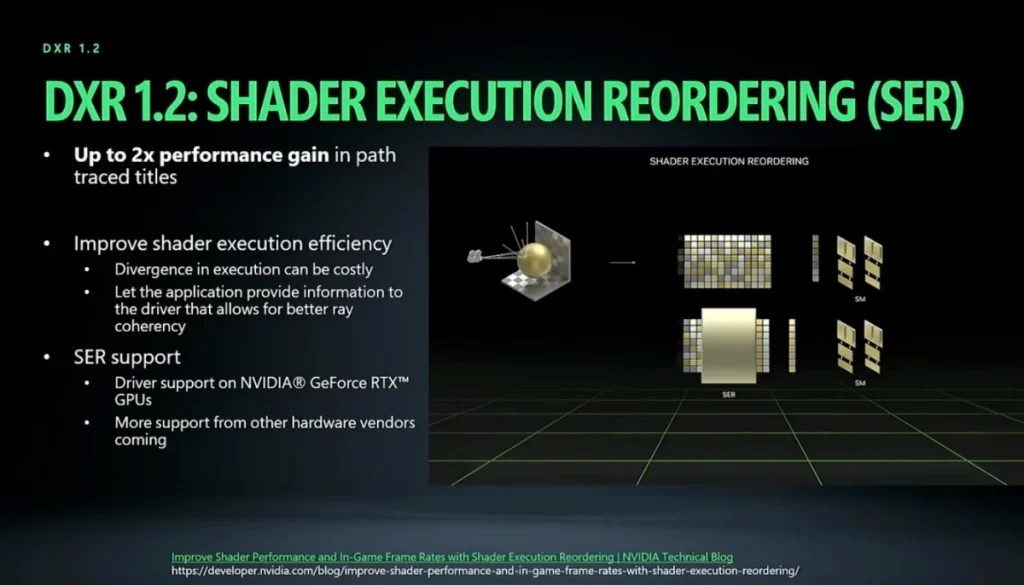
Microsoft has formally announced the comprehensive integration of “Shader Execution Reordering” (SER)—the cornerstone technology of the enhanced DXR 1.2 (DirectX Raytracing 1.2) standard, championed in concert with leading hardware titans—into the nascent Shader Model 6.9 specification. By bridging the underlying APIs, this monumental shift signifies that Intel’s Arc B-series graphics cards will achieve an astonishing surge of up to 90% in real-time ray tracing efficacy. Even the formidable NVIDIA RTX 4090 stands to extract an additional 40% enhancement in performance. The standardization of this technology not only spares gamers the exorbitant financial burden of hardware upgrades but also heralds a new epoch wherein ray tracing transitions from an exclusive “performance behemoth” to a universally accessible standard.
To truly comprehend the genesis of such a colossal performance leap, one must first apprehend the inherent “physical conundrum” that traditional ray tracing imposes upon GPU computation.
In the physical realm, the reflection and refraction of light occur with absolute spontaneity. When a rendering engine casts a solitary ray, it may haphazardly strike metal, water, glass, or jagged stone. Within the orthodox DXR rendering pipeline, as these rays collide with disparate materials, the GPU is compelled to invoke radically divergent shaders to process the resulting visual data. This inevitably precipitates a critical bottleneck: thread idling and processing stagnation. Because GPU architecture is fundamentally optimized for executing massive, highly uniform computational tasks, the influx of profoundly varied rendering requirements forces execution threads to languish in a state of mutual waiting. This cascading delay engenders a catastrophic squandering of computational resources—unless, of course, the GPU possesses an overwhelming surplus of raw processing power.
Microsoft’s integration of the SER feature into Shader Model 6.9 is meticulously engineered to eradicate this very predicament. SER empowers applications to conduct a comprehensive “task inventory” directly within the GPU by incorporating HLSL source code. By initially sequestering the data of all ray-intersected objects within a singular memory bloc, and subsequently reordering the processing pipeline predicated upon “spatial locality” and “shader congruence,” the GPU’s computational resources are marshaled with unprecedented efficiency. The paramount advantage of enshrining SER within Microsoft’s official API standard lies in its ability to directly emancipate the latent hardware potential of myriad graphics cards, entirely bypassing the need for extraneous software interventions or manual calibrations.
According to metrics disseminated by Microsoft, augmented by this groundbreaking technology, the real-time ray tracing rendering efficacy of the Intel Arc B-series (Battlemage) graphics cards skyrockets by a staggering 90%. Concurrently, the NVIDIA RTX 4090—a GPU already replete with prodigious ray tracing capabilities—extracts an awe-inspiring 40% supplementary performance boost.
For the everyday consumer, this paradigm shift demands absolutely no labyrinthine configurations to reap the rewards of elevated real-time ray tracing performance. As Microsoft codifies SER into the Shader Model 6.9 specification under the aegis of Agility SDK 1.619, gamers of tomorrow need only update their AMD, Intel, or NVIDIA display drivers. In doing so, they will seamlessly unlock the exhilaration of exponential performance surges across any game supporting this revolutionary technology.
Support Our Threat Intelligence
Find our tech and OS security coverage helpful? Support our work today and unlock a 100% ad-free reading experience!
 Buy Me a Coffee
