 Do Son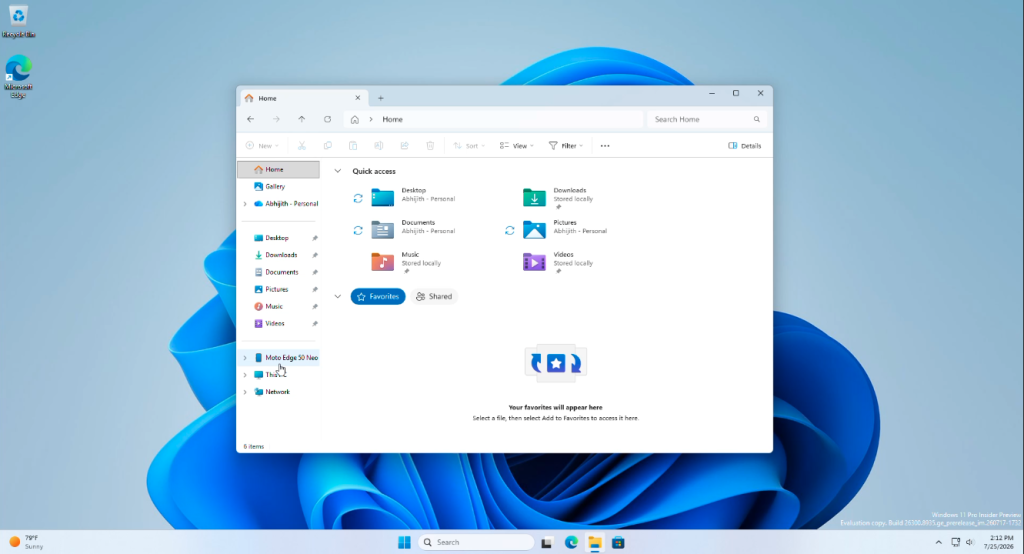
Microsoft recently pushed Windows 11 Build 26300.8935 to users in its preview program. The changelog highlights one useful gain. In certain scenarios, deleting large and heavily fragmented files now runs faster.
The build reached users on 20 July. However, the feature uses a gradual rollout mechanism. Therefore, not every user will notice the change right away. This counts as a rare speed win from Microsoft.
Why Deleting Fragmented Files Can Be Slow
Many users assume deletion just wipes a filename from the directory. In theory, that should finish instantly. The reality is messier, though.
On the NTFS file system, deleting a file also means clearing the records of the space it occupied. A file written contiguously is simple to handle. Yet when the disk nears capacity, a large file may be split into many fragments scattered across different locations.
The consequences differ by drive type. On a mechanical hard drive, fragmented files force the head to seek repeatedly. Solid-state drives have no moving parts, but NTFS must still process each fragment’s metadata one by one and mark the space as free again.
The pattern is clear. The more fragmentation there is, the more bookkeeping deletion demands, and the slower it becomes.
Where This Improvement Helps Most
Large files, huge file counts, and swarms of fragmented small files each behave differently. For developers, the fragmented small files cause the most pain. Some software packages spawn vast numbers of tiny files.
When developers delete those through File Explorer, they often see a long “calculating” or “preparing to delete” stage. Consequently, this optimisation matters to them directly.
The fix mainly affects a few file types. Large virtual disks, database files, ever-growing log files, and game asset packs all stand to benefit.
Microsoft’s solution likely optimises the fragment-cleanup path, so File Explorer can chew through these records faster. Still, the company did not spell out the underlying implementation in its changelog.
Support Our Threat Intelligence
Find our tech and OS security coverage helpful? Support our work today and unlock a 100% ad-free reading experience!
 Buy Me a Coffee
