• About WordPress
    • WordPress.org
    • Documentation
    • Learn WordPress
    • Support
    • Feedback
Skip to content
May 25, 2026
  • Linkedin
  • Twitter
  • Facebook
  • Youtube

Daily CyberSecurity

Zero-hour alerts. Unmatched analysis.

Primary Menu
  • Home
  • CVE Watchtower
  • Cyber Criminals
  • Data Leak
  • Linux
  • Malware
  • Vulnerability
  • Submit Press Release
  • Vulnerability Report
Light/Dark Button
  • Home
  • News
  • Malware
  • Malicious software disguised as legitimate ionCube encoded files has been infected in hundreds of websites
  • Malware

Malicious software disguised as legitimate ionCube encoded files has been infected in hundreds of websites

Ddos March 2, 2018 3 minutes read
ionCube

For PHP developers, in order to protect intellectual property or protect PHP program files, they often need to encrypt their own PHP code, while ionCube is widely used as a PHP encryption technology.

Founded in 2002, ionCube Inc. has introduced a series of tools to protect software written in the PHP programming language, making it impossible for anyone to view, change, or run PHP program files on an unauthorized computer.

Specifically, ionCube Encoder converts PHP source code to ByteCode. After the encryption and authorization processing PHP code is not open source, you must use the ionCube loader can execute encrypted PHP code.

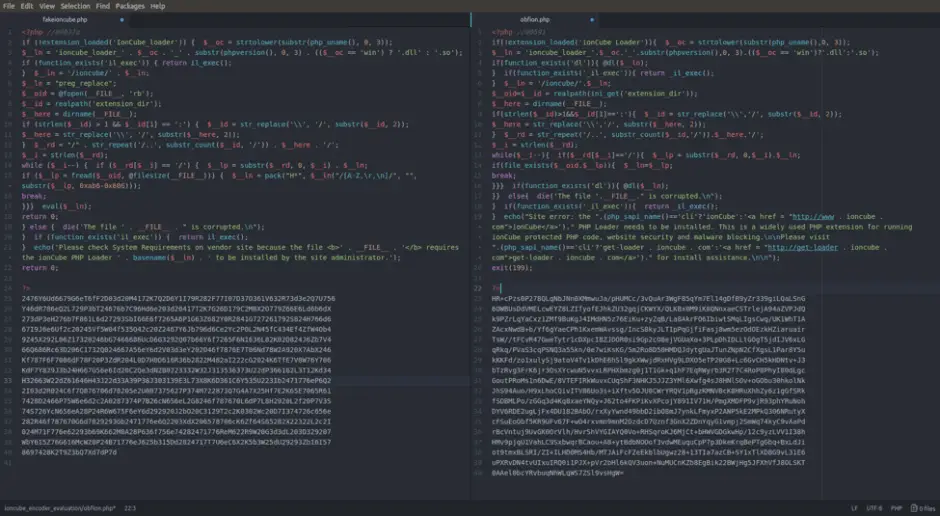
According to SiteLock, hundreds of sites have been found infected with malware disguised as legitimate ionCube encoded files. While viewing the infected site, SiteLock’s team found some suspect confusion files that are almost identical to the legitimate ionCube encoded files.

In general, ionCube is generally not used for malicious purposes due to the high licensing costs and high compatibility requirements. But there seems to be an exception this time around, and the team is pretty sure that these suspect ionCube encoded files are indeed malicious, affecting at least hundreds of websites and thousands of files.

These suspicious obfuscation files (such as “diff98.php” and “wrgcduzk.php”) were discovered by the research team when analyzing an infected WordPress website. Contrast legal ionCube file, if not carefully examined, we find it very difficult to find any difference.

After careful analysis and comparison, the team found some differences: First, the fake file uses a function that closely resembles the legal one, using the function “il_exec”, which in the legal file should be ” _il_exec “; Second, in the fake file also appeared two does not exist in the legal document” preg_replace “and” fopen “; Finally, there is a relatively obvious difference, the last line of the fake file is the return statement, And we know that legal ionCube encoded files end with “exit ()”.


The team noted that despite the considerable confusion with fake documents, it looks as legal as possible with legal documents. But the sheer number of “$ _POST” and “$ _COOKIE superglobals” and the eval request at the end of the file reveal its real purpose: to accept and execute remote code.

Further investigation revealed that attackers who distribute fake ionCube encoded files not only target WordPress, but also a large number of infected sites such as Joomla and CodeIgniter.

The team at ionCube emphasizes that fake files, in theory, can infect almost any web server running PHP. Once decoded, a fake ionCube file constitutes malware.

In addition, fake files do not have a fixed naming pattern, and even files with “inc.php” and “menu.php” names that have valid filenames can be malicious.

Overall, ionCube’s research team found over 700 infected websites and more than 7,000 fake documents in the survey. They even found that over 100 slightly different fake files exist on a single site at the same time.

Source: securityaffairs

Rate this post

Support Our Threat Intelligence

If you find our CVE report and cybersecurity news helpful, consider supporting our work.

Buy Me a Coffee Logo Buy Me a Coffee PayPal
Crypto QR Code
USDT (TRC20):
TN8BdV8cp4T1Cd28gK9qTAnZknzzuwyUtm
USDT (ERC20):
0x3725e1a7d3bc5765499fa6aaafe307fabcd75bce

Share this article:

Facebook Post LinkedIn Telegram

Related posts:

  1. IcedID Banking Trojan combine with Ursnif/Dreambot for expansion
  2. AllaKore RAT: The Trojan Horse Targeting Mexico’s Financial Titans
  3. MaaS in Action: How Lumma Stealer Employs Advanced Delivery Techniques
  4. XCSSET Malware Returns with Enhanced Obfuscation and Persistence Techniques
  5. NordDragonScan: New Infostealer Hits Via Weaponized HTAs, Stealing Browser Data & Documents!
Tags: ionCube

Search

Translation

CVE WATCHTOWER
🚨

Receive alerts for vulnerabilities being exploited in the wild.

⚑

Get notified instantly when a Proof of Concept (PoC) exploit is published.

πŸ”

Access critical info on vulnerabilities even when marked as "RESERVED".

🧠

Insights powered by decades of expertise and global intelligence sources.

🎯

Customize alerts with up to 10 keywords for your specific tech stack.

πŸ“Š

Export the raw CVE database for SIEM integration and reporting.

Upgrade Package

πŸ”΄ Live Critical Threats

  • CVE-2026-9478CVSS 9.8
    A weakness has been identified in Totolink A8000RU 7.1cu.643_b20200521. Impacted is the...
  • CVE-2026-9477CVSS 9.8
    A security flaw has been discovered in Totolink A8000RU 7.1cu.643_b20200521. This issue...
  • CVE-2026-9476CVSS 9.8
    A vulnerability was identified in Totolink A8000RU 7.1cu.643_b20200521. This vulnerability affects the...
  • CVE-2026-9475CVSS 9.8
    A vulnerability was determined in Totolink A8000RU 7.1cu.643_b20200521. This affects the function...
  • CVE-2026-9458CVSS 9.8
    A vulnerability was identified in Totolink A8000RU 7.1cu.643_b20200521. The impacted element is...
  • CVE-2026-9457CVSS 9.8
    A vulnerability was determined in Totolink A8000RU 7.1cu.643_b20200521. The affected element is...
  • CVE-2026-9456CVSS 9.8
    A vulnerability was found in Totolink A8000RU 7.1cu.643_b20200521. Impacted is the function...
  • CVE-2026-9455CVSS 9.8
    A vulnerability has been found in Totolink A8000RU 7.1cu.643_b20200521. This issue affects...
  • CVE-2026-9454CVSS 9.8
    A flaw has been found in Totolink A8000RU 7.1cu.643_b20200521. This vulnerability affects...
  • CVE-2026-9436CVSS 9.8
    A flaw has been found in Totolink A8000RU 7.1cu.643_b20200521. The impacted element...
Powered by CVE WATCHTOWER

Recent Zero-Day Vulnerabilities

  • Exploited in the Wild: Critical OWA Spoofing Flaw (CVE-2026-42897) Hits On-Premises Exchange Servers
  • Exploited in the Wild: Maximum CVSS 10 SD-WAN Flaw (CVE-2026-20182) Grants Admin Control
  • Exploited in the Wild: Critical 9.8 CVSS RCE Hits Canon GUARDIANWALL MailSuite
  • Exploit Code Released: Public PoC Dumps for Windows BitLocker Bypass and SYSTEM Elevation Zero-Days
  • Exploited in the Wild: “Dirty Frag” Linux Vulnerability Grants Instant Root Access
  • Under Active Attack: Ivanti EPMM Zero-Day Exploited in the Wild via Harvested Admin Credentials
Our Websites
  • Penetration Testing Tools
  • The Daily Information Technology
  • Daily CyberSecurity

    • About SecurityOnline.info
    • Advertise with us
    • Announcement
    • Contact
    • Contributor Register
    • Login
    • About SecurityOnline.info
    • Advertise on SecurityOnline.info
    • Contact Us

    When you purchase through links on our site, we may earn an affiliate commission. Here’s how it works

    • Disclaimer
    • Privacy Policy
    • DMCA NOTICE
    • Linkedin
    • Twitter
    • Facebook
    • Youtube
    Copyright Daily CyberSecurity Β© All rights reserved.