Skip to content
June 10, 2026
  • Linkedin
  • Twitter
  • Facebook
  • Youtube

Daily CyberSecurity

Zero-hour alerts. Unmatched analysis.

Primary Menu
  • Home
  • CVE Watchtower
  • Cyber Criminals
  • Data Leak
  • Linux
  • Malware
  • Vulnerability
  • Submit Press Release
  • Vulnerability Report
Light/Dark Button
  • Home
  • Technique
  • How does the speech synthesis system work?
  • Technique

How does the speech synthesis system work?

Do Son November 18, 2019 3 minutes read
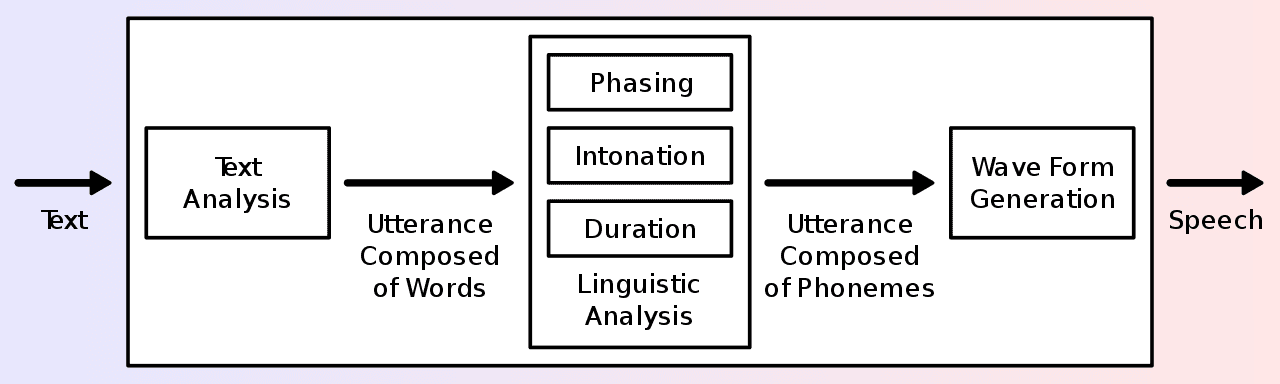
speech synthesis system

Andy0101 [Public domain], <a href="https://commons.wikimedia.org/wiki/File:TTS_System.svg">via Wikimedia Commons</a>

Speech synthesis processes an artificial voice that generates from a machine that reads out texts making it easier for visually impaired people and/or dyslexic people. The technology is known as Text-To-Speech (TTS). It has now become so common these days and is available in almost all smartphones.

Speech synthesis has a number of benefits in all kinds of fields. Those of you who didn’t know the meaning of TTS or speech synthesizer earlier would probably know what it is now by reading the article.

How speech synthesis works involve three essential stages; text to words, words to phonemes, and phonemes to sound.

  1. Text to words

It is easy for an adult to read a short or a long paragraph but when you ask the same paragraph to be read by a child, it gets challenging. The main reason is that the written text is ambiguous; a single word may have a different meaning and you may require proper knowledge or help from an educated person to make you understand under what context the word is used for. So, to reduce the ambiguity by narrowing down the article in a proper and easy manner to read and understand is the first step which is referred to as pre-processing or normalization.

English is a difficult language with lots of grammar and vocabulary rules. It is easy for a human being to know how to read numbers, dates, times, units, symbols, acronyms, synonyms and homonyms. But the same work is difficult for a machine to do. For example, the word ‘read’ can be pronounced in two ways- ‘read’ and ‘reed’.  How would the computer know which one to pronounce? So they use statistical probability techniques or neural networks to arrive at the most likely pronunciation by comparing with the tense of the sentence.

  1. Words to phonemes

Once the computer understands and converts the text to voice, the speech synthesizer has to generate the speech sounds. As we’ve already mentioned above, it is a pretty difficult task for a computer to read out the same words with a different pronunciation. The best alternative solution is to break the written words into graphemes. Once that’s done, the computer should be able to generate phonemes that correspond to them. This process will require a set of simple rules for the computer to follow. This is similar to a child reading words he or she has never encountered in their lives. For a person, a single line can be spoken with different styles and emotions while it is very difficult for a machine to do. The advantage of doing this is that the computer at least tries its best at reading any word.

  1. Phonemes to sound

This is the final step of how speech synthesis works. The conversion of phonemes to sound is possible in 3 different ways:

  • The first way is to use recordings of humans saying the phonemes
  • Another way is for the computer to generate the phonemes itself by generating basic sound frequencies. The most relevant example could be a music synthesizer.
  • The last way is to mimic the mechanism of the human voice.

Share this article:

Facebook Post LinkedIn Telegram

No related posts.

Tags: speech synthesis system

Search

Translation

CVE WATCHTOWER
🚨

Receive alerts for vulnerabilities being exploited in the wild.

⚡

Get notified instantly when a Proof of Concept (PoC) exploit is published.

🔍

Access critical info on vulnerabilities even when marked as "RESERVED".

🧠

Insights powered by decades of expertise and global intelligence sources.

🎯

Customize alerts with up to 10 keywords for your specific tech stack.

📊

Export the raw CVE database for SIEM integration and reporting.

Upgrade Package

🔴 Live Critical Threats

  • CVE-2026-45328CVSS 9.3
    ESF-IDF is the Espressif Internet of Things (IOT) Development Framework. In versions...
  • CVE-2026-48030CVSS 9.9
    ### Summary An OS Command Injection vulnerability in the terminal action handler...
  • CVE-2026-48303CVSS 10.0
    Adobe Campaign Classic (ACC) versions 7.4.3 build 9394 and earlier are affected...
  • CVE-2026-47938CVSS 10.0
    Adobe Campaign Classic (ACC) versions 7.4.3 build 9394 and earlier are affected...
  • CVE-2026-47928CVSS 9.6
    ColdFusion versions 2023.19, 2025.8 and earlier are affected by an Improper Input...
  • CVE-2026-30141CVSS 9.8
    An issue was discovered in bitbank2 AnimatedGIF v2.2.0. A buffer overflow in...
  • CVE-2026-10045CVSS 9.8
    Shenzhen Kangda Xin Intelligent Network Technology Company's router, model DR300, version 2.1.2.121,...
  • CVE-2026-34691CVSS 9.3
    Adobe Experience Manager Forms JEE versions LTS SP1, 6.5.24.0 and earlier are...
  • CVE-2026-49841CVSS 9.8
    FreeSWITCH is a Software Defined Telecom Stack enabling the digital transformation from...
  • CVE-2026-49840CVSS 9.1
    FreeSWITCH is a Software Defined Telecom Stack enabling the digital transformation from...
Powered by CVE WATCHTOWER

Recent Zero-Day Vulnerabilities

  • Check Point VPN Vulnerability Exploited in the Wild with Ransomware Links
  • Weekly Threat Intelligence: June 1 to June 7, 2026
  • Cisco SD-WAN Vulnerability Exploited in the Wild with Root RCE Risks
  • Android Zero-Day Flaw Exploited in the Wild: June 2026 Patches Released
  • Exploited in the Wild: Critical OWA Spoofing Flaw (CVE-2026-42897) Hits On-Premises Exchange Servers
  • Exploited in the Wild: Maximum CVSS 10 SD-WAN Flaw (CVE-2026-20182) Grants Admin Control
Our Websites
  • Penetration Testing Tools
  • The Daily Information Technology
  • Daily CyberSecurity

    • About SecurityOnline.info
    • Advertise with us
    • Announcement
    • Contact
    • Contributor Register
    • Login
    • About SecurityOnline.info
    • Advertise on SecurityOnline.info
    • Contact Us

    When you purchase through links on our site, we may earn an affiliate commission. Here’s how it works

    • Disclaimer
    • Privacy Policy
    • DMCA NOTICE
    • Linkedin
    • Twitter
    • Facebook
    • Youtube
    © 2017 - 2026 Daily CyberSecurity. All Rights Reserved.