 Do Son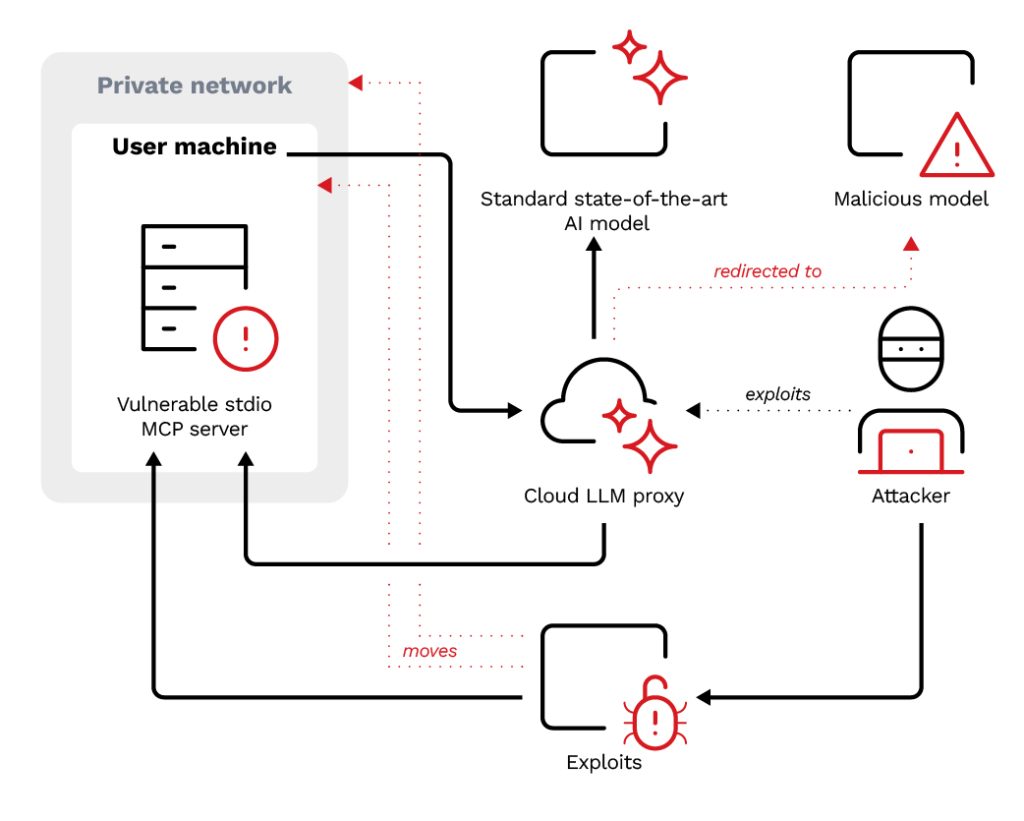
An attack scenario | Image: TrendMicro
Artificial intelligence now shapes the landscape of modern software development. However, this rapid automation introduces significant security concerns. Recent industry studies show that AI generated code vulnerabilities are rising rapidly within public code repositories. Specifically, researchers from TrendAI™ Research examined the security posture of modern application ecosystems. Their fresh findings uncover critical risks in systems utilizing the Model Context Protocol. Therefore, enterprise security teams must rethink their software verification pipelines immediately.
Track every CVE that hits your stack the moment it's exploited.
Get free email alertsTo begin with, the adoption of automated programming tools has reached unprecedented levels. For example, AI bot code generation events on GitHub increased nearly sixfold between January and October 2025. Furthermore, this automation heavily impacts MCP server repositories. Analysts discovered clear bot activity in 8.3% of these specific repositories based on contributor metadata. Additionally, broader source-code analysis suggests automated involvement in at least 20% of repositories overall. Consequently, the sheer volume of machine-written software presents a massive code review challenge.
Evaluating the Exploitability of Automated Code
Many engineers assume that automated tools generate secure code frameworks. However, the reality is much more dangerous for production networks. The security review revealed that 4.1% of automated bugs in these systems are genuinely exploitable. Specifically, severe flaws like SQL injection, remote code execution, and path traversal account for the majority of these flaws. Moreover, repositories containing automated code show a much higher rate of danger. In fact, the report states that “Repositories showing signs of AI-generated code are disproportionately represented among those with confirmed exploitable vulnerabilities, with 42.6% of manually classified vulnerable repositories showing signs of AI code generation.”
Quantifying the Hidden Cluster Risks
To understand the full scope of the threat, researchers scanned an immense dataset. Specifically, the team analyzed more than 19,000 distinct repositories. Based on this extensive data, they estimate that between 600 and 1,650 repositories contain exploitable vulnerabilities. Therefore, the overall percentage of compromised systems ranges from 3.1% to 8.6%. Additionally, the exact number depends heavily on how accurately security tools recall vulnerabilities. The point estimate of approximately 770 assumes near-perfect recall and unbiased review loops. Conversely, the higher end assumes that automation models missed a large chunk of true vulnerabilities.
The Limits of LLM Self-Correction
Many organizations attempt to fix these flaws by instructing language models to check their own output. Unfortunately, full delegation to automated tools remains a flawed strategy. The researchers caution that complex applications require deep human expertise. As a result, the study explicitly notes that “Complex applications require expert domain knowledge and should not be completely delegated to an LLM-multistage verification helps reduce hallucinations, but is not a perfect solution.” Furthermore, these core findings prove that not all automated security reports mirror real-world bugs. Therefore, software managers must not accept automated code outputs at face value.
Overcoming Model Inconsistency
To mitigate these errors, developers often refine their prompts and lower model temperature variables. However, even well-crafted instructions fail to achieve perfect consistency. Language models frequently deviate from explicit constraints during complex logic cycles. Consequently, researchers must implement multi-layered validation loops rather than basic single-pass generation. In addition, engineers must carefully validate parsed data, especially numeric fields inside structured JSON files. Ultimately, skipping these manual validation steps creates major security blind spots.
Expanding Attack Surfaces in Cloud Infrastructure
The rapid adoption of the Model Context Protocol directly expands corporate security risks. In fact, previous studies highlighted how quickly this ecosystem is expanding across internet-facing networks. A prior publication uncovered a rapid growth in open-source repositories, totaling over 19,000 files in just a few months. As a result, researchers began questioning if these servers actually outnumbered their human users. Moreover, this unchecked growth creates a larger attack vector for modern cloud environments. Therefore, continuous visibility into third-party code packages is vital.
Tactical Recommendations for Security Teams
To safeguard software pipelines against AI generated code vulnerabilities, security leaders must enforce structured defensive protocols. To begin with, developers should start AI-powered projects with small, easily verified datasets. Then, engineers can refine their prompt design frameworks before scaling up execution. Additionally, organizations must deploy automated testing alongside manual code reviews. In conclusion, human verification remains the ultimate line of defense against machine-made flaws. “As our ongoing research has shown, MCP adoption is expanding the attack surface in the age of Al.” Consequently, persistent monitoring is mandatory to secure modern development pipelines.
Support Our Threat Intelligence
Find our vulnerability reports and weekly recaps helpful? Support our work today and unlock a 100% ad-free reading experience!
 Buy Me a Coffee
