 Do Son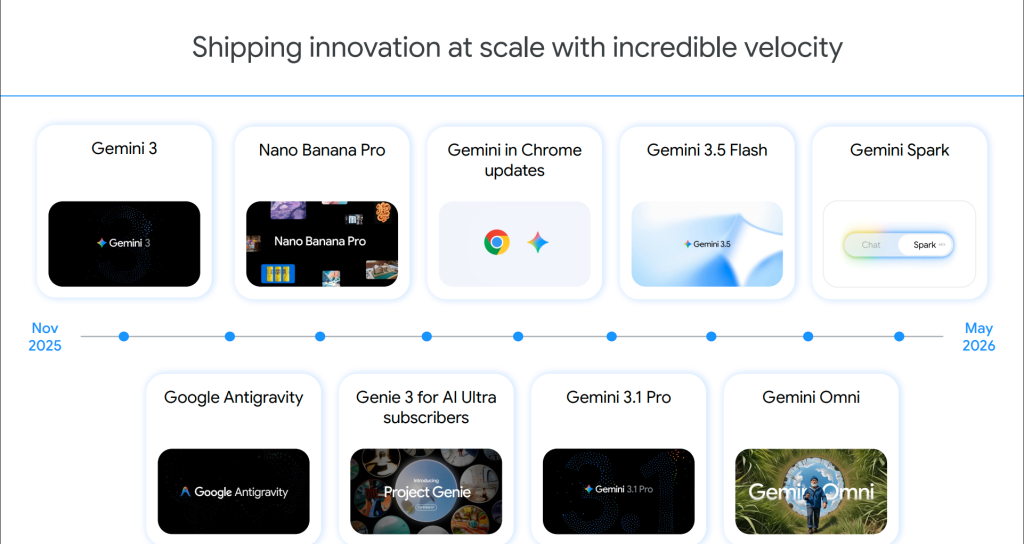
The AI compute race and its commercial payoff are now showing up plainly in the numbers. Alphabet, the parent company of Google, recently released its fiscal 2026 second quarter results. The company reported revenue of $119.8 billion, up 24 percent from the same period last year.
Alongside the results, Google CEO Sundar Pichai used the moment to offer an early look at the company’s next flagship model, Gemini 4.
Cloud Revenue Jumps 82 Percent as AI Drives Profit
The biggest engine behind this strong quarter is unmistakably the surge in demand for AI infrastructure and solutions.
According to the results, operating income for the quarter, April through June, reached $40.77 billion. Net income more than doubled, climbing from $28.2 billion a year earlier to $112.1 billion. Google Cloud alone brought in $24.77 billion, a striking 82 percent year over year increase.
“Our AI investments are redefining what is possible across every part of our business,” Pichai said on the earnings call. He also highlighted strong enterprise adoption of Gemini, noting that nearly 90 percent of the Fortune 100 now use Gemini Enterprise.
The Google Subscriptions, Platforms, and Devices segment, which includes hardware, the Google Play Store, and non advertising YouTube revenue, grew steadily to $12.91 billion this quarter.
Other Bets, the division developing longer term technology such as Waymo, remains in its investment phase. Revenue there ticked up slightly to $382 million, yet losses still reached $1.8 billion.
Looking Ahead to Gemini 4
During the earnings call’s question and answer session, outside attention centered squarely on Google’s competitiveness in frontier AI models. Gemini 3.5 Pro, originally expected in June, remains in testing with partners. Even so, Google’s sights are already fixed on the generation after it.
Pichai confirmed that the company is running what he called its most ambitious pretraining effort to date, for the next generation model known as Gemini 4.
Asked whether Google feels confident holding its lead in AI, Pichai acknowledged that the field is extremely dynamic and highly competitive. He conceded that Google still has room to improve in areas such as coding and agentic coding. At the same time, he stressed that Google has committed enormous TPU compute resources to developing the next generation model.
“For the next frontier model, you are going to need a larger base model to compete,” Pichai said. “We are training Gemini 4 right now, and our ambitions are very large. I am really excited about the progress I am seeing internally.”
Commentary: A Two Track Model Strategy
Pichai’s remarks point to a clear two track approach at Google’s AI division, whose full scope is outlined on the company’s corporate site map.
On one track, Google is iterating quickly on lightweight, fast Flash series models, including the recently released Gemini 3.6 Flash, 3.5 Flash Lite, and 3.5 Flash Cyber. Pichai has even suggested the company will ship updates at close to a monthly cadence, meeting demand for cost effective performance on specific tasks.
On the other track, Google is concentrating its most valuable TPU compute on the next flagship model, Gemini 4, to compete directly with rivals such as OpenAI. Based on the timing of past major model launches, Gemini 4 could plausibly debut around November or December this year.
Support Our Threat Intelligence
Find our tech and OS security coverage helpful? Support our work today and unlock a 100% ad-free reading experience!
 Buy Me a Coffee
