Sophisticated Android Banking Trojan Threat Evades Detection via High-Trust Lures
 Do Son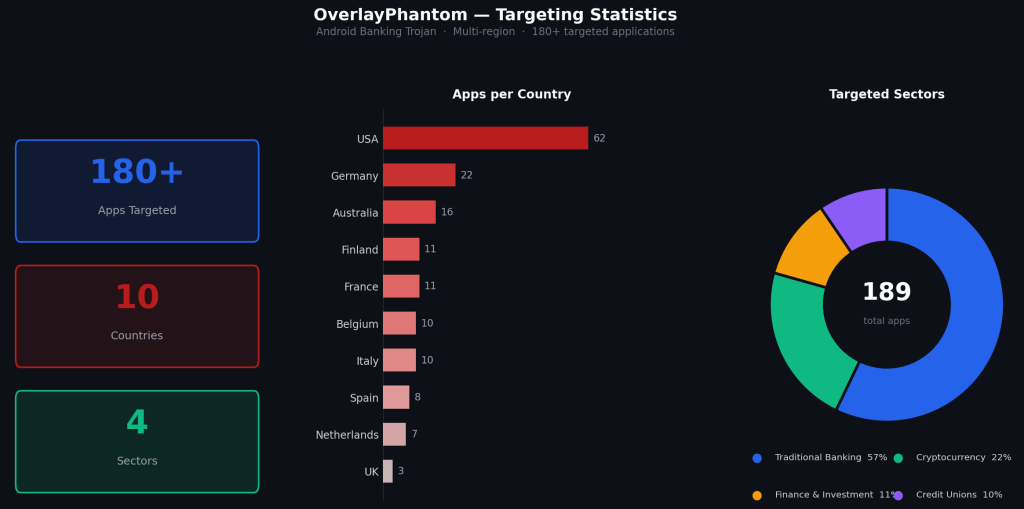
OverlayPhantom’s targets | Image: CRIL
Recently, global cybersecurity researchers uncovered a massive wave of mobile fraud hitting international consumers. This hazardous operation emphasizes that the Android banking trojan threat is expanding quickly across Western markets. To begin with, Cyble Research and Intelligence Labs (CRIL) discovered the malware spreading through deceptive download links. The advanced code uses a multi-stage process to compromise finance applications. Consequently, corporate and retail users face severe financial exposure. Defenders must quickly analyze these delivery pipelines to safeguard user environments.
Two-Stage Infection Chain Exploits Public Platforms
Initially, the malicious operators use highly popular software decoys to distribute the loader. For instance, one package masquerades as the official Austrian government identity application, ID Austria. Meanwhile, another variant pretends to be the high-popularity consumer platform, TikTok. Therefore, the campaign successfully diversifies its deployment tactics to capture different user demographics. Subsequently, the dropper displays a convincing Google Play update notification. This smart visual trap completely bypasses user suspicion by leveraging institutional trust.
Furthermore, the installer package features an interactive step-by-step tutorial. This guide walks the victim through enabling deep operating system permissions. The analysis explains: “Once deployed, Overlay Phantom masquerades as “Google Play Services” and abuses Android’s Accessibility Service to gain persistent, elevated control of the infected device.” Consequently, this deceptive naming scheme makes it exceptionally difficult for users to remove the infection.
Weaponizing Credential Harvesting Overlays
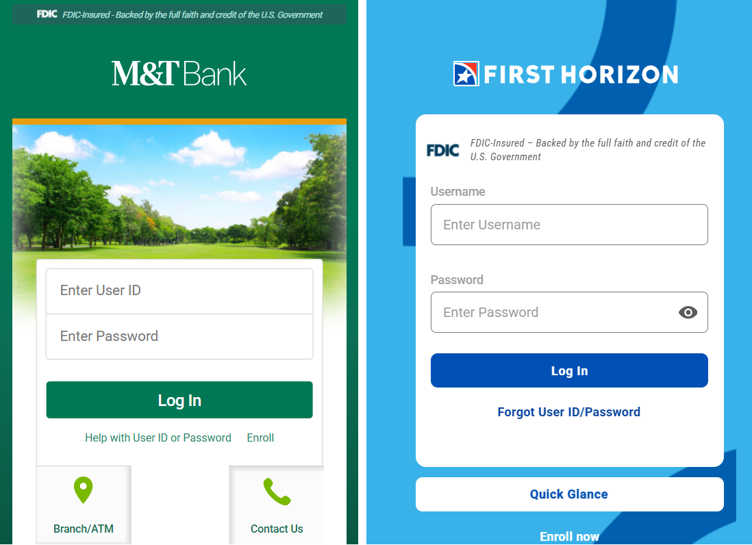
To begin with, the spyware monitors foreground application activity continuously. The software cross-references active application names with a hardcoded list inside its resources. Interestingly, the network handles a vast array of high-value targets. The report highlights that “The malware currently targets over 180 banking, finance, and cryptocurrency applications across 10 countries using embedded WebView-based HTML phishing overlays that are visually indistinguishable from the legitimate apps they impersonate.” Therefore, this massive Android banking trojan threat efficiently scales its operations across diverse financial sectors.
Automated Theft and Fake Notifications
Subsequently, the application triggers custom data extraction sheets when a match occurs. It loads pre-built assets to display credential harvesting overlays seamlessly above authentic interfaces. As a result, users enter their passwords without noticing any anomalous behavior. In addition, the command framework supports over 30 remote administrative commands. For example, operators can manipulate active clipboard items or simulate touch gestures. They can also trigger fake notification banners to force user interaction.
Real-Time Screen Streaming Capabilities
Moreover, the malicious agent features advanced visual monitoring capabilities. It leverages Android’s native MediaProjection API to capture the device screen constantly. Then, it compresses the visual assets into JPEG format to minimize bandwidth overhead. This approach grants the threat actor near real-time sight into active financial transactions. To execute this, the malware establishes a dedicated TCP connection to its backend server. Thus, the adversary captures private verification codes instantly.
Multi-Port Command Infrastructure
Interestingly, the backend architecture does not rely on a single communication line. Instead, the malware separates traffic across three distinct non-standard ports. Specifically, port 9091 handles operator command execution. Meanwhile, port 9092 tracks basic device status reports. Finally, port 9090 manages the outgoing screen streaming data. This structural division ensures that specialized data channels stay organized during high-volume operations. Consequently, this robust Android banking trojan threat poses extreme risks to retail banking clients globally.
Mitigation Strategies for Mobile Protection
Ultimately, organizations must implement rigid security controls to block mobile banking threats. Users should never download applications from unverified third-party web links. Furthermore, mobile users must audit active device accessibility permissions regularly. Security teams can also monitor enterprise networks for unusual traffic across the specified ports. In conclusion, prompt defensive action is necessary to limit the expanding blast radius of this campaign.
Support Our Threat Intelligence
Find our threat intelligence and malware analysis helpful? Support our work today and unlock a 100% ad-free reading experience!
 Buy Me a Coffee
