 Do Son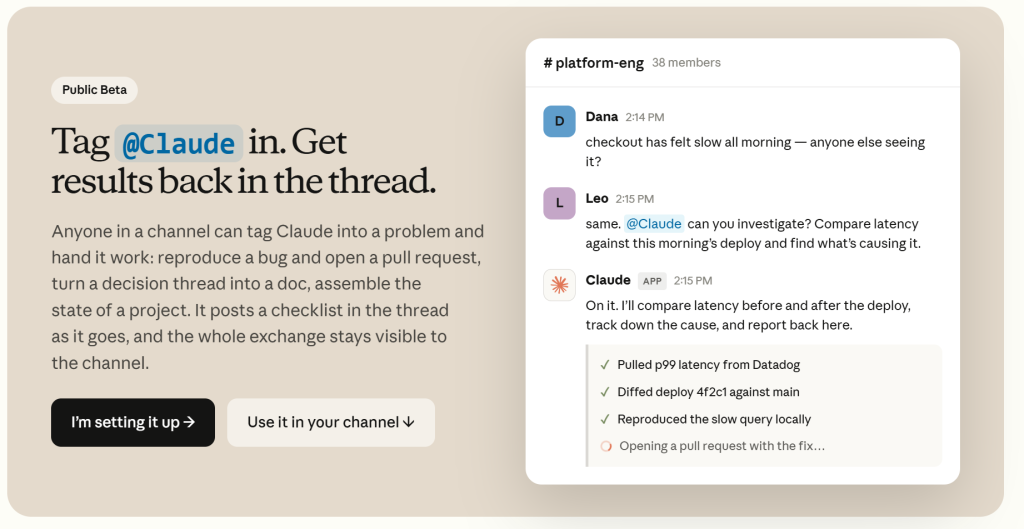
Generative artificial intelligence is rapidly evolving from a rudimentary question-and-answer utility into a sophisticated, agent-based collaborative partner. Recently, Anthropic introduced a groundbreaking application tool named “Claude Tag.” This innovative feature is currently available as a Research Preview specifically tailored for enterprise clients. Unlike traditional chatbots that require explicit human commands, the channel-resident “@Claude” boasts persistent memory across disparate conversations. Astonishingly, within its novel “Ambient Mode,” the AI can autonomously intervene in discussions. It can remind teams of forgotten tasks, functioning seamlessly as a virtual colleague possessing comprehensive situational awareness.
Presently, this transformative feature is exclusively accessible to subscribers of the Claude Enterprise and Claude Team plans.
From Passive Tool to Proactive Participant: Ambient Mode
Historically, users could privately message “@Claude” within Slack or utilize tags to summon assistance for coding or summarization. However, the system treated nearly every interaction as an isolated, discrete event. The most profound technological leap embodied by the new Claude Tag is the integration of persistent context and memory. This is a capability that legacy tools struggled to maintain.
According to the official Claude Tag overview documentation, the system operates across two distinct paradigms:
- Task Decomposition Mode: Upon receiving a definitive assignment, Claude dissects the task into sequential phases. It systematically utilizes authorized tools to execute each step, reporting its progress in real-time within the Slack thread.
- Ambient Mode: This represents the crowning achievement of the update. Claude no longer waits passively for inquiries. Instead, it continuously monitors its assigned channels. When it determines that a team requires a reminder, needs a cross-departmental summary, or uncovers neglected threads, it proactively inserts itself into the dialogue.
In a recent interview, Rob Seaman, the General Manager of Slack, emphasized a crucial point. Displaying the AI’s operational trajectory within public channels officially transitions artificial intelligence from an isolated, single-player tool into a novel form of multiplayer collaboration. Anthropic officially characterizes this experience as being akin to working alongside a genuine human colleague. You can see this dynamic in action through various demonstrations and explainer videos online.
A Unified Identity Eradicates Redundant Communication
Another core architectural design of the Claude Tag is the concept of a shared identity across an entire channel.
Consequently, everyone can transparently observe the specific tasks this virtual assistant is currently managing. If Colleague A delegates a project to Claude, Colleague B can seamlessly assume control at any moment. They can instruct Claude to execute subsequent steps without endlessly reiterating the project’s historical context. As channel conversations accumulate, Claude progressively learns and adapts to the team’s unique operational rhythms and unspoken understandings.
Stringent Boundary Controls and the Impending Transition
Naturally, an “always-on, continuously monitoring” artificial intelligence assistant inevitably triggers profound corporate anxieties regarding data security and workplace privacy.
To address these concerns, Anthropic grants system administrators absolute dominion over permission boundaries. Administrators meticulously define which internal tools, document repositories, and specific channels Claude is permitted to access. The system strictly confines the memory and context of each Claude identity within these administrator-defined perimeters. For instance, the accumulated memory and confidential data of a Claude deployed within a “Legal Team” channel will absolutely never permeate the “Engineering Team” channel.
Reportedly, the legacy Claude Slack App will officially transition to the Claude Tag framework on August 3 of this year. Anthropic has already published comprehensive user migration guidelines. While this functionality currently remains exclusive to Slack, Anthropic anticipates expanding to alternative enterprise collaboration platforms in the coming weeks.
Conquering “Blank Canvas Syndrome”: The Agentic Era
With the introduction of the Claude Tag, Anthropic precisely targets the most pervasive hurdle in enterprise AI adoption. Employees frequently lack the knowledge of how to formulate effective prompts, or they simply forget that AI tools are available.
Traditional ChatGPT interfaces or legacy Slack AI bots often resemble a daunting blank canvas. If a human remains silent, the tool achieves nothing. However, the Claude Tag’s Ambient Mode completely subverts this entrenched logic.
It elevates the AI’s status from a passive data retriever to a proactive project manager. When an AI can autonomously prompt you” Hey, regarding that contract mentioned in yesterday’s cross-departmental meeting, it appears unresolved; should I draft an initial version? that embodies the true essence of “Agentic AI.”
Furthermore, selecting Slack for a deeply integrated initial launch underscores Anthropic’s fierce ambition to challenge OpenAI within the enterprise (B2B) sector. By endowing artificial intelligence with persistent memory and a shared identity, the future of enterprise software competition will no longer hinge solely upon the parameter count of foundational models. Instead, victory belongs to whoever can integrate most seamlessly and naturally into existing human workflows.
Support Our Threat Intelligence
Find our tech and OS security coverage helpful? Support our work today and unlock a 100% ad-free reading experience!
 Buy Me a Coffee
