 Do Son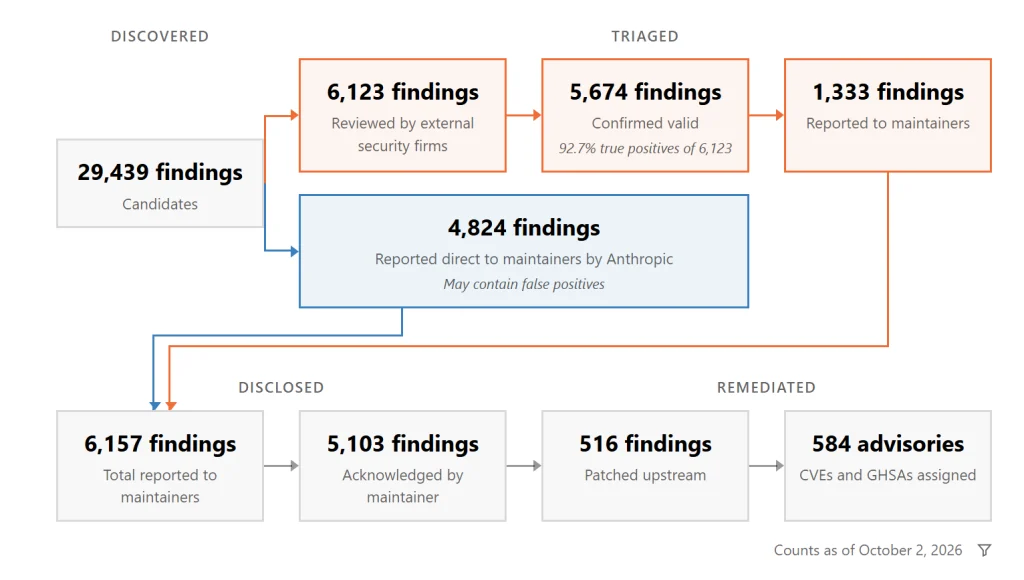
Anthropic recently announced the launch of the OSS Scanner initiative. This program is designed to provide eligible open source projects with complimentary and regular vulnerability scanning support. It leverages Anthropic’s advanced models, such as Claude Mythos. These models meticulously audit open source codebases for security flaws. Whenever a vulnerability is detected, Anthropic transmits a comprehensive vulnerability report alongside potential candidate remediation strategies directly to the developers.
Application and Review Process
This service operates entirely on a voluntary basis. Core project maintainers must submit applications through Anthropic’s GitHub repository. To qualify, a project must possess significant importance regarding infrastructure or user safety. After submission, Anthropic engineers evaluate whether the project meets the rigorous criteria. If successful, applicants are subsequently notified to proceed with necessary preparation work.
Once approved, Anthropic systematically utilizes its advanced models to scan and audit the open source code according to an established schedule. Regardless of whether vulnerabilities are discovered, Anthropic dispatches a scan report to the developers. When issues are identified, the report encompasses detailed vulnerability descriptions, reproduction materials, and candidate fixes whenever available.
Fully Automated Generation Without Human Review
Unlike Anthropic’s existing coordinated vulnerability disclosure workflows, the reports generated by the OSS Scanner initiative are produced entirely by artificial intelligence models. From the initial scan to the compilation of analytical reports, artificial intelligence guides each stage. Furthermore, the provision of remediation solutions and the entire procedure occur without any manual review or confirmation.
Anthropic asserts that this methodology enables faster and more frequent vulnerability updates for maintainers. However, model-generated reports may still contain errors, potentially exaggerate severity ratings, or fail to fully grasp a project’s specific threat model. Consequently, project developers must ultimately evaluate the reported vulnerabilities independently.
Early Testing Demonstrates High Accuracy
During early pilot testing, Anthropic invited specialized penetration testing researchers to evaluate 97 high and critical severity vulnerability reports. These reports originated from 48 distinct projects. Remarkably, 85 of those reports, accounting for 88 percent, successfully met the rigorous standards of the coordinated vulnerability disclosure workflow.
Among the remaining 12 findings, 11 represented genuine security issues that duplicated known vulnerabilities or other flaws uncovered during the scan. Only a single finding was judged to be invalid. These promising results derive from Anthropic’s published test sample and do not guarantee identical validation efficacy for all future reports.
Furthermore, unverified reports remain confidential and are exempt from the mandatory 90-day disclosure timeline. For critical security issues within major projects where vulnerabilities undergo manual auditing by Anthropic, traditional disclosure procedures will apply.
Support Our Threat Intelligence
Find our tech and OS security coverage helpful? Support our work today and unlock a 100% ad-free reading experience!
 Buy Me a Coffee
