The 10,000-Bug AI: How Anthropic’s Secret “Mythos” Model is Rewriting Cyber-Resilience
 Do Son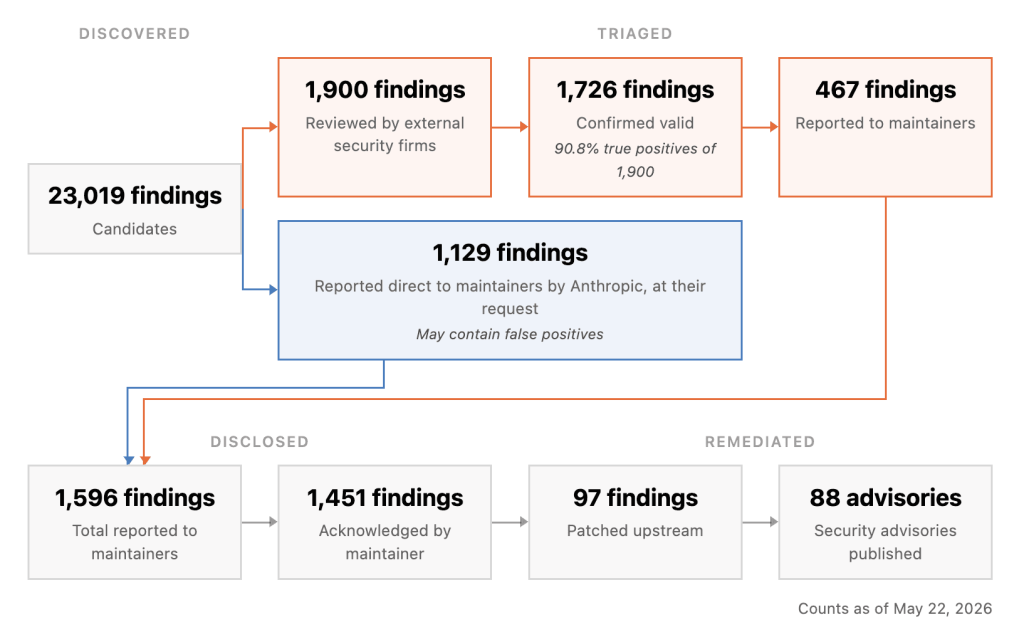
Dashboard of open-source vulnerabilities | Image: Anthropic
Amidst the escalating anxieties surrounding the security implications of artificial intelligence, a subset of the industry is pioneering a strategic reversal, actively weaponizing AI to fortify the perimeter against its own adversarial counterparts. Anthropic recently unveiled a comprehensive progress report detailing the latest evolution of its specialized cybersecurity initiative, Project Glasswing.
The foundational engine of this project is a proprietary, unreleased architecture designated as “Claude Mythos Preview.” The efficacy of this model is nothing short of superlative; within merely one month of the project’s inception, Mythos has assisted operational partners in identifying in excess of 10,000 unique software vulnerabilities, with a significant majority of these partners uncovering hundreds of defects categorized as “Critical” or “High-Risk.”
Per Anthropic’s telemetry, participants leveraging Project Glasswing experienced an order-of-magnitude acceleration in vulnerability identification—surpassing a tenfold increase in throughput. Notable exploits and metrics include:
- Cloudflare: Isolated 2,000 distinct vulnerabilities, of which an astounding 400 were classified within the critical or high-risk thresholds.
- Mozilla: Successfully mapped and remediated 271 vulnerabilities within the Firefox codebase—a figure representing a tenfold increase over the output generated by previous iterations of the Claude model.
- Microsoft: The recent anomalous surge in the volumetric size of Microsoft’s periodic patch bundles is attributed directly to the systemic extraction of deeply embedded vulnerabilities facilitated by Mythos Preview.
- Open-Source Audit: Anthropic deployed the model to triage 1,000 open-source repositories; out of 23,019 total detected defects, the model successfully isolated 6,202 vulnerabilities posing severe or critical hazards.
- macOS Infiltration: Although formally omitted from the primary disclosure, independent security researchers have claimed that by utilizing the analytical acuity of Mythos, they successfully bypassed the hardened, multi-layered security architecture of Apple’s macOS operating system.
Why does Anthropic maintain a policy of strictly restricted access to such a formidable technical asset?
Anthropic candidly asserts that the industry, including their own internal research divisions, currently lacks the defensive maturity to curate against the malicious weaponization of such high-capability models. Should the Mythos architecture be exfiltrated into the adversarial wild, it would catalyze a catastrophic epoch of automated, zero-day vulnerability exploitation. Consequently, until the maturation of comprehensive safety guardrails, models within the Mythos tier will remain strictly sequestered from public release.
For the present, Anthropic is calibrating a strategic pivot, expanding Project Glasswing through collaborative frameworks with sovereign governments—an initiative widely interpreted as a maneuver to solidify its geopolitical positioning with the U.S. executive branch. Simultaneously, the beta-testing registry for this project now encompasses a significant cross-section of the global technology hegemony, including AWS, Apple, CrowdStrike, Google, JPMorgan Chase, NVIDIA, and Palo Alto Networks.
Beyond its technological trajectory, Anthropic is manifesting profound fiscal momentum. According to recent dispatches from The Wall Street Journal, the firm—founded in 2021—is projected to realize $10.9 billion in revenue and $559 million in operating profit for the fiscal quarter concluding this June, marking the organization’s historic inaugural quarterly profitable cycle.
Pragmatically, Anthropic clarifies that this profitability is an ephemeral inflection point; sustained, massive capital reinvestment into computational resource acquisition and iterative model research dictates that this positive fiscal state will likely not persist across subsequent quarters.
The disclosures surrounding Project Glasswing illuminate a definitive strategic divergence between Anthropic and OpenAI.
While OpenAI pursues an aggressive push of ChatGPT into the mass consumer market, prioritizing feature breadth and fluid vocal interactivity, Anthropic has firmly anchored its corporate doctrine to the imperatives of “safety” and “alignment,” concentrating its operational weight upon B2B enterprise sectors and sovereign institutions.
The performance of the Mythos model provides empirical validation that within the high-stakes domains of code auditing and cyber-resilience—environments characterized by negligible margin for error—the commercial potential of artificial intelligence is virtually limitless. Anthropic’s deliberate decision to withhold the Mythos source-weights from public access, while seemingly conservative, has functionally secured an invaluable reservoir of institutional trust from the highest tiers of the technology and government apparatus, including Microsoft, Google, Apple, and the U.S. federal government.
Support Our Threat Intelligence
Find our tech and OS security coverage helpful? Support our work today and unlock a 100% ad-free reading experience!
 Buy Me a Coffee
