 Do Son
TL;DR
On November 18, 2026, ASUS released patches for its router firmware and five Windows software tools. In this update, ASUS Fixes 12 Flaws led by a critical CVSS 10.0 auth bypass in ASUS Control Center Express. IT teams and home users must install the latest firmware and software builds right away.
- Total: 12 CVEs
- Severity: 4 Critical · 5 High · 3 Medium
- Actively exploited: None confirmed
- Highest severity: 10.0 (Critical · CVSSv4) — CVE-2026-114202
- Action: Apply the latest security updates now
Notable CVEs
| CVE | CVSS (CVSSv4) | Status |
|---|---|---|
| CVE-2026-114202 | 10 | Not exploited |
| CVE-2026-114205 | 9.4 | Not exploited |
| CVE-2026-126574 | 9.4 | Not exploited |
| CVE-2026-114204 | 9 | Not exploited |
| CVE-2026-88711 | 8.7 | Not exploited |
| CVE-2026-93459 | 8.5 | Not exploited |
| CVE-2026-112115 | 8.5 | Not exploited |
| CVE-2026-112117 | 7.3 | Not exploited |
Why It Matters
Firms and home users run ASUS routers, server tools, and PC drivers across millions of devices. Thus, auth bypasses and root command bugs put both home gateways and office networks at high risk.
In addition, five bugs carry High scores from 7.0 to 8.7, while three hold Medium ratings. Neither ASUS nor outside teams have confirmed live attacks in the wild or public exploit code yet.
How the Attack Works
Critical Control Center Flaws
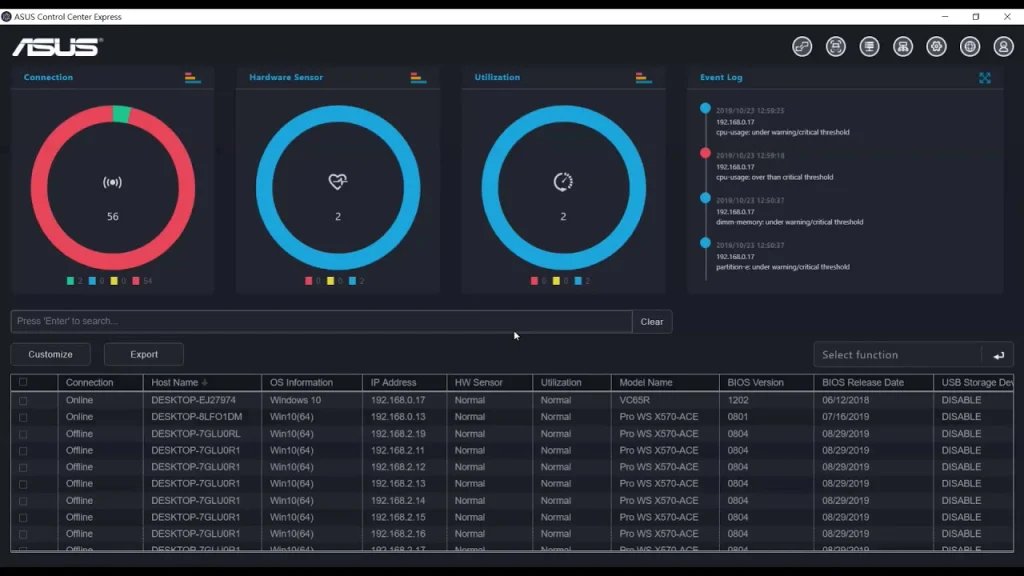
First, ASUS Fixes 12 Flaws that include three critical bugs in ASUS Control Center Express found by researcher 0x0dee. The vendor warns, “If exploited, these issues could allow a remote user to bypass authentication or improperly gain administrator-level access to the management console and the clients it manages.” Specifically, CVE-2026-114202 (10.0 CVSS) and CVE-2026-114204 (9.0 CVSS) use hard-coded crypto keys (CWE-321). Remote attackers can use those keys to forge login tokens. Next, CVE-2026-114205 (9.4 CVSS) is an access check bug (CWE-863) that lets a low-privileged user make an admin account.
Meanwhile, researcher Emilio Galle (emilloc) found CVE-2026-126574 (9.4 CVSS) in ASUS Control Center Datacenter and Enterprise. Due to missing auth checks (CWE-862), a low-level Viewer user can change an admin password.
Router Firmware and PC Tool Bugs
Second, five flaws hit ASUS router firmware. Klein Andras reported CVE-2026-88711 (8.7 CVSS), an OS command injection bug (CWE-78). It gives root access if an admin visits a bad site. Also, CVE-2026-93459 (8.5 CVSS) is a format string bug (CWE-134) that lets an adjacent admin read or write memory. Moreover, CVE-2026-19399 (6.1 CVSS) and CVE-2026-88760 (5.3 CVSS) let nearby users read files or media over HTTP. At the same time, CVE-2026-93458 (6.1 CVSS) leaks router UIDs or linked cloud tokens.
Third, three local privilege bugs hit Windows PC tools. CVE-2026-112115 (8.5 CVSS) uses an unsafe search path (CWE-426) in Armoury Crate to run a rogue file. Similarly, CVE-2026-112117 (7.3 CVSS) is a driver path traversal bug (CWE-22) in System Control Interface. Lastly, CVE-2026-119469 (7.0 CVSS), found by M. Fauzan Wijaya, stems from bad folder rights in DisplayWidget Center.
Affected Versions
Vulnerable Firmware and Software Builds
Because ASUS Fixes 12 Flaws across hardware and software lines, several versions face risk.
- Control Center Express: Builds through v1.7.27 (older than v1.7.29).
- Control Center: Datacenter 4.0.0.2 and older, and Enterprise 3.1.0.8 and older.
- Router Firmware: Series 3.0.0.6.102, 3.0.0.4.388, and 3.0.0.4.386.
- PC Tools: Armoury Crate through V6.7.2, System Control Interface 3.1.68.0, and DisplayWidget Center v1.3.1.3 to v1.5.1.3.
Patch and Mitigation Steps
In its alert, the vendor states, “ASUS strongly recommends that all users update their router firmware to the latest version immediately.” Enterprise admins must install Control Center Express v1.7.29 or newer and update client agents via Client Agent Updater. Teams should also patch Control Center, Armoury Crate, System Control Interface, and DisplayWidget Center.
Finally, if router admins cannot patch today, ASUS advises turning off the iTunes Server, remote file access, and WAN access. Users should also set strong 10-character passwords, log out after use, and re-link cloud accounts after patching.
Support Our Threat Intelligence
Find our vulnerability reports and weekly recaps helpful? Support our work today and unlock a 100% ad-free reading experience!
 Buy Me a Coffee
