BankWeaver Campaign Abuses Temenos Quantum Fabric Middleware to Plant Webshells in Banks
 Do Son
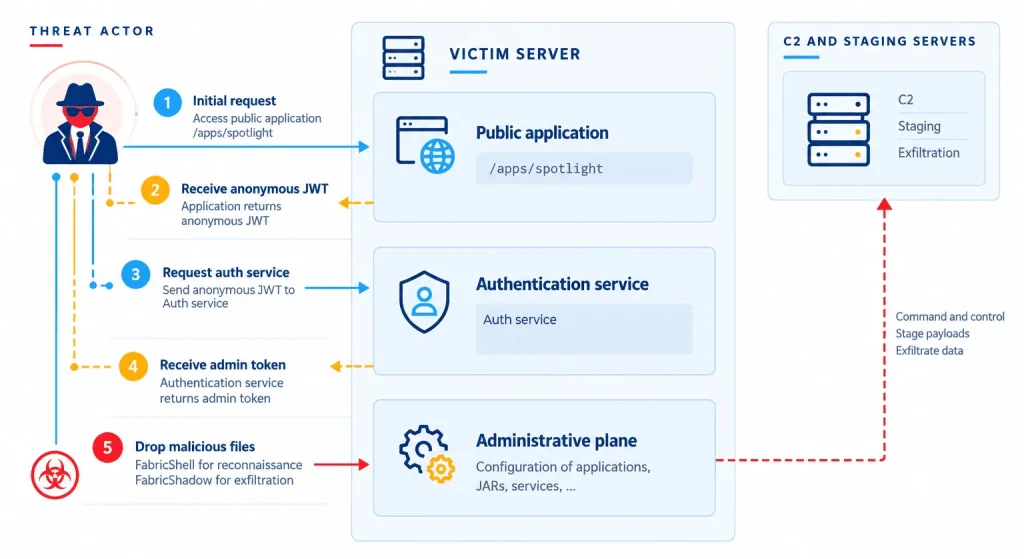
Image: Forescout Research
| At a glance | |
| Malware family | FabricShell (Java webshell) and FabricShadow (Java recon and exfiltration tool) |
| Threat actor | Unknown; not attributed by Forescout |
| Targets | Banks running Temenos Quantum Fabric; one confirmed compromise, six more exposed deployments |
| Delivery vector | An internet-facing Fabric authentication service set to allow anonymous access |
| Key capabilities | Admin token theft, OS command execution, database queries, reverse shells, host reconnaissance |
TL;DR
In early September 2026, Forescout investigated a breach at a financial firm and uncovered the BankWeaver campaign. Attackers abused a misconfigured Temenos Quantum Fabric service to turn an anonymous token into admin access. They then uploaded two Java tools that ran commands, queried databases, and stole server data.
Delivery
Temenos Quantum Fabric is middleware that links banking apps to identity systems, databases, and payment services. Temenos serves more than 950 core banking and 600 digital clients in over 150 countries.
In the breached deployment, an authentication service was set for anonymous access instead of private access. It was also reachable from the internet. As a result, attackers opened a public back-office app and captured the anonymous token it issued. They then traded that token for an admin token “without possessing valid credentials,” Forescout says.
Forescout reported the issue to Temenos. Temenos determined it stemmed from the service configuration, and it released updates and guidance to set the service to private.
Infection chain
Abusing a trusted extension feature
Fabric lets administrators upload custom Java code as services. The BankWeaver campaign turned that legitimate feature against its owners. With admin rights, the attackers imported a ZIP file that created a new service open to command injection.
They tested it with simple commands and opened a reverse shell. Next, they pulled shell scripts from free file-hosting sites. Typos and repeated commands showed a human operator at the keyboard.
FabricShell and FabricShadow
The attackers then uploaded two JAR files. FabricShell is a webshell that runs system commands or database queries on request. It returns up to 50 rows of data per query.
FabricShadow fires before every data request. It collects the hostname, network addresses, Java details, the service account, and folder listings. Then it sends that profile to the attacker and keeps a local copy.
Because both tools ran inside Fabric’s own service framework, they inherited the app’s identity and database access. In Forescout’s words, “What seemed like normal application traffic became attacker-controlled command execution.”
Command-and-control and data exfiltration
The operators kept their own infrastructure small. FabricShell carried hardcoded database credentials for another victim. Likewise, FabricShadow pointed to a webshell on that same victim’s server, which served as a staging point for stolen data. Forescout believes the actor used “victims as staging points to minimize their own infrastructure.”
Forescout also traced more than 30 rotating source IPs. Most were hacked UK home routers and NAS devices, plus a few rented VPS nodes. One proxy IP was seen downloading botnet malware. However, Forescout notes those bots “may not be directly related” to the BankWeaver operators.
Attribution and scale
Attribution remains open. Forescout has not linked the activity to any known group. It confirmed one compromise, and the hardcoded credentials point to at least one more victim. It also found six other banks in Asia, the Middle East, Europe, and the Americas with the same exposed setup. It has not confirmed that those six were breached.
Defense and detection guidance
Banks running Temenos Quantum Fabric should:
- Set Fabric authentication and backend services to private, and apply Temenos updates.
- Remove internet access to admin, identity, workspace, import, and JAR routes.
- Reject anonymous tokens at any service beyond its intended login step.
- Alert on ZIP imports, JAR uploads, and new service publications.
- Flag Java or Tomcat processes that launch shells, curl, wget, or netcat.
- Apply default-deny outbound rules on application servers.
- Revoke sessions and rotate every secret found in logs or packages.
In short, BankWeaver shows how one exposed setting can turn trusted banking middleware into an attacker’s tool.
Support Our Threat Intelligence
Find our threat intelligence and malware analysis helpful? Support our work today and unlock a 100% ad-free reading experience!
 Buy Me a Coffee
