BlackNevas ESXi Ransomware Abuses vCenter Host Profiles to Destroy Virtual Infrastructure
 Do Son
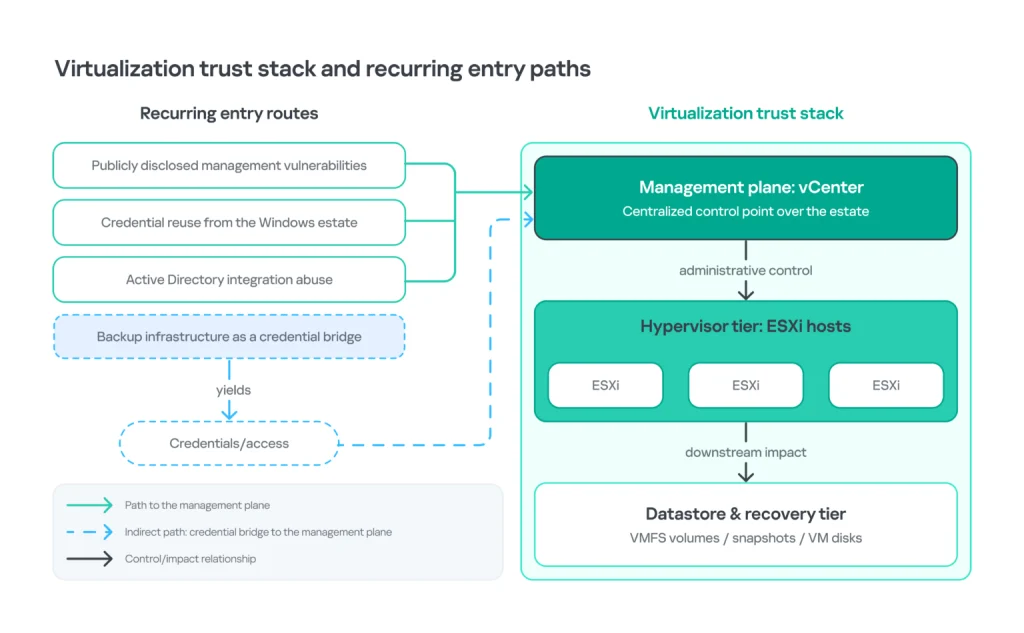
The virtualization trust stack and recurring entry paths | Image: Kaspersky
TL;DR
Kaspersky Global Emergency Response Team (GERT) investigated a 10-day intrusion where BlackNevas ESXi ransomware destroyed an organization’s entire virtualized environment without exploiting a single hypervisor vulnerability. Instead, the attackers extracted credentials from backup systems and planted two persistence tools on a vCenter Server Appliance. They also used vCenter Host Profiles to turn on SSH across four ESXi servers. Before launching the final VMware BlackNevas ESXi ransomware binary to wipe virtual disks, the intruders encrypted the backup servers. Moreover, they locked out administrators.
Delivery and Attribution
Over a 10-day dwell period, the attackers progressed from initial portal reconnaissance to Domain Admin privileges in roughly five hours on Day 2. By Day 3, they compromised the backup server and both vCenter Server Appliances using credentials harvested from the Windows estate. They targeted backup infrastructure, rather than using a software exploit. According to the Kaspersky GERT incident report, “What’s interesting about this attack is that no virtualization layer vulnerabilities were exploited: no guest-to-host escapes, no hypervisor memory corruption. Every action taken against ESXi was executed through legitimate VMware management interfaces.”
Confirmed Versus Suspected Attribution
Confirmed claim attribution comes from the ransom notes dropped during the attack, which named the BlackNevas group first observed in November 2024. Meanwhile, suspected code attribution links the unrecovered esx64 binary to the Trigona ransomware lineage. SentinelOne previously documented BlackNevas as a Trigona derivative. The forward-slash command-line flags recorded in shell logs match Trigona’s syntax. However, because the locker binary itself was missing during post-incident forensics, analysts rate the exact family implementation match at medium-to-high confidence. While this investigation focused on one enterprise where four ESXi hosts, two vCenter appliances, and all guest VMs were wiped, Brandefense Blackhole telemetry tracked 12 dark-chat posts mentioning BlackNevas between August and November 2026.
Infection Chain
On the disaster-recovery vCenter appliance, the attackers logged in as root over SSH for just two minutes and 26 seconds. Within 43 seconds of logging in, they ran a shell script to install MeshAgent, the legitimate endpoint client for MeshCentral. Next, they stopped using interactive SSH on that appliance altogether. Four hours later, they connected through MeshAgent and registered a Ligolo-ng v0.8.2 reverse tunnel as a systemd service named vmware-vdma.service. They placed the binary inside a VMware directory. Thus, it blended in with standard appliance tasks.
Weaponizing vCenter Host Profiles
After six quiet days of maintaining access, the operators re-entered the network on Day 10 and turned vCenter’s compliance features against the hypervisors. Specifically, they modified a vCenter Host Profile to change the Tech Support Mode SSH (TSM-SSH) service state on the managed ESXi hosts. Within 11 minutes of reading the host configuration, vCenter pushed the updated profile. As a result, TSM-SSH switched to a running state 33 seconds later. As the researchers noted, “The security control was not bypassed from below. It was reconfigured from above.” Using the trusted vCenter IP address, the attackers then connected to the ESXi hosts via SSH. They uploaded the locker to the temporary folder over SFTP using a Bitvise FlowSsh client.
Command-and-Control and Impact Behavior
While Ligolo-ng maintained an outbound tunnel to a lookalike Cloudflare domain on TCP port 443, the attackers prepared the destructive phase on Day 11. Rather than hitting the hypervisors first, they stopped backup services at the start of the final sequence. They encrypted the backup server seven minutes later. Next, ransomware spread across SMB shares at 52 minutes, and locked out administrators at two hours and eight minutes.
Roughly three hours before final detonation, the operators ran the staged binary with a /selftest flag for 16 seconds to verify compatibility with the target ESXi build. On the disaster-recovery host, all running virtual machines stopped within 23 seconds. Finally, at two hours and 31 minutes into the impact sequence, the attackers launched the VMware BlackNevas ESXi ransomware payload with forward-slash arguments targeting the /vmfs/ volume path. This action reached a depth of five directories in wipe and detached mode. Forensic artifacts showed that the locker overwrote the first 2 kilobytes of virtual disk files. In addition, it created ._wipe markers. This destroyed primary boot records and rendered every guest VM unbootable in about three hours.
Defense and Detection Guidance
Because third-party antivirus and EDR agents are unsupported on ESXi and guest agents cannot see hypervisor processes modifying VMDK files from outside, defenders must rely on architectural boundaries and centralized logging. As Gridinsoft and Kaspersky analysts emphasize, organizations must treat vCenter as a Tier 0 asset with dedicated identities separate from corporate Active Directory. Furthermore, administrators should keep the execInstalledOnly runtime and kernel settings enabled. They should also forward ESXi ramdisk logs – especially auth.log, shell.log, vpxa.log, and vobd.log – to an external syslog server before a reboot wipes local evidence.
Security teams should build correlation alerts for Host Profile remediations that enable TSM-SSH outside approved maintenance windows. These alerts are especially important when followed by direct SSH connections from a vCenter IP address. Finally, defenders must isolate backup servers on a separate identity plane. This measure ensures that a production domain breach cannot be used to wipe recovery repositories prior to hypervisor encryption.
Support Our Threat Intelligence
Find our threat intelligence and malware analysis helpful? Support our work today and unlock a 100% ad-free reading experience!
 Buy Me a Coffee
