 Do Son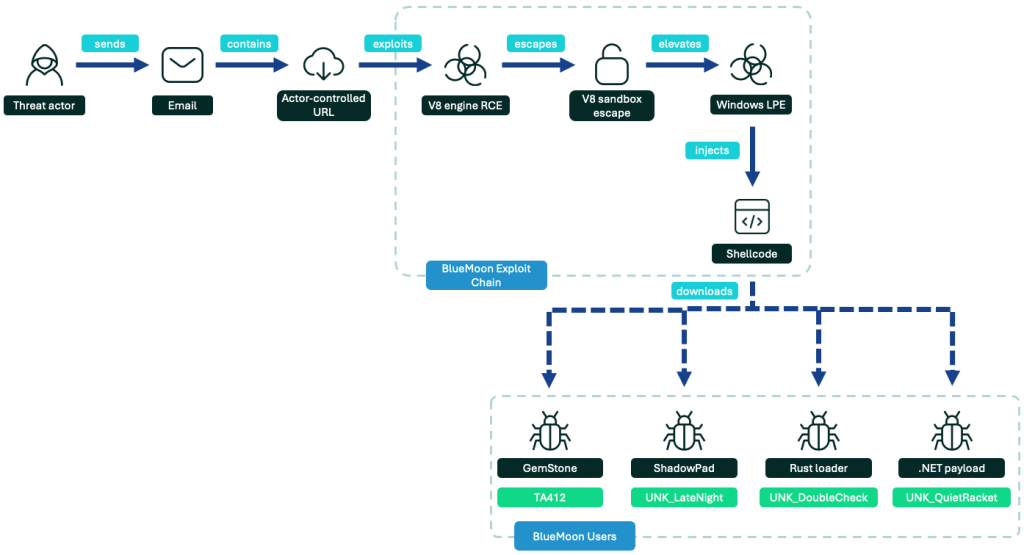
BlueMoon exploit chain used by multiple actors | Image: Proofpoint
Proofpoint threat researchers uncovered state-aligned espionage groups deploying zero-day browser exploit chains in late August 2026.
| Field | Details |
|---|---|
| Actor or Group | Suspected China-aligned espionage groups, including TA412, UNK_LateNight, and UNK_QuietRacket |
| Activity Type | Targeted spearphishing, browser zero-day exploitation, and cyber espionage |
| Targets or Victims | US NGOs, defense firms, aerospace entities, and Southeast Asian organizations |
| Scale | Targeted spearphishing operations hitting critical infrastructure across multiple nations |
| Jurisdiction Status | Active tracking by threat researchers; US authorities previously indicted alleged TA412 members |
| Source | Proofpoint Threat Insight |
Executive Summary
Proofpoint identified four espionage-motivated threat actors deploying the new BlueMoon exploit kit in targeted attacks. The attack chain exploits two Chrome browser flaws alongside a Windows kernel privilege escalation vulnerability. Security teams must patch Chromium browsers and update older Windows operating systems immediately to neutralize the threat.
What Happened in the BlueMoon Attacks
Proofpoint observed espionage groups adopting the kit in late August and early September 2026. Threat actors delivered malicious links through deceptive spearphishing emails. Once a victim opened a link, the exploit chain compromised their browser without warning.
According to the report, “Proofpoint identified four espionage-motivated threat actors employing a new exploit kit that chains multiple Chrome browser and Microsoft Windows vulnerabilities.” The exploit kit targets two Chromium flaws and a Windows kernel bug. Specifically, the chain uses a type-confusion bug in the Chromium V8 engine tracked as CVE-2026-85046. Next, the chain executes a V8 sandbox escape to break out of the browser tab. Finally, it triggers an elevation of privilege flaw tracked as CVE-2026-85880 in the Windows kernel.
Both V8 bugs represented patch-gap zero-days during the attacks. Developers committed upstream fixes to the public Chromium repository weeks before Google shipped downstream stable updates. For instance, engineers fixed CVE-2026-85046 on August 7, 2026. However, Google rolled the patch into stable builds on September 3, 2026. As researchers noted, “This opened a nearly four-week window during which the diff was publicly available without a released patch.”
The exploit kit developer converted these public fixes into functional weapons. The technical analysis in the Proofpoint threat research report details this exact exploit chain. Furthermore, researchers found clues pointing to artificial intelligence assistance in building the kit. The code contained detailed debugging logs, handover markdown notes, and iterative developer comments.
Who Is Behind the Intrusion Clusters
Proofpoint assesses with moderate-to-high confidence that most observed activity aligns with Chinese state interests. The initial cluster using the kit was TA412, also known as APT31 or Violet Typhoon. The group began deploying the tool on August 28, 2026. The United States government previously indicted alleged members of TA412 in 2024 for economic espionage.
Soon after, three other distinct espionage clusters adopted the same exploit framework. A suspected China-aligned actor tracked as UNK_LateNight targeted American aerospace companies. These attackers sent business-to-business lures related to the defense industrial base. Meanwhile, an actor tracked as UNK_QuietRacket targeted organizations in Indonesia and Singapore. This group disguised phishing messages as invitations to creative economy conferences.
Additionally, an actor tracked as UNK_DoubleCheck targeted a manufacturing firm in Vietnam. The attackers sent these emails from a compromised Southeast Asian government account. Proofpoint has not attributed UNK_DoubleCheck to a specific country. However, the team assesses that the actor is very likely espionage-motivated. The rapid adoption across separate groups suggests a shared digital quartermaster or centralized supplier.
Impact and Scale of the Exploitation
The impact varies depending on the specific payload delivered by each threat group. For example, TA412 installed a malicious browser extension called GemStone. The extension pretended to be an AI browsing companion from Google Gemini. Once installed, GemStone steals cookies, captures browser sessions, logs keystrokes, and takes screenshots.
To install GemStone, the attackers bypassed Chromium Secure Preferences protections. They computed valid cryptographic checksums using the user security identifier. Consequently, the browser loaded the rogue extension without displaying warning prompts.
Meanwhile, UNK_LateNight delivered the ShadowPad backdoor to targeted aerospace networks. The malware unhooks twenty network monitoring functions to evade endpoint defenses. It then sniffs network traffic and beacons to command servers. In contrast, UNK_DoubleCheck deployed a custom Rust loader through dynamic link library sideloading.
Fortunately, the exploit chain relies on a Windows kernel flaw that exists only on older builds. Supported builds include Windows 10 versions 1809 through 22H2 and Windows Server 2022. Because modern Windows 11 systems block the kernel exploit, the overall target pool remains limited.
What Comes Next and Defense Guidance
Security analysts expect the tool to spread further across the threat landscape. Proofpoint warned that “Given its ease of adoption, it is likely to proliferate further and be adopted by espionage-motivated and financially motivated threat actors.” The open-source patch gap creates recurring opportunities for attackers to build browser exploits.
Recommended Defensive Measures
To defend enterprise networks against BlueMoon exploit kit campaigns, organizations must adopt layered protections:
- Update Google Chrome, Microsoft Edge, and other Chromium browsers to the latest stable versions immediately.
- Upgrade endpoints running legacy Windows 10 versions to modern Windows 11 builds.
- Audit installed browser extensions for unauthorized items that request excessive tab permissions.
- Monitor endpoint processes for unusual curl executions spawned by browser processes.
- Block network connections to known command infrastructure and dynamic worker endpoints.
Support Our Threat Intelligence
Find our threat intelligence and malware analysis helpful? Support our work today and unlock a 100% ad-free reading experience!
 Buy Me a Coffee
