CL-STA-1238 Uses Cairn Framework and Chinese AI Models to Breach 10 Organizations
 Do Son
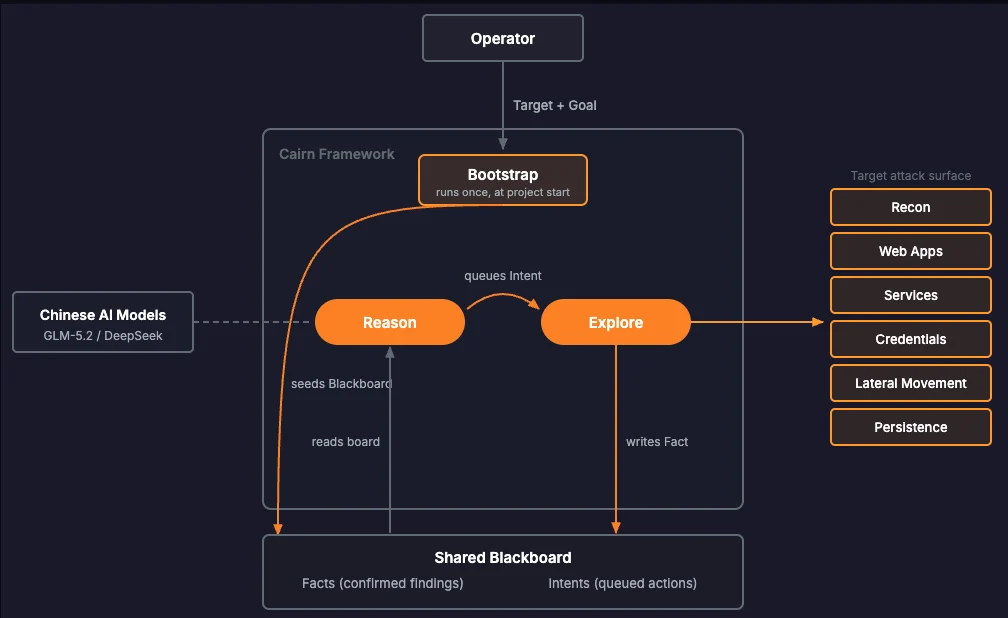
Cairn orchestration loop | Image: Unit 42
TL;DR
Between August and September 2026, Chinese-speaking threat actors used the open-source Cairn framework to run 25 autonomous hacking operations against 19 organizations. By pairing this Cairn framework CL-STA-1238 setup with commercial Zhipu GLM and DeepSeek language models, the attackers breached 10 targets without manual keyboard intervention. Compromised victims included semiconductor manufacturers, defense policy groups, and a U.S. teachers’ union where over one million member records were exposed.
What Happened in the Campaign
From August through September 2026, threat actors tracked as CL-STA-1238 deployed a customized fork of an open-source penetration testing tool from a server in Hong Kong (154.44.31.4) and routed attack traffic through a U.S. staging node (82.29.129.54). According to an investigation into Cairn framework autonomous attacks by Palo Alto Networks Unit 42, human operators simply typed a root domain and a one-line objective in Chinese. From there, the software planned and carried out the intrusions on its own for periods lasting from 20 minutes to over 50 hours.
“The attackers supplied a target and a goal, then Cairn planned, executed and recorded results on its own,” Unit 42 researchers wrote. In one task targeting a semiconductor equipment vendor, the operators seeded the system with pre-collected VPN gateway addresses and shared group passwords to speed up initial entry.
The Shared Blackboard and AI Models
Inside the Cairn framework, an artificial intelligence model drives each worker agent through a central “blackboard” architecture. After an initial bootstrap task, the agent alternates between a “Reason” phase and an “Explore” phase across three to seven operational stages. Confirmed findings are written to the blackboard as immutable facts, while next steps are queued as intents.
Because the tool is model-agnostic, the attackers tested multiple Chinese language models across their 25 operations. Specifically, they ran 13 operations on Zhipu GLM 5.2, eight on DeepSeek V4 Flash, and four on DeepSeek V4 Pro, switching to the higher-tier Pro model whenever a target resisted initial attempts. Each session also loaded a custom skill pack named “AIScan Runner Skills” and generated an AUTHORIZATION.md file. To bypass model safety guardrails, the operators prepended a Chinese system prompt declaring that all tasks were part of an authorized security assessment or capture-the-flag (CTF) exercise.
Who Is Behind the Activity
Unit 42 tracks this activity cluster as CL-STA-1238 and assesses with moderate confidence that it represents a China-nexus intelligence collection effort. Researchers noted that autonomous orchestration allowed a single operator or a very small team to attack 19 organizations simultaneously over a two-week period.
Three main indicators support this attribution assessment. First, all task names, one-line prompts, and authorization pretexts were written in Simplified Chinese. Second, the operators relied exclusively on Chinese artificial intelligence models (Zhipu GLM and DeepSeek). Third, the target selection — covering seven semiconductor supply-chain firms, three defense policy entities, and four civil-society groups — aligns closely with Beijing’s strategic priorities.
Impact and Confirmed Breaches
Across the 25 operations, the Cairn framework CL-STA-1238 campaign achieved unauthorized access or data theft at 10 organizations. At a semiconductor firm, the agent brute-forced a partner-integration credential, pulled user and email lists, and created persistent administrator accounts alongside an API token in production. At an industry standards body, the agent sprayed weak passwords, accessed internal directories, and overwrote a live standards-ballot document via an unauthenticated cloud-storage flaw.
Meanwhile, at a U.S. teachers’ union, the agent exploited an unauthenticated account-creation bypass in a content management system to access over one million member records, 31,000 CRM contacts, and staff password hashes. At a defense-policy think tank and analytics vendor, the tool abused an open registration endpoint to expose roughly 500 user records, including .mil and .gov accounts. Five additional breaches exposed employee data at a semiconductor-lithography firm, 150,000 internal documents at an industrial-automation company, and student records at an education nonprofit.
How Organizations Can Stay Protected
Although the Cairn framework automates the speed and scale of intrusions, the agents only succeeded by exploiting known security gaps. “Autonomous AI raises the volume and coverage of exploitation, but not its complexity. Identity hygiene, attack-surface reduction and software patching remain effective,” Unit 42 noted. To defend against autonomous agents, organizations should enforce multi-factor authentication, eliminate default and weak passwords, restrict unauthenticated cloud storage writes, and lock down open backend registration endpoints. Finally, network defenders should block connections from 154.44.31.4 and 82.29.129.54 and audit production systems for unauthorized administrator accounts or API tokens.
Support Our Threat Intelligence
Find our threat intelligence and malware analysis helpful? Support our work today and unlock a 100% ad-free reading experience!
 Buy Me a Coffee
