 Do Son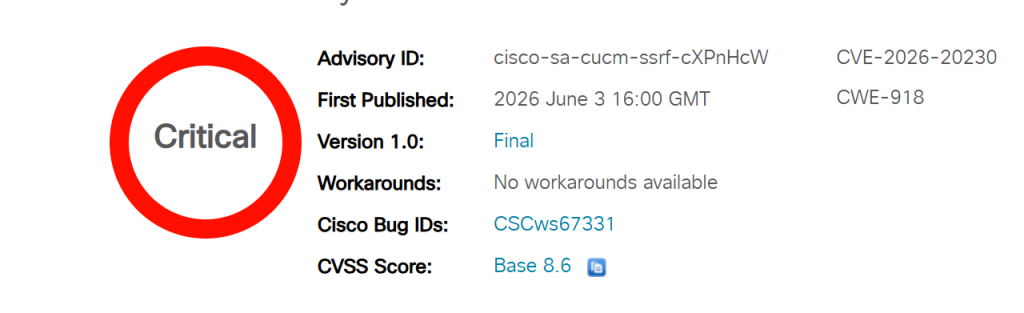
A severe Cisco Unified CM vulnerability threatens network infrastructure globally. This flaw allows unauthenticated remote adversaries to execute server-side request forgery (SSRF) attacks. Furthermore, full technical details and proof-of-concept exploit code are now accessible to the public. Consequently, enterprise administrators must examine their active software configurations immediately to protect corporate environments.
Inside the WebDialer SSRF Flaw
The high-severity software defect, officially tracked as CVE-2026-20230, carries a CVSS score of 8.6. However, Cisco elevated its overall threat priority due to the severe downstream risks. According to the official security advisory, “Cisco has assigned this security advisory a Security Impact Rating (SIR) of Critical rather than High as the score indicates.” This decision stems from the fact that an attacker can write unauthorized files to compromise the underlying operating system. Therefore, the security flaw directly leads to total system takeover.
Fortunately, the exploit requires a specific application configuration to run successfully. The advisory explains that “To exploit this vulnerability, the WebDialer service must be enabled.” Because this feature remains disabled by default, many organizations are safe from immediate harm. Nevertheless, any system running the active dialing tool faces immediate exposure due to the recent public PoC code disclosure.
Remediation and Mitigation Paths
Enterprise defenders must act quickly to close this perimeter exploit path. Currently, the vendor has already prepared secure software updates to fix the Cisco Unified CM vulnerability entirely. Administrators using software release 14 should upgrade to version 14SU6 immediately. Meanwhile, companies running release 15 must deploy version 15SU5 or install a designated COP patch.
Implementing Temporary Workarounds
If your operations team cannot apply the full software update today, you must apply alternative controls. The report notes that “There are no workarounds that address this vulnerability.” However, as an effective mitigation, administrators can disable the vulnerable service completely until a patch becomes accessible. Proactive service management remains your best line of defense against infrastructure compromise.
Enhancing Monitoring Protocols
Additionally, network teams should continuously monitor local server traffic for unusual HTTP patterns. This continuous observation helps analysts catch malicious requests before file manipulation occurs. Ultimately, maintaining strict patch hygiene will ensure long-term platform reliability for your enterprise users.
Support Our Threat Intelligence
Find our vulnerability reports and weekly recaps helpful? Support our work today and unlock a 100% ad-free reading experience!
 Buy Me a Coffee
