 Do Son
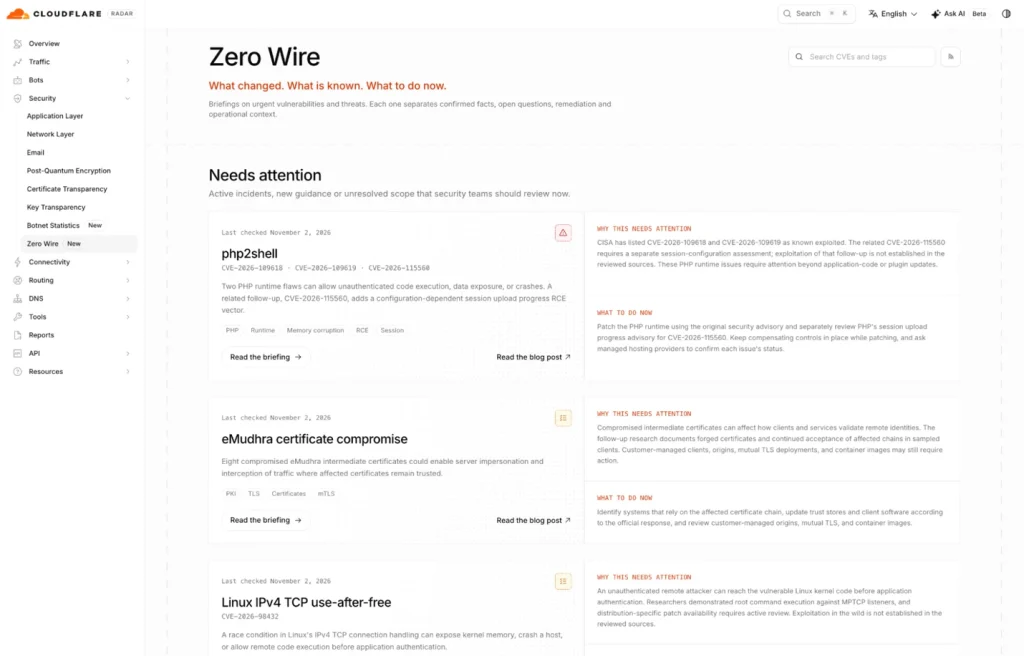
Cloudflare recently unveiled an open repository dedicated to tracking critical software vulnerabilities. Specifically, the company launched Cloudflare Zero Wire to aggregate actionable threat intelligence across the global internet. The platform operates within the security division of the public Cloudflare Radar threat intelligence portal. Each briefing outlines affected software components, remediation strategies, supporting evidence, and revision histories. Consequently, systems administrators and security teams can assess organizational risk profiles swiftly.
Tracking Critical Internet-Exposed Software Flaws
The portal focuses primarily on vulnerabilities within perimeter systems exposed to the broader internet. These targets include modern web applications, software runtimes, underlying dependencies, and outward-facing infrastructure components. Furthermore, the repository organizes incident alerts into two distinct operational classifications. The first category highlights emerging vulnerabilities that demand immediate evaluation and patching. In contrast, the second category compiles stabilized technical documentation for broader reference inquiries.
Moreover, every briefing maintains a transparent verification log recording recent review timestamps. Security personnel can monitor evolving threat activities alongside vendor security advisories and shifting remediation guidance. As explained in the Cloudflare announcement of Zero Wire, analysts can search entries using Common Vulnerabilities and Exposures identifiers. Additionally, direct documentation links connect readers with vendor advisories and independent security research.
Automated AI Prompts and Global Threat Telemetry
Beyond static technical briefings, the service delivers structured artificial intelligence agent prompts. Defending teams can feed these pre-built prompts into enterprise intelligence assistants to conduct read-only environment audits. Subsequently, autonomous agents examine deployed software versions, vendor patches, internet exposure vectors, and existing firewall policies. Therefore, engineering departments generate comprehensive compliance evidence and tailored remediation roadmaps rapidly.
Empirical Defense Through Live Edge Telemetry
Crucially, Cloudflare enriches individual vulnerability reports with empirical observation data harvested across its global network. For example, the briefing covering PHP2Shell illustrates real-time Web Application Firewall rule matches. Users observe historical trend lines depicting attack volume fluctuations over consecutive weeks. Ultimately, synthesizing real-time edge telemetry with actionable remediation guidance establishes a modern defensive standard for enterprise networks.
Support Our Threat Intelligence
Find our tech and OS security coverage helpful? Support our work today and unlock a 100% ad-free reading experience!
 Buy Me a Coffee
