 Do Son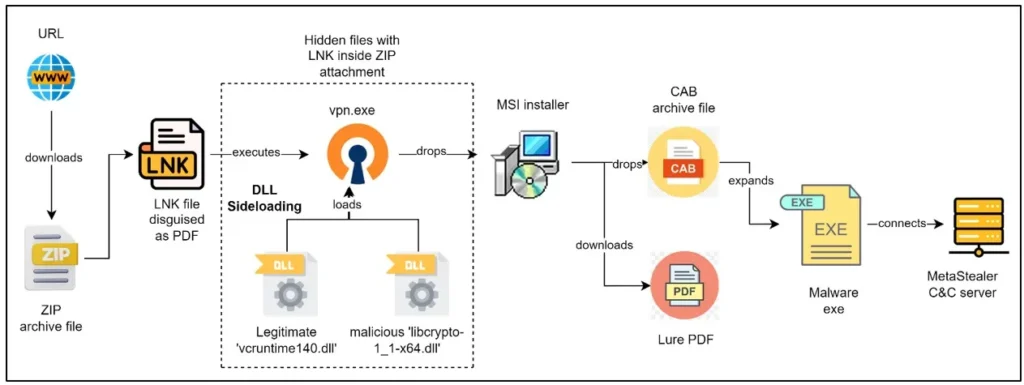
Infection chain
Recently, Cyble Research and Intelligence Labs (CRIL), in a meticulous investigation, has unveiled a chilling campaign that preys upon individuals seeking refuge and hope—those applying for asylum in the United States. The actors behind this campaign deploy a cunning weapon: the MetaStealer malware, a menace hidden within what appears to be a beacon of aid.
The deceit begins with a ZIP archive, seemingly innocuous, available through a link that might as well have been scattered across the digital winds via spam emails. This ZIP harbors not just files but a trap: a shortcut LNK file masquerading as a PDF document. This disguise is the first step in a meticulously crafted deception, leading the unwary down a path paved with malicious intent.

Upon the execution of this shortcut, a sequence unfurls—a VPN application springs to life, employing DLL sideloading techniques to inject a hidden, malicious DLL. This act is but the prelude to the main event: the deployment of an MSI installer that, while presenting a decoy PDF to the victim, quietly unleashes the MetaStealer malware.
The lure is crafted with chilling precision—an “I-589, Application for Asylum and for Withholding of Removal” document, a facade that preys on the hopes and vulnerabilities of those seeking a haven. This document is nothing but a mirage, a ploy employing social engineering to lower the guard of its targets, making the infiltration all the more insidious.
MetaStealer, once deployed, is a thief in the night. It reaches into the very heart of the victim’s digital life, pilfering information that should be sacrosanct: browser data, autofill information, cookies, and login credentials. But its reach does not end there; MetaStealer communicates with a Command-and-Control server, ready to be used for purposes dark and unknown.
MetaStealer is the product of continuous development, with roots entwined with the RedLine info-stealer malware. Its dissemination through malicious spam and malvertising campaigns reveals a threat that is both adaptable and persistent, signaling a clear and present danger to the security domain.
The use of official documents as bait exploits emotions establishes a veneer of legitimacy, and attracts a wide audience, amplifying the malware’s effectiveness. CRIL’s revelations serve as a stark reminder of the importance of vigilance. In a landscape where attackers camouflage their intentions with the trappings of legitimacy, the ability to discern the genuine from the deceitful becomes paramount.
Support Our Threat Intelligence
Find our threat intelligence and malware analysis helpful? Support our work today and unlock a 100% ad-free reading experience!
 Buy Me a Coffee
